Retiring teacher, coach urges Colony grads to ‘find their 68’
By Jeremiah Bartz Frontiersman.com A football coach using a hockey reference as the centerpiece for his keynote address may


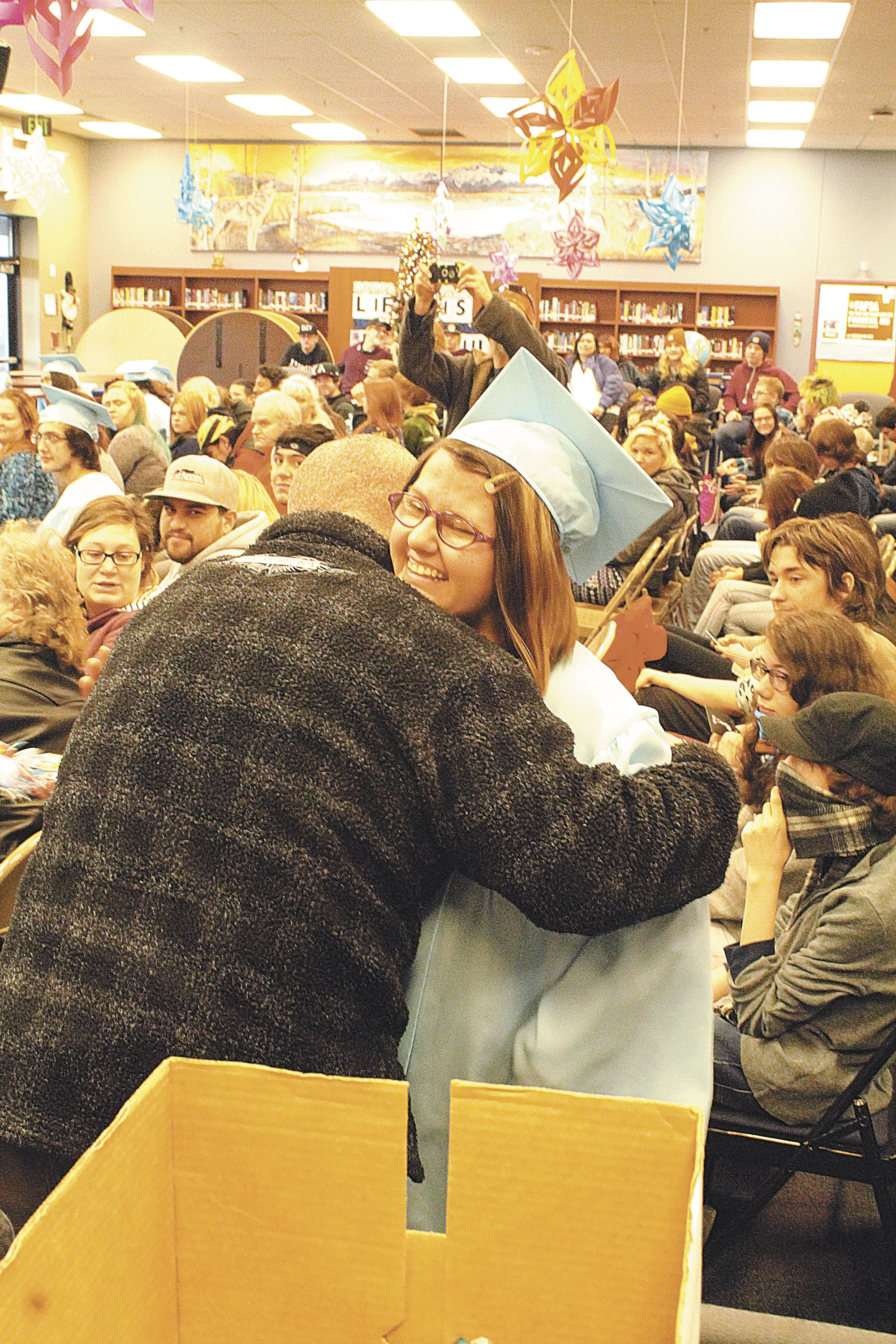
WASILLA — Abby Lampley just graduated from Wasilla's Burchell High School. She was one of nine graduates of the school's AdvancePath Academy (APA). Nothing unusual about that. But Lampley isn't your average 20-year old.
She was born with Rasmussen's Encephalitis, a rare disorder which led to her undergoing a hemispherectomy when she was 3. The procedure is one where surgeons remove half the brain to alleviate symptoms that do not respond to any other treatment.
In Abby's case, she had the right hemisphere of her brain removed, which immediately left her partially paralyzed on her left side. That’s only obvious symptom she still carries.
Lampley was born in Seaside, Oregon and raised in Texas. At one point, the family moved to Washington.
"I had to learn walking, talking all over again. And how to dress myself using half my body," Lampley said. "I missed preschool because I was recovering from surgery. I had cognitive issues, trouble with problem-solving skills. If I would go for a walk and I got stuck in the middle of the road, I wouldn't know what to do."
Lampley said she attended regular school through the seventh grade.
"I was a good student but my real struggle was math. I had problems and I would take my work home," Lampley said. "My dad really helped."
But Lampley said she continued to struggle academically and socially in a regular school setting. She said the school system didn't know how to help and that peer pressures became more problematic. That led to her withdrawal from public schools. For the next two years, ages 15 and 16, her family tried home schooling. Lampley explained that with both parents working, she was pretty much left on her own.
Still with no high school graduation in site, Lampley said in 2014, he family dragged her, kicking and screaming, to Alaska.
"I thought I was going to be eaten by a bear," Lampley said, not joking.
With assistance from MyHouse, a Mat-Su-based non-profit agency that specializes in assisting distressed teens in setting up shelter and networking, Lampley said she was able to get settled in the area. She secured a job at MyHouse's Steamdriven Boutique and restarted her education at Mat-Su Central School. She said being able to work at her own pace really helped.
"I was also working my job and it got kind of hard to juggle school and work," Lampley explained. It was then that some friends introduced her to Burchell's APA program. "I started there two months short of my 18th birthday."
Still facing a cognitive deficit, Lampley said math remained a difficult task. But it was one that she had to deal with if she wanted to achieve her goal of earning a high school diploma.
APA
The school's APA program is geared at allowing students to advance through high school at their own pace. It has become increasingly popular for students with difficulties in a traditional high school classroom setting. It's main focus is helping students who may be behind in credits, students who have or are at risk of dropping out of other traditional high school programs, or those students needing to graduate early. It's motto is "MY GIG" or "my goal is graduation".
APA is much like a job. Students clock-in upon arriving for the day, grab subject folders, and get to work. They have their own cubicles and work area. Also similar to a job, students do not have designated break time. At the end of the school day, students again punch the clock.
"It's blended learning program...and a professional environment," said Dan Hietala, lead APA teacher at Burchell. "Students have complete control of their own schedules."
Excelling
"Abby is one of the most inspirational people I've ever met," Hietala said. "She is resilient and came to us without family support."
Hietala explained Lampley arrived midway through the 2014-2015 school year with 7.5 high school credits.
"She is inspirational to other kids who think, 'if she can do that, so can I.' She's an all-around great person. She's self-reliant and has great social skills," Hietala added. "She had perfect attendance. She earned 14.5 credits. That's 29 classes in two semesters.
Included in the mix was all the required math classes.
"I decided to tackle it if I was going to be able to graduate," Lampley said. "Within four months, I had three years worth of math credits. I think I set the school record for the most amount in the shortest amount of time."
At the same time Lampley whipped through nearly double the class load of a traditional high school students, she maintained a 3.9 GPA in the process. It would have been better, Lampley said, if she hadn't gotten a few "B's" in mathematics.
"It's going on three years. I'm living on my own and I'm ready to graduate," Lampley said.
Since her arrival at Burchell, Lampley has secured additional employment writing articles for The People's Paper, circulated around the Mat-Su Valley.
"I do like to write. I've written a few articles about the things that I've had to overcome," Lampley said, "getting a direction."
In between everything else, Lampley has found time to share her story with others through speaking about her affliction.
"I've been sharing my testimony about overcoming brain surgery once a year since I was 13. When I got connected to MyHouse, I was asked to share my story about my brain surgery and overcoming homelessness," Lampley said, adding she's done so with the help of a wide variety of groups and organizations.
"I think God has used me to help others," Lampley commented.
Last summer, she had the opportunity to go to Colorado. There she was asked to address the annual Hemispherectomy Foundation International Conference.
"I had to give a three-minute speech in front of 275 people," Lampley said. "It was fun!"
Meeting her set goal of graduating high school prior to this Christmas, Lampley has no plans of slowing down — both as it relates to her education and life in general. The following is taken from her APA program exit interview.
"The biggest thing that helped me was having teachers that believed in me. Having teachers who encouraged and worked with me every step of the way made a world of difference," she wrote.
Her advice to her fellow classmates?" Again taken from her exit interview.
"Don't give up on yourself. I had half my brain removed as a child and I was told that I may never be able to graduate. As a teenager, I wasn't allowed to go to high school. When I left home 2 and a half years ago, the first thing I did was get into high school. Now here I am, ready to graduate because I never gave up on myself. If I can graduate, so can you. You just have to believe in yourself."
What's next for Lampley?
Between now and next fall, she plans to dedicate herself to her job. In August, she will enroll at Mat-Su College and pursue a bachelor's degree in public communications.
"That will be enough for awhile. I really haven't thought much past that," Lampley said adding she's overcome her fear of Alaska. "I want to be living somewhere in Wasilla and work in public communications and media."
Rasmussen's Encephalitis (RE)
RE, also Chronic Focal Encephalitis (CFE), is a rare, progressive neurological disorder, characterized by frequent and severe seizures, loss of motor skills and speech, hemiparesis — paralysis on one side of the body), encephalitis-inflammation of the brain, dementia, and mental deterioration. The disorder, which affects a single cerebral hemisphere, generally occurs in children under the age of 10.
The disease's cause is unknown. Indicators in the brain matter that is removed during a hemispherectomy or biopsy, when positive for RE, indicates antibodies in the blood similar to when the immune system attacks a virus. Research has discovered the antibodies that are possibly responsible for RE attack a certain type of brain cell making it more of an autoimmune disease. At this time, the cause of RE is undetermined and there are few clues to help find ways of discovering it. What does seem certain, though, is that the “blood-brain barrier” must be breached in some way for the antibodies to be able to attack the brain.
RE presents itself with multiple symptoms, not all of which show up in all patients. Every patient is different, although there are commonalities to diagnose the disease. The most obvious symptom, and by far the most universal, is seizures.
RE is almost always confined to one side of the brain, so once the initial onslaught of seizures is over, patients usually experience just one-sided complex partial seizures involving only a part of the body on just one side – the opposite side of the brain hemisphere that is affected. This is because movement on each side of the body is controlled by the brain hemisphere opposite to it. Other symptoms may include one limb (arm/hand, leg/foot) or group of muscles (neck, face) twitches continually and rhythmically for relatively long periods of time. Episodes can last a matter of minutes to days, weeks, or even months.
Cognitive deterioration, especially in longer-term versions of the disease, causes the patient to lose learning ability. Speech ability, especially if the affected hemisphere is the left one, deteriorates.
RE is most commonly seen in children, especially between the 2-12, although there are adult cases and cases where it has been diagnosed earlier than age two. Some medical centers use a biopsy, usually in conjunction with some sort of scan or grid placement to pinpoint where seizures are starting out in the brain. The presence of any or all of the symptoms listed above gives a good idea that a diagnosis of RE might be indicated.
A Magnetic Resonance Imaging (MRI) scan of the brain shows spots of atrophy on the affected side. An Electro-Encephalograph (EEG) shows all seizures emanating the same side of the brain. Any surgery less than a hemispherectomy has not been successful against RE in the past, that is, it was not effective in stopping seizures or lessening them to a controllable level.