Retiring teacher, coach urges Colony grads to ‘find their 68’
By Jeremiah Bartz Frontiersman.com A football coach using a hockey reference as the centerpiece for his keynote address may


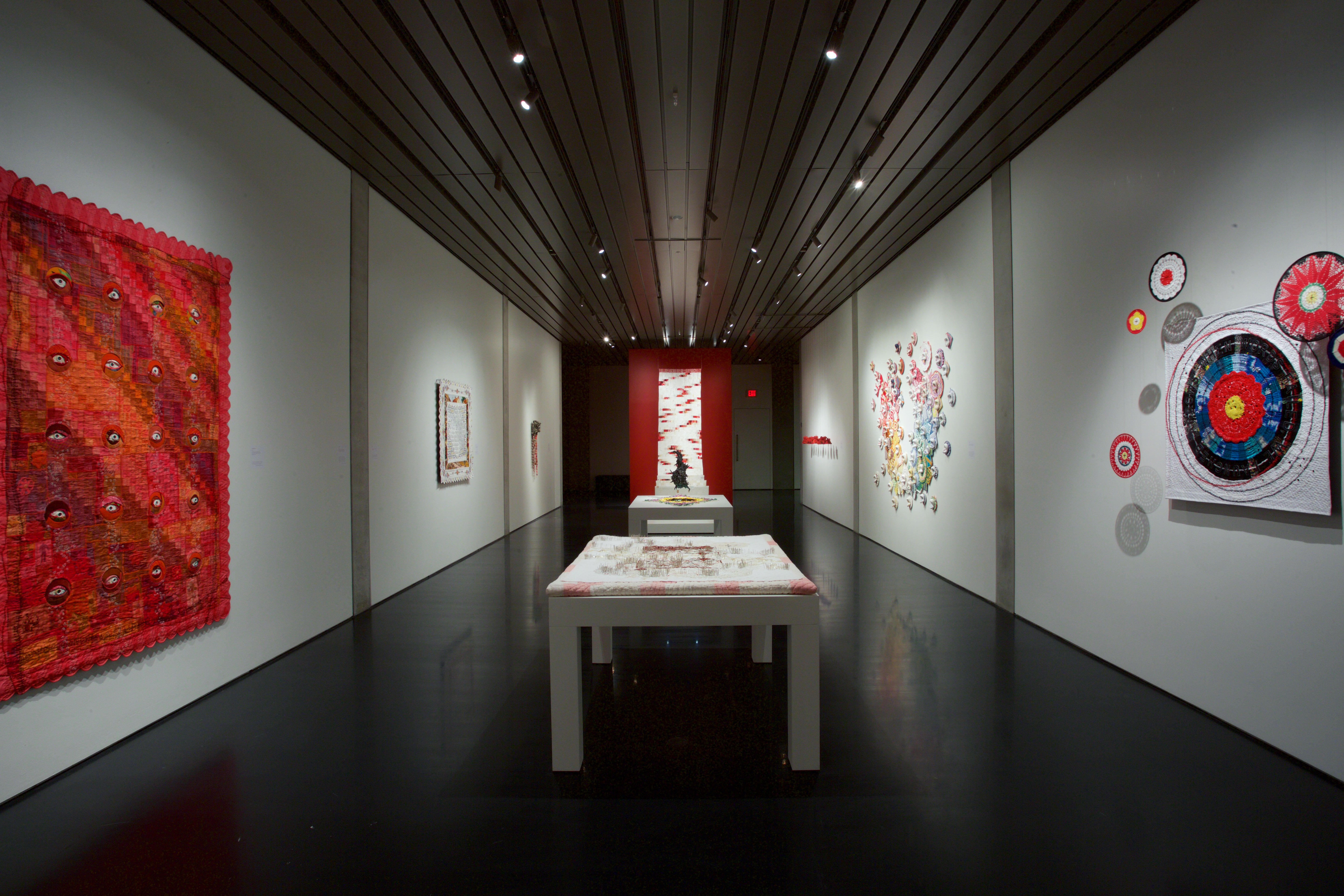
Those multiple eyes on a quilt on the gallery wall unsettled me as soon as I walked into Amy Meissner’s exhibition “Inheritance: makers. memory. myth.” at the Anchorage Museum at Rasmuson Center. I felt them bore into me as I moved around the gallery to look at her meticulously crafted works in the museum’s ConocoPhillips Gallery. Most of us know such eyes—angry, glaring, stern, critical. And most of us would be unnerved faced with twenty relentlessly staring eyes darting around the room, their pupils dark and forbidding.
The solo exhibition includes ten pieces by Meissner and one, “Needle and Myth,” a community art project in which local residents participated. The small gallery space fits intimate works that address emotional and personal issues women face—post-partum depression, menopause, sex, relationships, tensions, raising children, and balancing work with family.
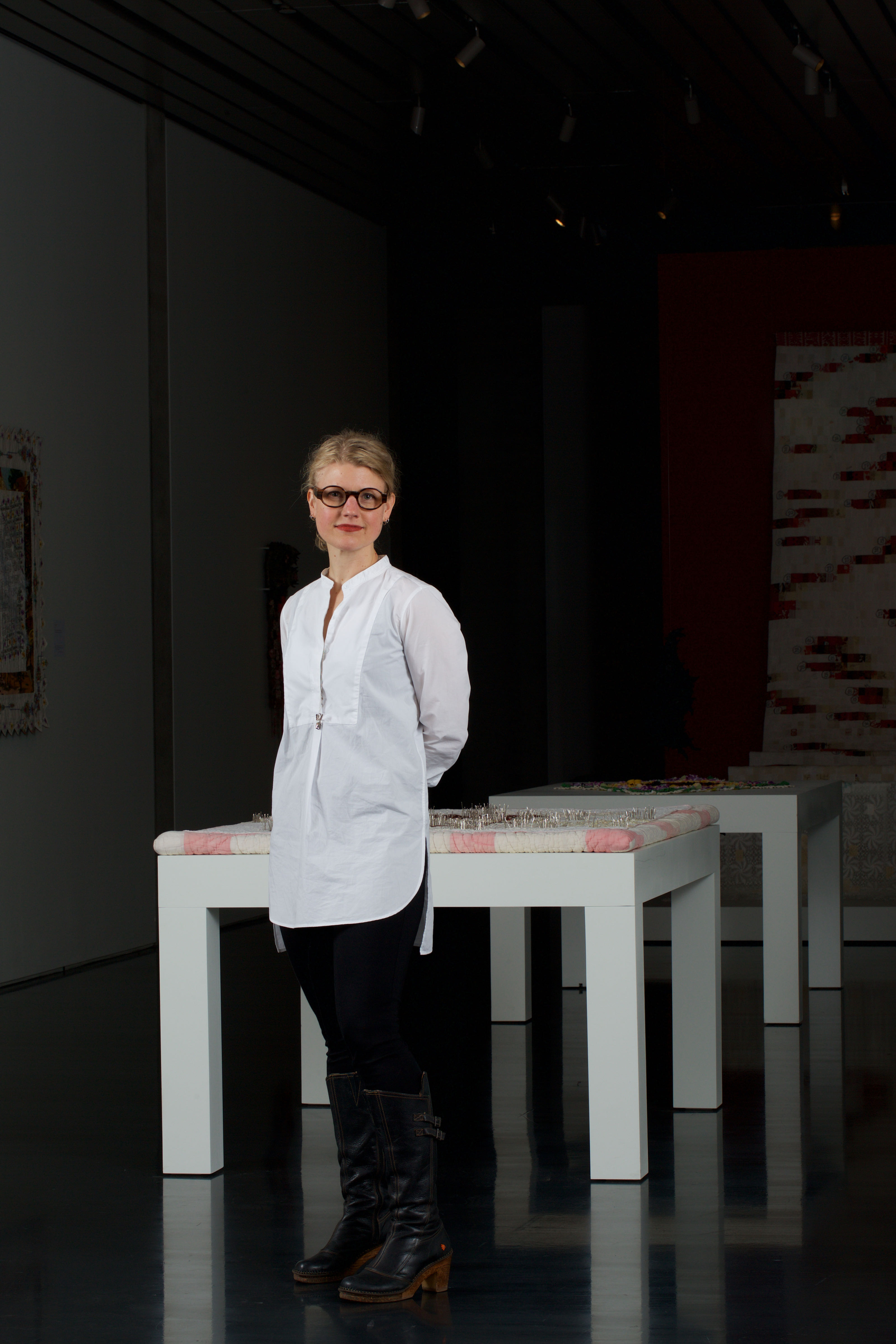
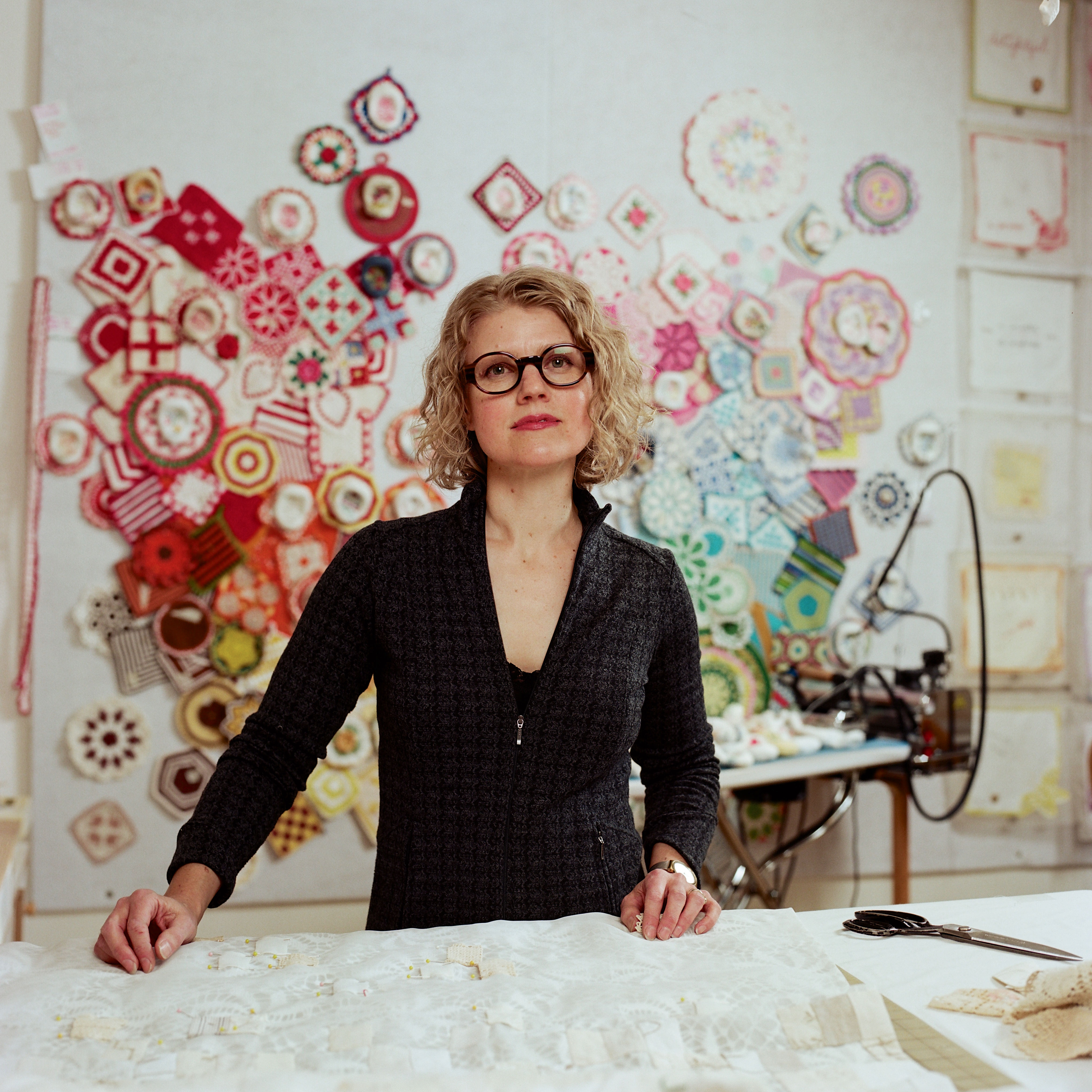
Meissner, 46 an artist, a writer, and an illustrator, has undergraduate art degrees in art and textiles and a Master of Fine Arts in creative writing from the University of Alaska Anchorage. Her past careers included 12 years as a clothing designer, mostly of wedding gowns; then 14 years as a children’s book illustrator. She continued writing and illustrating children’s books throughout graduate school and after receiving her MFA in 2004.
However, when she became a mother a few years later, Meissner faced difficulty balancing the care of two small children and working as an illustrator. “Whimsy was not working for me, I was stressed and suffering from postpartum anxiety. In fact I was combusting. So I turned to textiles again.”
Her turn to textiles took her in a new, creative direction. She no longer created gowns or other clothing but rather intricate pieces made with vintage linens handed down from her great-grandmother, grandmother and mother and others. “Textiles provided me an outlet that was manageable. I could create work with children next to me.”
By 2013, Meissner felt confident of the artistic merit of her work and submitted a piece to the Anchorage Museum’s biennial juried exhibition, Earth, Fire and Fibre XXIX. She won the $1,500 Juror’s Choice Award for “Spontaneous Combustion,” an art quilt crafted out of vintage linens gifted by her great-grandmother and grandmother in Sweden. The piece now resides in the Anchorage Museum’s permanent collection.
“Spontaneous Combustion,” was her response to her postpartum anxiety and the persistent question from her then four-year-old son, Pelle, “Mama, what in this house can catch on fire?” Her son’s despair about things in their house that might go up in flame had collided with Meissner’s worries about her own creativity.
On her blog, also called “Spontaneous Combustion,” she wrote about that time. “I was absolutely in despair that I would never create art again, that I would never bemyself again. This piece was my own spontaneous combustion as a mother, artist and woman. Reinvention.”
The reinvention continues with Meissner continuing her exploration of textile art. She has won awards and shown her work in exhibitions in Alaska, the Lower 48, and internationally, in Karachi, Pakistan. Two awards from the Rasmuson Foundation, in 2014 and 2017, also recognized Meissner’s talent. In 2016 the Anchorage Museum accepted her application for the current solo exhibition.
The genesis of “Inheritance: makers. memory. myth.” lies in what Meissner calls a “box of mystery” that arrived from a woman, also a textile artist, in upstate New York in 2015, whom Meissner had “met” on Pinterest. Meissner blogged about the box, but apart from describing how she and her daughter explored the items—vintage pointy bras, doilies, old linens, quilts, dresser scarves, laces, and garments—she had no clear plan of what to do with the items. The blog about the first box led other readers to contact her, sending their own vintage textiles. A couple of months later the second box came.
As the boxes continued to pile up Meissner decided she would reuse their contents to create new pieces. The first box “became the catalyst for a multi-year effort to collect used, unfinished or unwanted vintage linens . . . the majority of makers, origins and timelines still remains unknown.” She became the “final inheritor” of things that would have been ended in the garbage or relegated to a box in some attic, she wrote in a May, 2018 blog post. Soon afterward she began crowdsourcing for boxes of mystery from her blog readers .
She received over 70 boxes with nearly 600 objects from 20 countries and 25 states. Meissner used the objects to create the body of work now on display at the museum.
John Ruskin, the leading English writer and art critic of the Victorian era wrote, “All great art must be inventive; that is to say, its subject must be produced by the imagination.” Meissner’s work exemplifies what a rich imagination can produce. She took old objects and breathed in new life. She used some pieces whole, some cut up, some unraveled and reworked. She painted some; others she shaped with epoxy clay, wire, adhesive, and stones. Objects destined to disappear into nothingness now challenge viewers to confront difficult issues that explore “the work of women–literal, physical, emotional,” Meissner explained. Objects that came without any stories are now imbued with personal narratives that resonate universally.
Take, for example, “Materfamilias,” the piece with those 20 dark, brooding eyes that scrutinized me on my first visit. On my second visit I met Meissner, who told me about it, and other works. My unsettled feeling about those eyes was correct: they represented the eyes of Meissner’s grandmother, a formidable Swedish woman who had a strained and unpleasant relationship with her granddaughter. “I had a very uneasy relationship with her. Nothing I did made her happy. She was never going to be happy.”
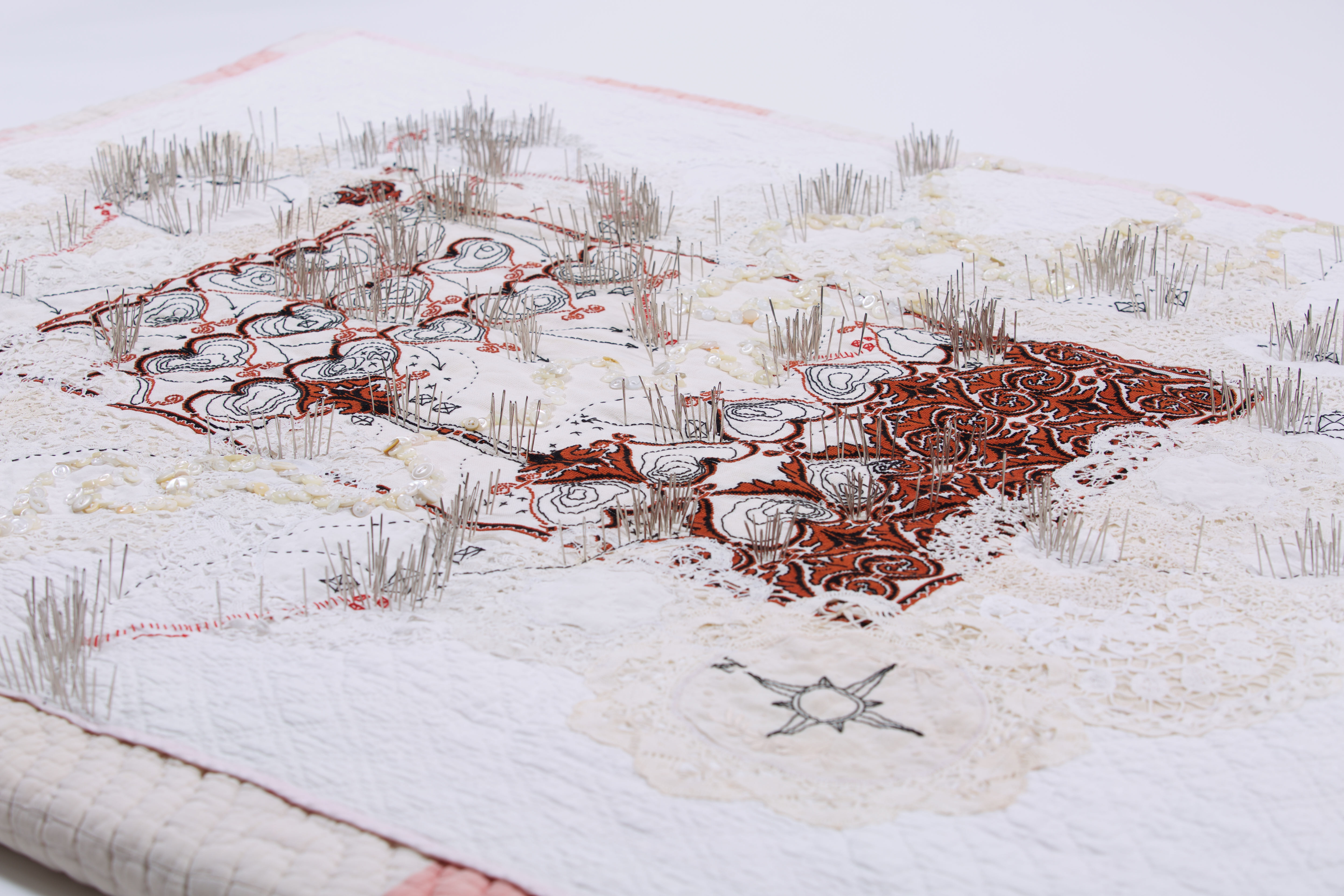
Another piece, “War Room” depicts the “way that women do battle–in the realm of the home, in the domestic environment, with tools that are not weaponry and yet are sharp,” Meissner said. Her war landscape uses baby quilts, an abandoned embroidery piece in the center, buttons to depict rivers, and groups of needles the soldiers.
Unlike other pieces “War Room’s” center embroidery came with a story about the fraught relationship of Olga Norris, who settled in England, and her family back in Greece. Norris, a student in Edinburgh in the 1960s had met someone there she wanted to marry but the family expressed displeasure at her choice. Norris went to Greece one last time to salvage her relationship with the family. The embroidery was a way to show she was part of them. But she never finished it. She walked away. The piece sat in a closet until 2015, when she sent it to Alaska.
Each of the pieces in Meissner’s spectacular exhibition has a story. I leave it to viewers to figure out most of stories or to make their own from the information that is next to each piece. Mind you, there isn’t a lot of information, only the title and the materials used. That is one complaint I have—the signage could have a little more information, not a treatise but just enough to express the sentiment or the motivation for each piece.
There is one more piece that merits mentioning. Quilting, which is often done as a collaborative project, is at the heart of “Needle and Myth,” a community art project with 80suspended panels at one end of the gallery. Meissner held six “Needle & Myth” workshops with 70 participants, who were asked to complete the phrase “She was ----.” or “She is ----.” The completed phrase was embroidered on linen handkerchiefs mounted on sheer silk organza. All the handkerchiefs came through crowdsourcing, Meissner said. The participants included four men, five children, who spoke seven languages–English, French, Scottish, Gaelic, Spanish, Russian and Romanian–among them.
The short completed phrase expressed varying sentiments such as anger, sorrow, happiness, frustration, and resilience. They noted how “she was or she is ‘tough as nails, finding herself, a complex woman, covered in glitter and dancing like a fiend, ancestral, a smoother of roughness, a Kansas City girl, heartbroken, trouble, far from home, grieving, an oasis, told to be quiet, an artist, beautifully strong, mom . . .”
This exhibition of inheritances bequeathed to Amy Meissner by many people around the world will continue at the Anchorage Museum until August 26, 2018. It will then go to the Alaska State Museum in Juneau and will be on view from Dec. 7, 2018 until Feb. 9, 2019.
This exhibition is a thought-provoking, mesmerizing display of creativity. Don’t miss it.
Shehla Anjum is a writer who lives in Anchorage.

Frontiersman.com Multi-platinum, Grammy-winning artist Amy Grant will perform at the 2026 Alaska State Fair on Monday, August

By Kyle Wilkinson For the Frontiersman Friday Fling returns to downtown Palmer this week and will continue through the summer.

By Barbara Hunt Palmer Buzz She walks in Palmer twice a day on Alaska Street from Arctic to Jenski’s.

By Russell Clark For the Frontiersman Obstacle courses. Alaska seafood. Live music. Farmers. Fishermen. Yoga. Art. Birds. Rock climbing. Kids