Retiring teacher, coach urges Colony grads to ‘find their 68’
By Jeremiah Bartz Frontiersman.com A football coach using a hockey reference as the centerpiece for his keynote address may


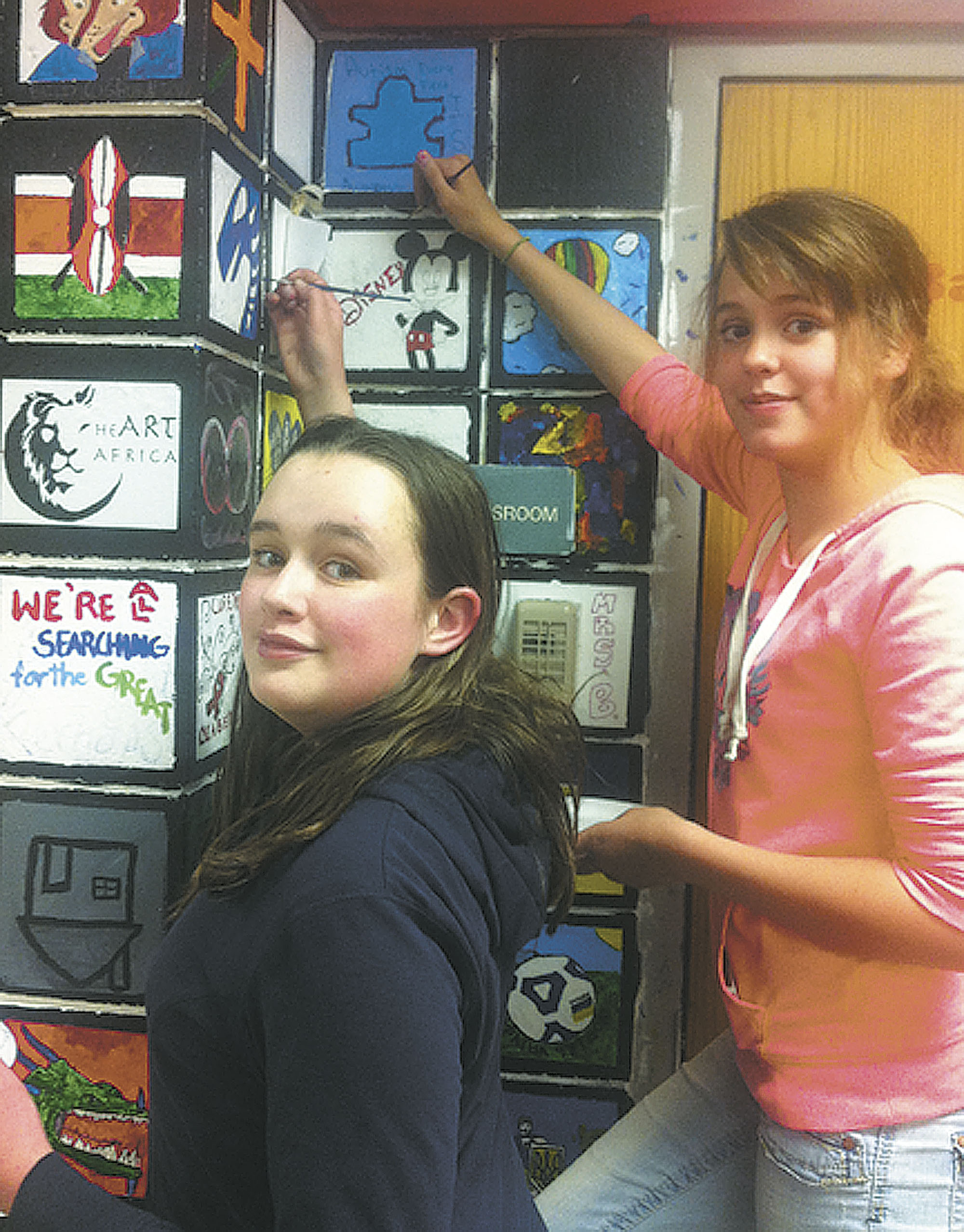
WASILLA — This is the story of what happens when you mix paint with kids. It is a story of one young man studying the Maasai in Kenya, two seventh-grade writing skills classes, 100 cement blocks, and the power of art.
Connor Jandreau, an accomplished artist, earned a Fulbright scholarship that took him to Kenya. However, an unintended consequence occurred while spending time at an orphanage: the orphans stole Jandreau’s heart. The next thing he knew, HeArt Africa was born.
HeArt Africa is a non-profit using art to help the orphans in Loitokitok, Kenya. In Kenya, students pay to attend secondary school. At $500 a year, orphans don’t stand a chance.
All proceeds from Jandreau’s annual Art to Educate exposition and art sale go directly to an orphanage in Loitokitok, Kenya. Currently, HeArt Africa sponsors 16 orphans – a drop in the bucket considering Kenya has 1 million orphans due to AIDS/HIV, the third highest rate in the world.
Now, my first- and second-hour classes aren’t artists or orphans; they just have a slight deficit in writing skills. These are the outlier kids who color outside the lines. They badger me for their attention; lose their work and pencils more times than I lose the glasses sitting on my head; and they have made their mark inside of my heart.
So obviously, I became enraged when I discovered that for the majority of them their schedules didn’t include geography. I threw around the words “wrong,” “unethical,” even “criminal.”
A writing skills deficit is not a thinking skills deficit, so I taught what geography I could in between the capitals and periods.
It was then that we learned about Kenya and Jandreau. We determined to help at least one orphan in Kenya go to school. With the generous genius of Wasilla Middle School’s art teacher, Jenny Bachelder, we decided students could paint more than 100 beige cement blocks around the art room anyway they wanted for $5 each.
“Have a heArt,” their slogan began, “help an orphan using art.” Before the gesso on the blocks could dry, we’d sold more than 20 blocks. Once color started appearing on the walls, odds and ends of students brought in various assortments of cash for their chance to paint.
Each block told a story. The first block painted was in memory of a teacher’s daughter. The next block a colorful suicide prevention symbol. Another block for autism in recognition of a younger brother. Two blocks went to turtles, and four to the Green Bay Packers.
A small coalition of Ukrainian students painted six blocks, the Ukraine flag, three blocks for Ukrainian soccer, and finally just a blue and yellow handprint under the Ukrainian words, “We want to be independent.” Our ‘Have a HeArt’ blocks had started a small revolution of artists.
The story could stop right there. But it didn’t. It became a tale of equity.
Yesterday, I caught a sixth-grader peeking into the art room after he had finished painting his name in bold red and blue letters. “I’ve never seen an art room before,” he said. “Could I look inside?”
“Wow,” I thought. Just as my writing skills students had been missing out on geography, the blocks were being painted by students who had never had art. Ever.
What a perfect lesson on irony. A new school can’t be built without 1 percent of its cost going to art. But, we can’t offer art to the students who attend them.
We demand more and more school choice outside of the brick and mortar schools while at the same time we demand more and more from the traditional school. The choice schools offer art, but the standard schools aren’t able to for a variety of reasons, one being the effects of low socio-economics (SES) on learning.
The 2013 United Way Community Assessment shows the district supports 17 schools with Title I funds, and 39 percent of the district’s students receive free or reduced lunches.
Low SES students are less likely to attend a choice school and more likely to come to school needing academic interventions. Therefore, Mat-Su’s conventional schools have layers of intervention classes for students scoring low in the basics because research is clear: students who can’t read, write or do math, don’t graduate.
But if we are to rely on research, let’s know all the research.
A 2012 National Endowment for the Arts study found that low SES students and English Second Language learners who have high arts education don’t just do better on standardized tests and the NAEP, they do better everywhere. They not only graduate from high school more, they attend college more. They not only attend college, they finish college by three times the amount of their peers with low arts education.
High arts low-SES students are even more likely to register to vote. But, too often the arts are not available to these students. More than likely, they also need interventions, so like the sixth-grade painter, they never get to see inside an art room or music room.
I watched in amazement as 100 bricks of beige turned into a storybook of color and painted inspirations. The students in my classes worked as personal assistants with each student. They gathered the paint, cleaned the brushes out, and picked up the messes. Their presence created an energy I hadn’t felt all year.
My two intervention classes typically hold a 71 percent attendance record. During the HeArt Africa project, that number jumped to 85 percent. The outliers had become the leaders.
Nelson Mandela once said that education is the most powerful weapon you can use to change the world. I believe that. I also have been witness to the power of art.
It isn’t just wrong that the district doesn’t promote high arts education in our schools, it borders on the foolish. I will go one step further and call it irresponsible.
In the end, my motley crew of 29 seventh-graders made and surpassed their goal. Moreover, they brought together a school with tempra and Sharpies. I will mail a check for $545 to Kenya this week. And that’s what happens when you mix paint with kids who have big heArts.
Emily Forstner is a Language Arts teacher at Wasilla Middle School. She taught art for one year and is currently writing a book called, “Art with Mrs. Forstner and Other Tales of Horror.” For more information, visit heartafricafund.org.

Frontiersman.com Multi-platinum, Grammy-winning artist Amy Grant will perform at the 2026 Alaska State Fair on Monday, August

By Kyle Wilkinson For the Frontiersman Friday Fling returns to downtown Palmer this week and will continue through the summer.

By Barbara Hunt Palmer Buzz She walks in Palmer twice a day on Alaska Street from Arctic to Jenski’s.

By Russell Clark For the Frontiersman Obstacle courses. Alaska seafood. Live music. Farmers. Fishermen. Yoga. Art. Birds. Rock climbing. Kids