Retiring teacher, coach urges Colony grads to ‘find their 68’
By Jeremiah Bartz Frontiersman.com A football coach using a hockey reference as the centerpiece for his keynote address may


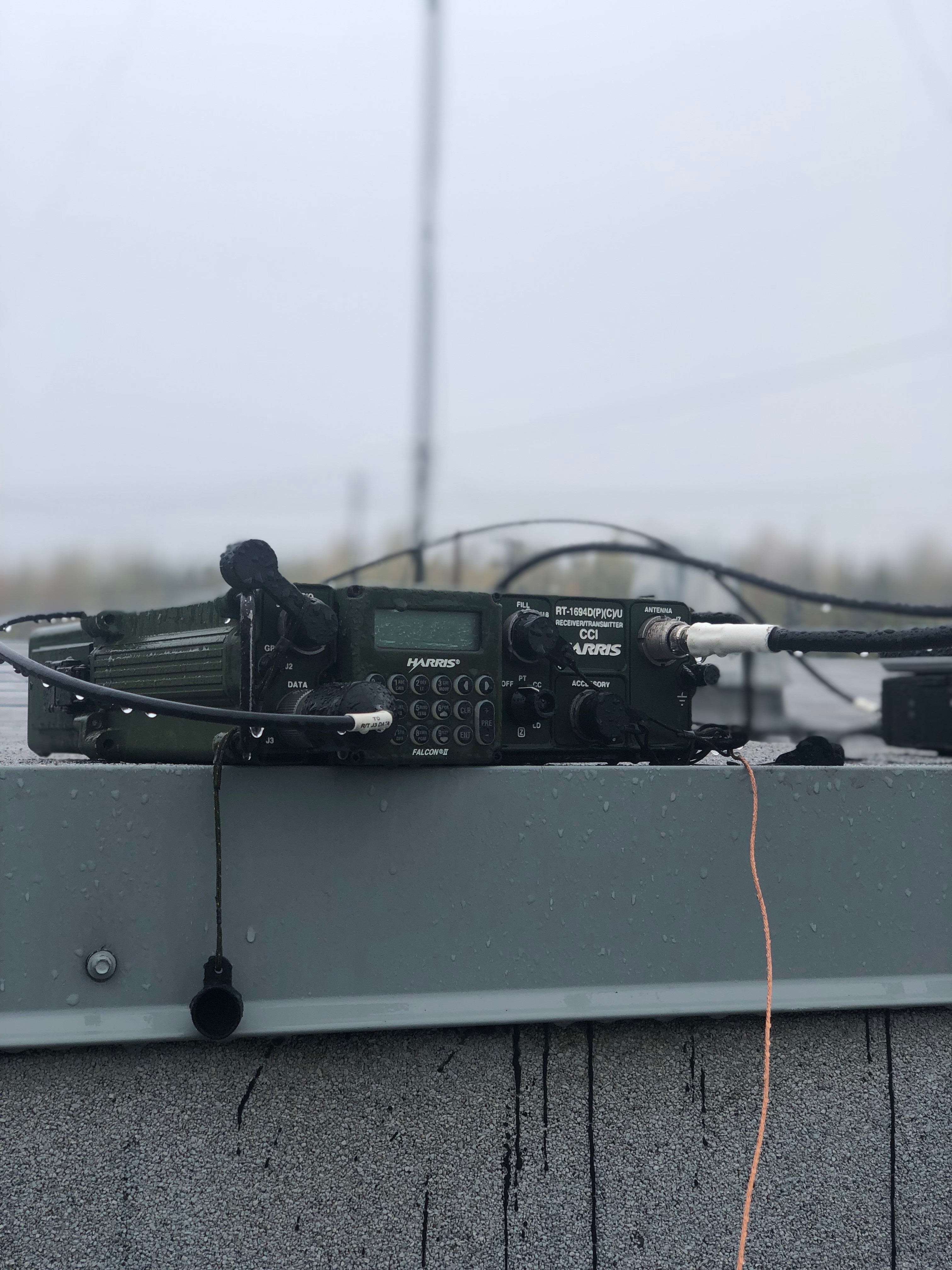
ANCHORAGE, Alaska — Navy Explosive Ordnance Disposal (EOD) Group One conducted a successful test of their high-frequency communications system today by transmitting from Joint Base Elmendorf-Richardson in Anchorage to EOD Mobile Unit One operating over 2,000 miles away in Adak, Alaska, as part of Arctic Expeditionary Capabilities Exercise 2019.
With the increased development of satellite communications (SATCOM) over the years, today’s EOD forces have rarely had to rely on high-frequency communication between forces. However, being able to communicate using a high frequency has become increasingly important in the event satellite communications are compromised in a future fight.
Prior to tactical SATCOMs making its way into the EOD inventory, high-frequency radios were the dominant communications method. As technology advanced and SATCOM provided the long-distance ability to communicate beyond the line of site, the use of high-frequency communications declined and almost became a relic of the past. However, an increased emphasis is now being placed on redundant capabilities to transmit and receive messages as well as being able to communicate in a satellite-denied environment.
Lt. Jennifer Chapman, an information professional officer assigned as EOD Group One’s communicator, said, “I am really proud of my team. This is a great opportunity for us to test our equipment and knowledge in an area that is out of our comfort zone.”
She said because high-frequency communication use has decreased over the years, information systems technicians and electronic technicians have not had as many opportunities to train with the system and understand how their propagation, antennas and radios operate differently from other communications systems. Today’s high-frequency radio call to Adak proved EOD Group One did not have to rely on satellite communications to command and control their forces thousands of miles away.
Capt. Oscar Rojas, commodore, Explosive Ordnance Disposal Group One said AECE 2019 is already providing relevant training opportunities for his forces that replicate real-world threats.
“In our increasingly volatile national security environment, Navy EOD will not always be able to rely on satellite communications that are susceptible to jamming, eavesdropping, hijacking, electromagnetic warfare and cyberattacks,” said Rojas, “Today, we proved we could rapidly adjust to meet changing circumstances by using high-frequency communications instead of SATCOM. Our warfighter’s flexibility and tactical acumen will be our asymmetric advantage against our adversaries in the high-end fight.”
Approximately 3,000 U.S. Navy and Marine Corps personnel are participating in Arctic Expeditionary Capabilities Exercise (AECE) 2019 in the Aleutian Islands and south-central Alaska Sept. 1-28. AECE is one in a series of U.S. Indo-Pacific Command exercises in 2019 that prepares joint forces to respond to crises in the Indo-Pacific region. AECE will specifically test joint expeditionary force logistical transfer capabilities in the Arctic environment, including wet logistics over the shore, expeditionary mine countermeasures, mobile diving and salvage, offshore petroleum discharge system operations, and expeditionary infrastructure assessment program. Navy and Marine Corps participants will conduct operational and tactical actions to validate the Distributed Maritime Operations (DMO), Littoral Operations in a Contested Environment (LOCE) and the Expeditionary Advanced Base Operations (EABO) concepts.
U.S. Navy EOD is the world’s premier combat force for eliminating explosive threats so the Fleet and Nation can fight and win wherever, whenever and however it chooses.


By Airman 1st Class Theodore Gowdy Joint Base Elmendorf-Richardson Public Affairs In July 2025, the Secretary of War released
Frontiersman.com Alaskans aged 17 to 28 have a unique opportunity to earn a college degree with major financial support
By Katie Stavick Frontiersman.com The United States Marine Corps has launched a strategic initiative known as "Campaign - Alaska,
By Katie Stavick Frontiersman.com As the 'Guardian of the North,' Alaska has historically been on the front