Retiring teacher, coach urges Colony grads to ‘find their 68’
By Jeremiah Bartz Frontiersman.com A football coach using a hockey reference as the centerpiece for his keynote address may


Butterflies presented the first surprise. About a dozen of them greeted Jan and me when we arrived at the Rapids Camp Yurt on a bright and warm late summer afternoon. I hadn’t seen so many butterflies since May, when an abundance of mourning cloaks and tortoise shells brightened my springtime walks.
I knew from research I’d done (which informed my City Wilds column, “Mourning cloak butterflies: a beautiful indicator of spring’s arrival”) that mourning cloaks overwinter as adults and figured the ones that welcomed us to Eagle River Valley had recently emerged from their chrysalid cocoons.
Before too long, those mourning cloaks would seek shelter for their long winter hibernation. But in the mid-60s temperatures of a late August day, they fluttered about in what can only be described as insect merriment.
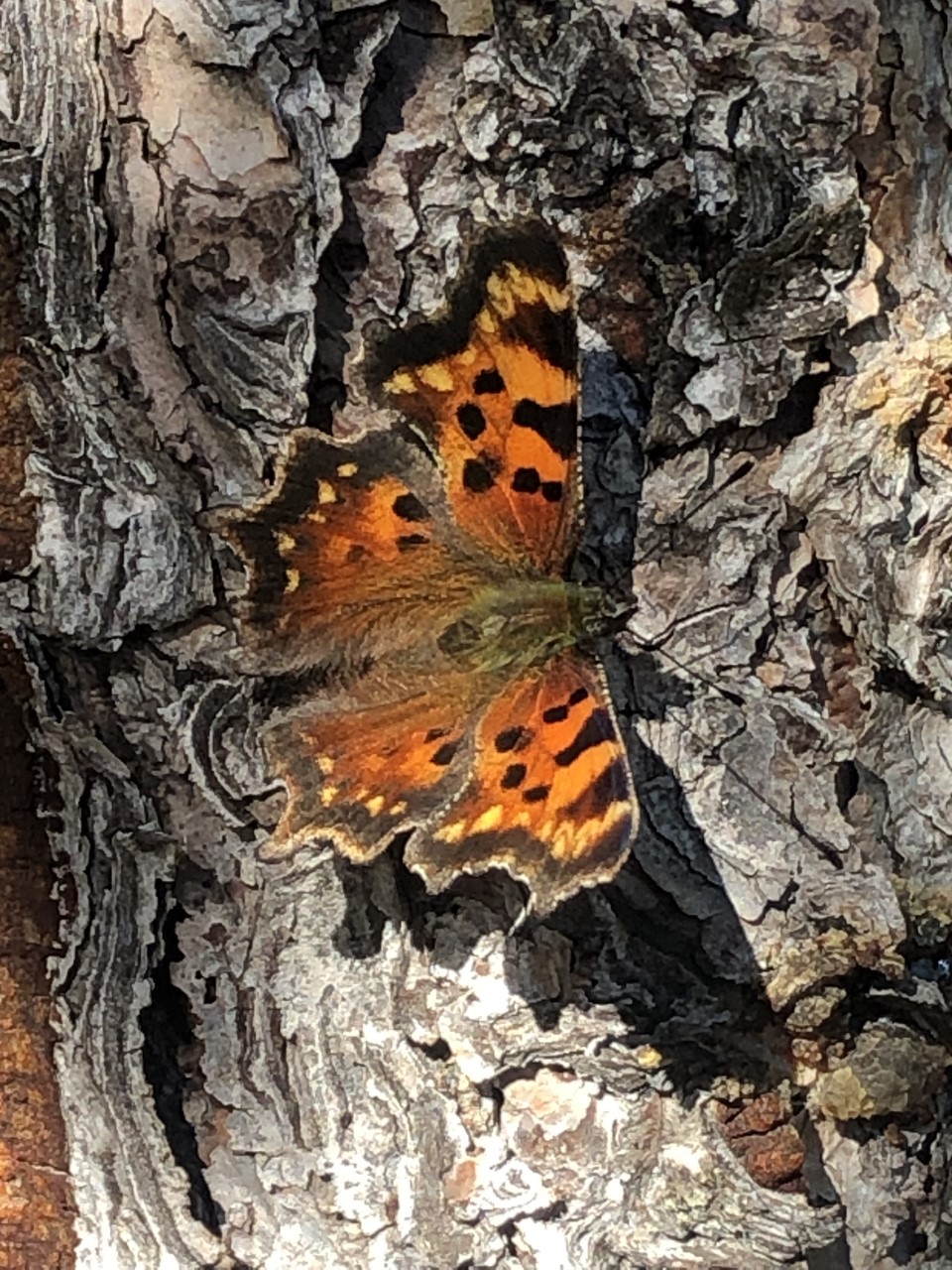
Joining the mourning cloaks in flitting flight were smaller but more colorful butterflies, whose wing tops are primarily orange, spotted with black and also lined with black along the wings’ jagged edges. Those serrated wing tips account for one of the species’ common names, “anglewing.”
The other name given to this butterfly is “green comma,” apparently derived from the fact that its drab, mostly brown underwing includes some faintly greenish comma-shaped spots. To be honest, I had a hard time seeing, or even imagining, those greenish shapes, but as names go I prefer green comma to anglewing.
One of the green commas landed on the back of Jan’s hand and seemed to enjoy its perch, remaining there long enough for me to get a couple of pictures. But when they landed, most seemed to prefer the trunks of spruce trees that faced the afternoon sun, those trunks—and presumably Jan’s skin as well—radiating warmth helpful to their late summer flights.
The wings and bodies of the green commas, like those of the mourning cloaks, seemed in excellent shape, as if they too had recently emerged from their chrysalis phase. This suggested to me that they too would overwinter as adults, which turns out to be the case.
We recognized our good fortune, to encounter such a wealth of fresh and energetic butterflies, like a sort of spirited welcoming committee.
After enjoying the butterflies’ company a while, we moved our gear into the yurt and began unpacking. We also inspected the shelter where we’d stay the next two nights, one of three yurts (and one cabin) available to the public for overnight stays through the Eagle River Nature Center.
It had been Jan’s idea to rent the yurt, a spur-of-the-moment decision prompted by a stretch of warm, sunny days following a rainy spell. We were surprised to find the yurt available for back-to-back nights and jumped at the opportunity to do some relaxed “yurt camping” with our dogs, Denali and Guido. It helped that the shelter is only 1½ miles from the nature center, an easy backpack.
Placed upon the top of a knob a few hundred feet above the cascading, roaring Eagle River, our yurt site offered compelling views of the mountains that border this part of the valley, among them Hurdygurdy Mountain, Eagle and Polar Bear Peaks, and Mount Yukla. The tallest of them reach between 6,500 and 7,500 feet high, their jagged upper reaches containing remnant ice or snow fields—and, during our visit, also bearing the powdery traces of freshly fallen late-summer snows that we Alaskans like to call “termination dust.”
It turned out that this yurt and the others had been slashed in early summer by a black bear trying to break inside. A note posted on an interior wall noted that the vinyl outer coverings had been taped up where gashed and were “not very pretty” but would be replaced sometime soon. That would help on a couple of counts, because the vinyl coverings of three windows were in disrepair, having nothing to do with the bear’s assault.
Though the bear didn’t get inside any of the yurts, its continued attempts dealt it a death sentence. As the note further explained, it was the first time in more than twenty years that this had occurred. “We’re all saddened that this (the bear being euthanized) had to happen but we had no choice.”
After settling in, our party of four went for a short walk through the forest, then returned for dinner, a card game named Quiddler (Jan won the Eagle River championship) and some time sitting on the yurt’s expansive deck, observing night’s approach.
The place was beautiful and peaceful enough (even with the river’s muted “white noise” roar) that it seemed hard to imagine two years had passed since my last visit to this section of Chugach State Park—and some two decades had elapsed since my only other overnight stay in this valley. How was that possible?
Cloudless skies suggested that the night would be a cold one and indeed it was; temperatures dropped into the upper thirties. The chill plus some built-up exhaustion kept us inside our sleeping bags until after 9 the next morning. By then the sun had reappeared, quickly warming both the valley and our yurt, and we felt no need to build any fires.
We spent much of Day 2 hiking the Dew Mound Loop, or at least a substantial portion of it. We moved at a leisurely pace, stopping frequently to pick and eat the forest’s plentiful pumpkin berries and lingonberries, study and photograph mushrooms and other fungal forms, and simply take in the beauty of the day and the forest through which we passed.
I’d forgotten the nature of these woods, particularly its forest floor. Large carpets of vibrantly green moss covered much of the ground, joined here and there by thick mats of lichens. For much of the day no wind blew. And sections of the trail were far enough from the river that the forest seemed extraordinarily quiet and still. Combined with the moss- and lichen-covered ground, the silent stillness gave the forest something of an enchanted feel. Jan and I certainly felt the magic of the place.
We stopped for a snack and rest stop atop Dew Mound, an open, rounded mass of weathered, lichen-covered rock. According to the nature center’s trail system guide, the mound is a “large glacial erratic.” If true, I would say it’s a gigantic piece of rock left by a glacier’s retreat; it’s hard to imagine it’s a boulder.
The stone’s texture and form struck me as that of a granitic rock, but so far I haven’t found anything to confirm (or deny) that. In any case it was a grand place to stop and take in the surrounding forest and mountains. Dew Lake is nearby—though it’s more of a marshy pond than lake—which helped account for the abundance of dragonflies and damselflies. I’d bet that earlier in the summer mosquitoes are a great annoyance here.
Perhaps because we hiked the trail on a Monday, we met no other people during our walk around the loop—and there were few humans even on the main Iditarod-Crow Pass Trail. The solitude added to our enjoyment—and, I suppose, the sense of enchantment.
The mountains were a constant presence and I couldn’t help but admire anyone who would attempt to reach their high, craggy, angular tops, which suggested a grander alpine kingdom. The standard routes must be on the peaks’ southwestern flanks (from the South Fork Eagle River). On “our” side, the peaks’ lower slopes are heavily covered by brush and forest, and pushing uphill through that would be hellish, I’d think.
Still, on this trip our attention was pulled mainly to the landscape’s smaller wonders: the carpets of moss, the abundant fungal forms, the dragonflies and damselflies and butterflies. Leaving in early afternoon on our third day, we were pleased that a few of the green commas showed up at the yurt to see us off, a fitting goodbye to an unexpectedly magical visit.
Anchorage nature writer and wildlands/wildlife advocate Bill Sherwonit is a widely published essayist and the author of more than a dozen books, including “Living with Wildness: An Alaskan Odyssey” and “Animal Stories: Encounters with Alaska’s Wildlife.” Readers wishing to send comments or questions directly to Bill may do so at akgriz@hotmail.com

By Kyle Wilkinson For the Frontiersman The Happy Gardener Greenhouse is neatly tucked away in a forest of spruce trees

By Kyle Wilkinson Kyle in the outside A couple of weeks ago I had the privilege of covering a story

By Katie Stavick Frontiersman.com Amidst the fallout of a harrowing animal cruelty case in the Caswell Lakes area, where

By Howard Delo Outdoors When I was about eight years old and living on a 40-acre fallow farm in