Retiring teacher, coach urges Colony grads to ‘find their 68’
By Jeremiah Bartz Frontiersman.com A football coach using a hockey reference as the centerpiece for his keynote address may


PALMER — When you think of ceramics you think of a piece of clay molded and then fired in a kiln that holds that form until the day it breaks into shards and becomes archeology.
But for her masters thesis, Valley artist Alida van Almelo deconstructed the very notion of ceramics by leaving out one vital element — fire.
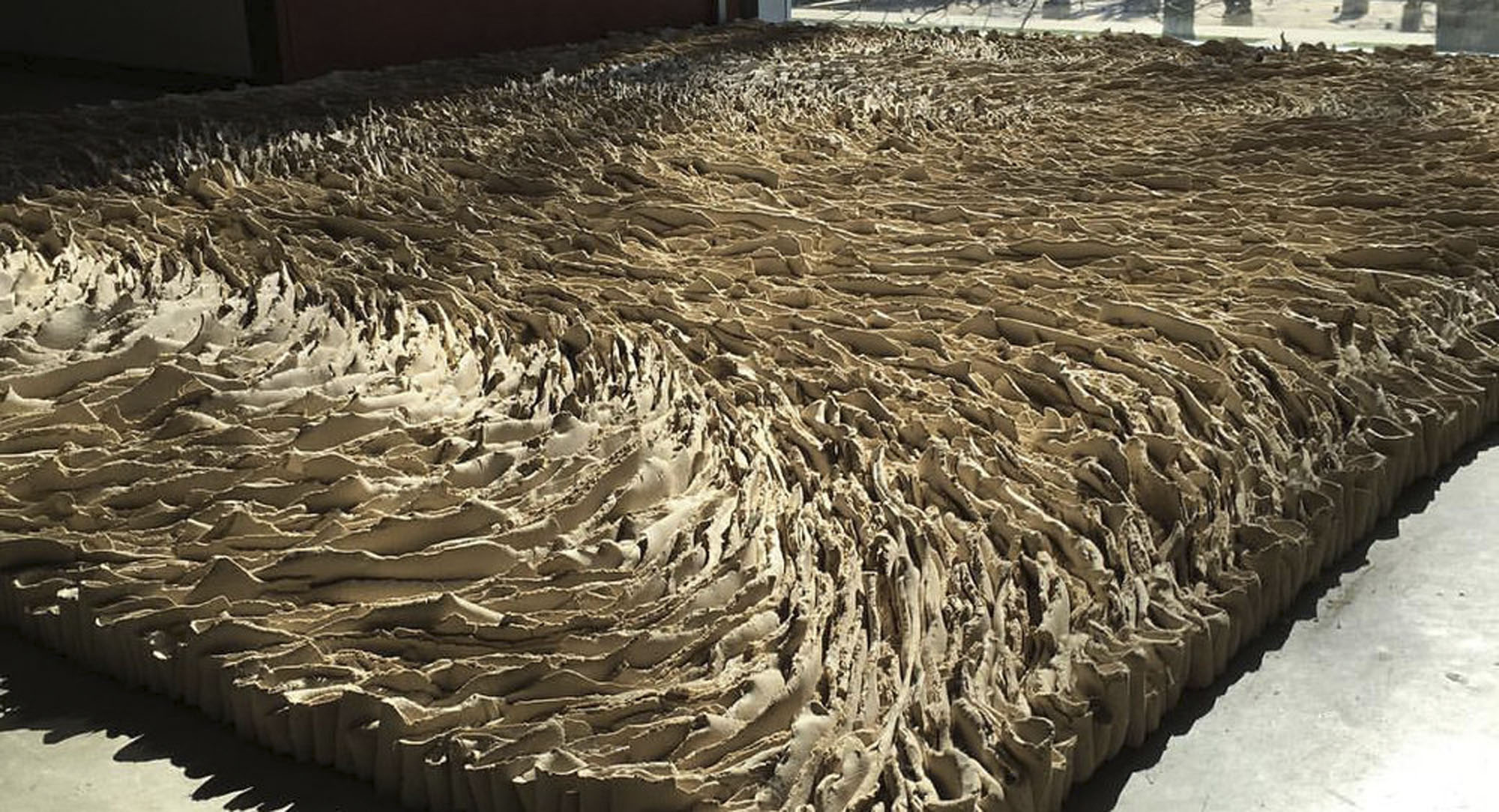
The result far exceeded her academic goals, and from next weekend through October her installation called ‘Coriolis’ will be on display at the World Ceramic Biennale at the World Ceramic Center in Icheon, South Korea. Van Almelo’s work is one of 90 or so on display, chosen from more than 2,400 entries world wide and her novel concept earned her a bronze prize, which carries with it a cash prize, including the museum’s purchase of her piece.
It’s a good thing the museum is keeping it because, at 8 feet by 8 feet, consisting of more than 750 pounds of unfired, breathing, moving clay there would really be no practical way to bring it back.
“I was given a really restricted spot in the museum — 8 feet by 8 feet, so I just decided to fill it up somehow and use the dimensions to my advantage,” van Almelo said from her tiny studio in a cabin off of Knik River Road. “I’m not sure how exactly I got the idea to line the slabs up, I just started playing with ideas and I liked the idea of how completely unpredictable it would be in how it would shrink.”
Accompanied by Palmer veterinarian Milissa Knox, van Almelo sat in her tiny rectangle and began forming slabs of clay she acquired in Korea in a pattern of intestine-like waves until, after more than 24 hours of labor, there was no room for her in the space.
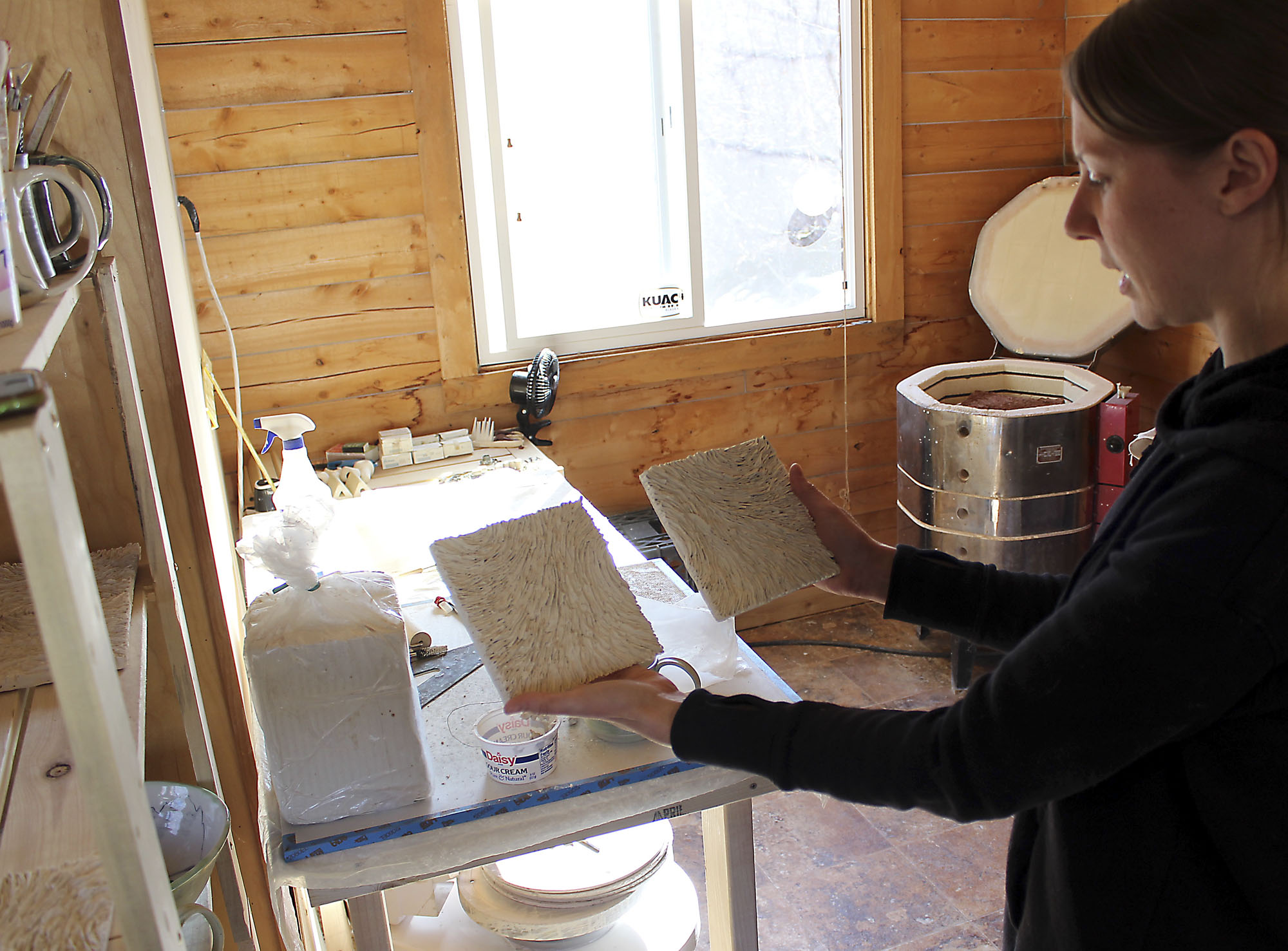
“Right now it’s covered in plastic to keep it wet, but as the clay dries it shrinks quite a bit,” she said. “I think it will shrink by 5 to 7 percent over time, so the piece is moving in front of you — kind of like a glacier.”
That state of constant, steady change inspired the title ‘Coriolis’, a physics term most associate with the phenomenon of toilet bowls flushing in opposite directions depending on which hemisphere you’re flushing at.
“I like the concept of motion occurring because of other movement; this idea that every impact causes another impact, causes another and that nothing is ever experienced twice — everything is constantly changing,” she said. “So the idea of naming it ‘Coriolis’ was because of the action of my laying the pieces down causes them to shrink… Every time the viewer looks at it, it’s a new experience. It’s a good way to isolate those experiences.”
Originally from upstate New York, van Almelo first came to Alaska in 2010, residing in Fairbanks. She attended graduate school at the Cranbrook Academy of Art in Michigan, but was eager to return to Alaska, a state she said she fell in love with almost immediately.
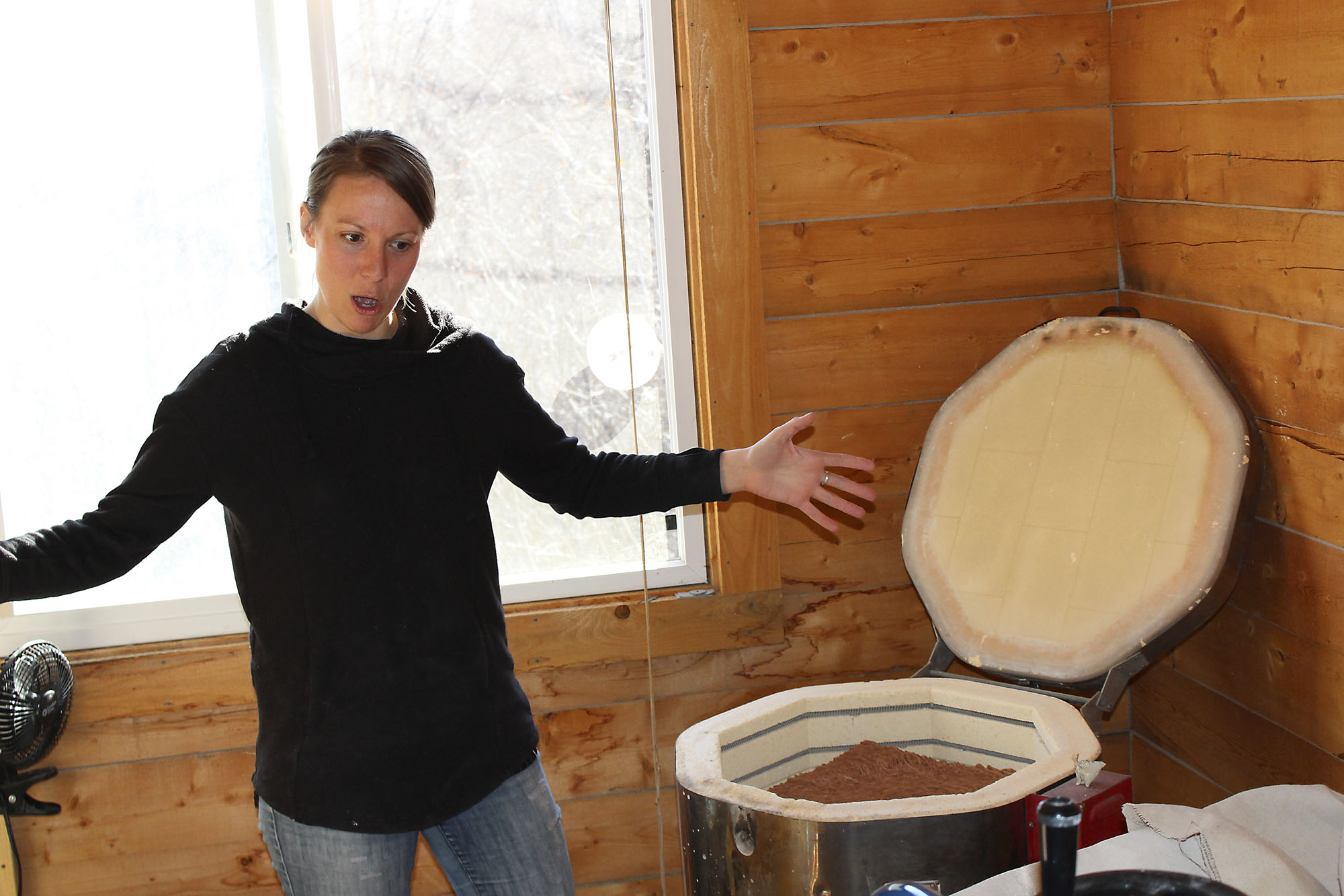
She settled in the Valley, just off Knik River Road and rented a cabin up the hill just big enough to fit her kiln and slab roller, which she likens to a ‘giant pasta maker.’ She arrived last November, just in time to experience an almost sunless winter pressed against the massive awning of Pioneer Peak.
“I actually get a similar feeling to when I was in Fairbanks in regard to appreciation for sunlight,” van Almelo said. “Cody and Amy, who own the property, keep a date on their calendar marked for the day when there’s 45 seconds of sunlight. Every day after that, they start counting down, so it definitely gives a sense of appreciation for every single day. It drives me to use the light and think about the energy and invigoration the sunlight gives me. It sort of indirectly affects my work. As an artist, it reminds me of those daily exceptional moments.”
The appearance in the international exhibition is van Almelo’s third, and her first time winning a prize. To prepare for the live installation, she practiced in a 6-foot, by 7-foot space. She said it took her 16 hours, and afterward, standing up for any stretch of time wasn’t easy.
Jurors at the Korea show included a list of questions and comments for the contestants. One particularly flattering one stood out for van Almelo.
“I think mine was the only piece that was not fired. It was the only truly ephemeral piece in the exhibition,” she said. “One of the questions was something like my work is causing them to consider what ceramics can be in a way we’ve never seen before.”
Van Almelo is looking to use the prize money from the show to put on her own exhibit in Alaska.
“I haven’t even full comprehended what this award means because it’s a huge, internationally renowned thing and here I am in this little cabin out in the Knik Valley,” she said. “I’ll just keep working and putting myself out there.”
See more of van Almelo’s artwork at www.alidavanalmelo.com.
Contact editor Matt Hickman at 352-2268 or news@frontiersman.com