Retiring teacher, coach urges Colony grads to ‘find their 68’
By Jeremiah Bartz Frontiersman.com A football coach using a hockey reference as the centerpiece for his keynote address may


In 1923, King Tut’s burial chamber was opened in Egypt, Warner Brothers Studios, the studio responsible for the ‘Harry Potter’ movie franchise, ‘Casablanca,’ ‘Dirty Harry,’ and ‘The Matrix,’ to name just a few, was established; the first issue of “Time” magazine was published; and Insulin was first used in the treatment of Diabetes.
Here in Alaska, President Warren G. Harding started off on his trip, which he called the “Voyage of Understanding,” across the country to Alaska. During his visit, President Harding drove in the ‘golden spike,’ near Nenana, marking the completion of the Alaska Railroad.
Precipitated by the conversion of U.S. naval vessels to run on oil rather than coal, President Harding creates the National Petroleum Reserve in 1923. West of what is now the Arctic National Wildlife Refuge, the reserve is managed by the U.S. Bureau of Land Management.
In the Fairbanks and Anchorage-Matanuska area, the chief agricultural regions of the territory, there are only 90 farmers with around 1,400 acres of cultivated lands.
It’s also the year Elverda Lincoln was born.
Lincoln is an original icon of Wasilla. She served in the U.S. Navy, well before women could serve on ships or other capacities besides being a nurse or in a clerical capacity, as a Women Accepted for Volunteer Emergency Service, or WAVES.
WAVES were volunteers and temporary, authorized to stay in the Navy for the duration of the war, plus six months.
Elverda served in a communications capacity, updating communication manuals
During that time, Elverda met her husband, who had joined the Marines. After he was discharged from the Marines in 1949, still young and seeking adventure, Elverda, her husband, and young son pointed their car north to Alaska, travelling on the newly constructed AL-CAN highway. Oddly, or perhaps ironically, they left the lower 48 on April Fool’s Day, 1950.
She said that when they told their families of their plans to move up to Alaska and begin a new life, her father responded:
“You won’t last. You can’t make it without old Pop!”
While their families may have had their doubts, Elverda said the spirit of adventure and the idea of carving out a life on their own land kept them moving, and after 23 days, traveling roughly 3,000 miles, they arrived in Palmer.
After a few years, Elverda and her family were looking to set up their homestead, finding land that had been abandoned, and after filing the necessary paperwork, were able to take ownership of the land they had found. As veterans of World War II, by law, they could homestead 160 acres by simply building a habitable home and living on the land for 7 months.
“I remember when Wasilla had less than 100 people, including the dogs,” she recalled, “People don’t realize this, but we had around 30, maybe 40 grade-A dairies back then, and now, wherever there’s a subdivision, that was a dairy that had been cleared. Now they bring in milk from the outside, when we used to do it ourselves.”
It wasn’t just the families and farming that was different, but also the traffic, Elverda noted, saying that there weren’t freeways then, the traffic was much easier, and that there weren’t any stoplights back then either.
“When we got one, oh it was a big deal, we were really uptown then!” She says she could do without all of that now.
What does she think of the growth that has exploded in recent years? Well, she’s not exactly a fan, and rather longs for the simpler, though harder days of homesteading.
“Life was tough back then, but we had no desire to go back. The opportunities and the wages were much better. Life was just better.” She says that here in Alaska, there isn’t the need to ‘keep up with the Jones’s,’ because everyone did their own thing.
She is also not overly fond of all the technology younger people use, saying that it encourages a lack of discipline and respect that was expected in her time.
“Kids today think they have it so tough nowadays. They really don’t. It’s easy.”
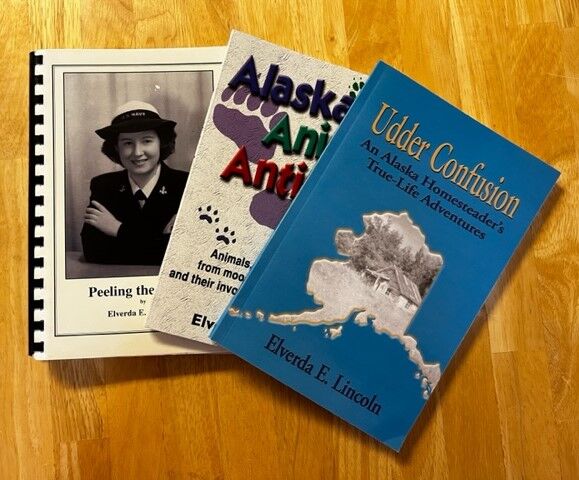
Elverda has written several books based on her experiences as an Alaskan homesteader. Her most popular, “Udder Confusion: An Alaskan Homesteader’s True-Life Adventures,” documents her family’s trip up to the Last Frontier, all through the first decades as they eked out a living, with tales of the people they met and worked alongside, the tales told to them from others, as well as their own travails as an Alaskan homesteader.
“Our friends ranged from preachers to alcoholics, and everything in between. You won’t find that outside (of Alaska).”
A second book, “Alaska Animal Antics,” published in 2001, was part of a writing class where she and several friends graciously gave her their written, oral, and taped manuscripts. “Alaska Animal Antics” is about animals, wild and tame, from moose to mosquitoes, and their involvement with people.
Not one to rest on her laurels, Elverda has also traveled, especially on trips called “Mystery Tours.” The idea is simple-pack your bag, show up at the airport, board the plane, and once airborne, find out the destination. But not everybody was on board for the unknown destinations.
“Some would get so worked up, not bringing a sweater. So what? If you goof, go buy one. People wouldn’t go because they didn’t know what to wear? So what, that’s nothing.” She traveled from Vietnam, which was a favorite of hers, to Spain, with dozens of places in between.
“That’s what I liked. Everything was a big mystery. It was so fun.”
And her advice to those who ask how she’s made it to this milestone, it’s simple. Stay positive.
“There’s nothing worse than complaining. I don’t want to listen to all that. I believe that you have a better aura around you when you’re positive.”
Her other piece of advice-stay out of fast food restaurants. Elverda says she could appreciate it when those types of restaurants were cheaper, but now doesn’t understand the appeal when the food isn’t good for you and it’s expensive to boot.
Elverda still stays active, participating in the many programs that WASI offers and doesn’t look to be slowing down anytime soon. She says she is very capable of opening doors for herself and cannot stand people treating her like an invalid.
“If I need help, I’ll ask!”
Another piece of advice she proffers? Don’t worry so much about other people’s issues.
“I do not take other people’s problems and treat them as my own.” She says that over worrying about someone going through divorce or down times, isn’t good, especially when there isn’t much that can be done but to let them work through their problems
“Be sad that it’s happening, yes. But there’s nothing they can do –they have to work out their own problems. So I say don’t take on someone else’s problems as your own.”
One last thing that Elverda says is important to a long life is to stop talking and just go do it.
“If you want to paint, don’t just talk about wanting to paint. Go do it. If you want to write a book, stop talking about it and go write a book.
It is hard, and at the same time not so hard, to think of all of the ups and downs, the good times and bad, that Elverda has experienced throughout her life-Alaska becoming a state, the “Good Friday” earthquake of 1964, oil being discovered in Prudhoe Bay, and the pipeline coming in. And, according to her, she is not going anywhere anytime soon.
“I’ve got a few more years left in me. Someone said I was going to live to be 130. Well, from the day you’re born, if you live righteously, eat right and all that stuff, you will live to be 130. But we goof it up. Got to be careful.” If anyone could do it, it would be the feisty Elverda.
Elverda is said to be looking forward to the party so she has a chance to see everybody instead of waiting for her funeral.
“Why do you have to wait for a funeral for everyone to get together when you haven’t seen everyone in so long? I don’t see the point in that.”
To celebrate her 100th birthday and her remarkable life, a party is being held in her honor, and the public is invited to attend. On Saturday, at the Wasilla Senior Center, there will be food, fun, and a cake cutting. The celebration begins at 1:00 pm at the WASI, 1301 S. Century Circle.

By Christian Hartley Now You Know If you have ever wondered what the borough attorney actually does, you are not

By Katie Stavick Frontiersman.com In a direct response to public outrage over a horrific animal neglect case, the Matanuska-

By Barbara Hunt Palmer Buzz It was 6:43 on Friday morning and the Plant Owner was sound asleep when

By Kyle Wilkinson Frontiersman Memorial Day Weekend was filled with a variety of events in Willow. From live music to