Retiring teacher, coach urges Colony grads to ‘find their 68’
By Jeremiah Bartz Frontiersman.com A football coach using a hockey reference as the centerpiece for his keynote address may


Thursday evening marked the beginning of Chanukah, the Jewish festival commemorating the recovery of Jerusalem and subsequent rededication of the Second Temple at the beginning of the Maccabean Revolt against the Seleucid Empire in the 2nd century BCE.
2500 years ago, the Holy Land was ruled by the Seleucids (Syrian-Greeks), who tried to force the people of Israel to accept Greek culture and beliefs instead of mitzvah observance and belief in God.
Against all odds, a small band of faithful but poorly armed Jews, led by Judah the Maccabee, defeated one of the mightiest armies on earth, drove the Greeks from the land, reclaimed the Holy Temple in Jerusalem and rededicated it to the service of God.
“It was illogical, this small group of people that were weaker physically than the Greeks, wouldn’t cave in and fought this army, and overcame,” says Rabbi Mendy Greenberg from the Mat-Su Jewish Center.
“This was the first miracle, when the Maccabees were victorious when they shouldn’t have been.”
When they sought to light the Temple's Menorah (the seven-branched candelabrum), they found only a single small jar of pure olive oil that had escaped contamination by the Greeks.
“This led to the 2nd miracle, where they were able light the menorah, and that one-day supply of oil lasted for eight days.”
To commemorate and publicize these miracles, the sages instituted the festival of Chanukah.
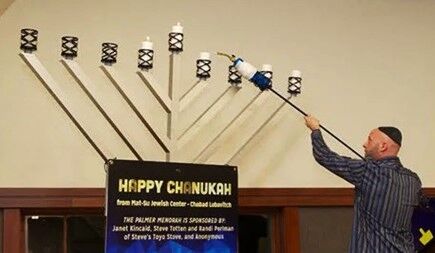
At the heart of the festival of lights is the nightly menorah lighting. The menorah holds nine flames, one of which is the Shamash (“attendant”), used to light the other eight candles.
“On the first night, we light just one flame. On the second night, an additional flame is lit. By the eighth night of Chanukah, all eight lights are lit,” says the Rabbi, who says that there is a universal message that holds as much power and meaning today as it did 2500 years ago:
“Light will always triumph over the darkness, and the power of one single light, like there was on that first night then was enough to chase away the evil, we need that light now, too.”
The message is relevant in light of the ongoing war in Israel that began in October when the terrorist organization Hamas invaded Israel, killing nearly 1,200 and taking hostage over 235 men, women, and children.
“We need to stand up, shine, and lead by example. In Judaism, we use the word ‘mitzvah,’ and it means to do divine acts, good deeds. We need more of these to show the world that goodness and holiness always defeat evil.”
Rabbi Mendy also encourages everyone to shine their own light, which is in part why the menorah is lit and displayed in windows. It is not simply for the aesthetics, "The reason the menorah is displayed in the window is because we want to make public the story Chanukah, and bring forth God's glory."
Rabbi Mendy says that there are an estimated 50,000 menorah celebrations, from here in the Mat-Su Valley, which has four menorah displays, to Washington D.C., to Berlin, and even in the Gaza Strip.
“People should not be happy with one light. We need to grow the light, the goodness, now more than ever. Honor the ‘mitzvah,’ because if more people that do just one extra act of kindness, the world would be such a better place. We need that now.”
The Rabbi says that if there are people in the Valley that is in need of Chanukah candles or anything for their own celebrations, to contact the Mat-Su Jewish Center for assistance.
“We should never be satisfied with not helping our fellow man. It is important to be kind, be charitable, and reveal the goodness within.”
For more information, please visit the Mat-Su Jewish Center at www.matsujewishcenter.org

By Jonathan Rockey Faith Last Sunday, May 24, 2026, was the 7th Sunday AFTER Easter, and celebrated by most liturgical

By Christian Hartley Now You Know If you have ever wondered what the borough attorney actually does, you are not

By Katie Stavick Frontiersman.com In a direct response to public outrage over a horrific animal neglect case, the Matanuska-

By Barbara Hunt Palmer Buzz It was 6:43 on Friday morning and the Plant Owner was sound asleep when