Retiring teacher, coach urges Colony grads to ‘find their 68’
By Jeremiah Bartz Frontiersman.com A football coach using a hockey reference as the centerpiece for his keynote address may


The above slogan is the title of the 2019 Venice Biennale, where I just spent three days immersing myself in Global art. This venue is like the Olympics of aesthetics, and like that sports event, artists and curators don’t necessarily live in their birth country (many artists work in Los Angeles and New York City). ‘May You Live in Interesting Times’ is allegedly translated from a Chinese curse, which apparently cannot be authenticated. But since we do live in a fascinating/uncertain world aided by fake news, this year’s title for one of the oldest art shows seems purposefully ironic as well as all-encompassing: denial of Climate Change, and indifference to displaced populations, by those in charge.
To begin: I went to the Venice Biennale after attending the 52rd Congress of International Art Critics held in Cologne and Berlin, as a delegate. The theme of the conference was ‘Nationalism and Populism’ referencing escalating trends towards conservative leadership worldwide, resulting in refugee-homelessness plaguing our planet. As an Alaskan with strong interests in Climate Change-art projects, I made inroads encouraging AICA-International to begin acknowledging art/artists that highlight this global crisis through making.
After Berlin, husband Dave and I trained through the Austrian/Italian Alps to Venice. Much of this mountainous area resembles the Colorado’s Rockies, and Alaska’s Turnagain Pass. The landscape is a mish-mash of gingerbread houses next to car dealerships. The lower hillsides are stepped with farming, notably grape growing. Unique were the multiple layers of roadways pushed into the mountains along with the bridges over deep gorges.
After twelve hours, we arrived at Mussolini’s train station on Venice’s Grand Canal. Hordes of visitors with roller-bags bumped along the cobbled pathways adjacent to the waterways, dodging street hawkers selling masquerade paraphernalia reminiscent of a bygone era. Congested canals smell like raw sewage, which no one seems to mind. The aquatic traffic dances an amazing do-si-do, as gondolas and 1930s refurbished speedboats dodge industrial barges loaded with groceries, dry cleaning and ambulance medics, serving hotels and sinking palazzos. Upon leaving Venice, we boarded a 5 am Vaporetto (municipal water bus) to begin our short but arduous journey to Marco Polo Airport, and watched rats emerge from the canal, march up and down the cobblestones, temporarily replacing the bedded-down tourists, restauranteurs and construction crews that keep this unique place functioning.
The Venice Biennale, which began in 1895, is worth all the overcrowding and stench. Although there are small events all over canal embankments, and an architecture show in even years, the major extravaganza is held odd-years, spring to fall in the Giardini (a park) and the Arsenale (a renovated twelfth century shipyard). Note to self: We came for three days of art, which wasn’t enough. Getting to the Biennale, like every tourist destination, is by Vaporetto. Thirty countries have permanent pavilions in the Giardini, and there are plenty of cafés (paninis and curry dishes abound) to digest the overwhelming visual, textual, color/sound experiences, as well as the book shops --yes, I bought the two-volume catalog and the Biennial t-shirt.
Ethnic portraiture, photographs of manikins having sex, and a Christian Marclay video of 48 layered cacophonic war movies (available on YouTube) serve as intermissions between headless bodies that hang from ladders, a giant computerized paint brush programmed to squeegee ink, and a rusty 90 ft. fishing boat which had capsized off Libya, 2015, killing over 1,000 refugees. This boat sits on a dock outside the Arsenale adjacent to art lovers drinking wine, slurping gelato, and soaking up the Adriatic sunshine. The contrasting narratives of death by entrapment/drowning and those in effect partying poolside, became one of the most poignant performances.
Two Artists: Puryear and Alghamdi
Two artists exhibited well-constructed projects, with differing approaches. Martin Puryear was the chosen solo artist at the US Pavilion. Some backstory: The American Pavilion, constructed in 1930, was the ninth country-gallery built in the Giardini. It’s a three room, one floor, mini-neo-classical Palladian building maintained by the Guggenheim Foundation. Becoming the US representative requires recommendations from the National Endowment of the Arts, the Department of State, and completion of a hundred page application. Most American master artists have shown at the US Pavilion: Andy Warhol, Jasper Johns, Helen Frankenthaler, Diane Arbus, to name a few, along with famed curators like MoMA’s post-war Alfred Barr.
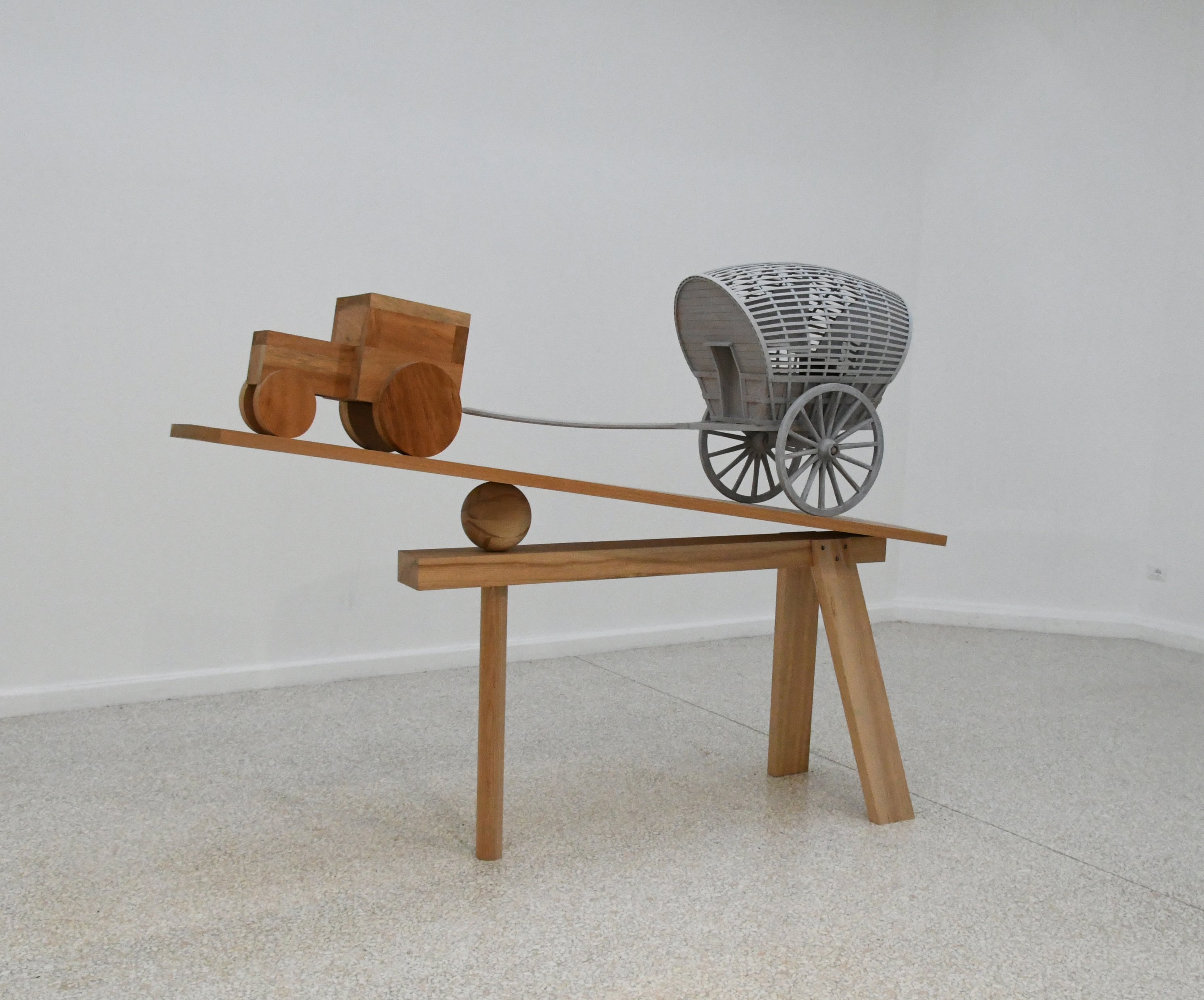
Puryear’s exhibit is entitled ‘Liberty, Libertà’ and reflects society’s push/pull of progress that marches along with social injustices, and greed. Eight sculptures of wood, metal and stone are both outside and inside this US mini-museum and all truly marry Form with Content. Puryear’s ‘New Voortrekker, 2018,’ is a model of a covered wagon pulled by a tractor instead of mules or horses. According to the exhibition brochure, “The artist has long recognized how a utilitarian object can evoke monotonous labor, seasonal ritual, oppression or emancipation….The cart is also a sign of the vast contemporary global migration of the displaced people fleeing political persecution, drought, conflict, and war.” Cart and tractor appear to be moving uphill atop a see-saw that could easily revert and push the objects downward to destruction, thus indicating life’s progressions embedded with uncertainty and failure.
Second Puryear: ‘A Column for Sally Hemings, 2019’, consists of a shackle atop a cast-iron stake driven into a classical Doric column. Lots of references: Jefferson resided in a Palladian mansion with neo-classical columns, as did Hemings who was his slave/mistress/mother to some of his children. This piece which resembles a mixed-race figure stands confidently in the US Pavilion, symbolizing American Democracy, decency, and sadly hypocrisy. The dark metal shackle on top of the sculpture punctures the longer white column, “destabilizing the pristine purity of the column’s classic form.” The white column also reminds viewers of the planation garb worn by female slaves who were routinely shackled. The sculpture is the trace of Hemings who was elevated into an intolerant white world, as it also addresses our modernity: the unresolved post-Civil War racial injustices.
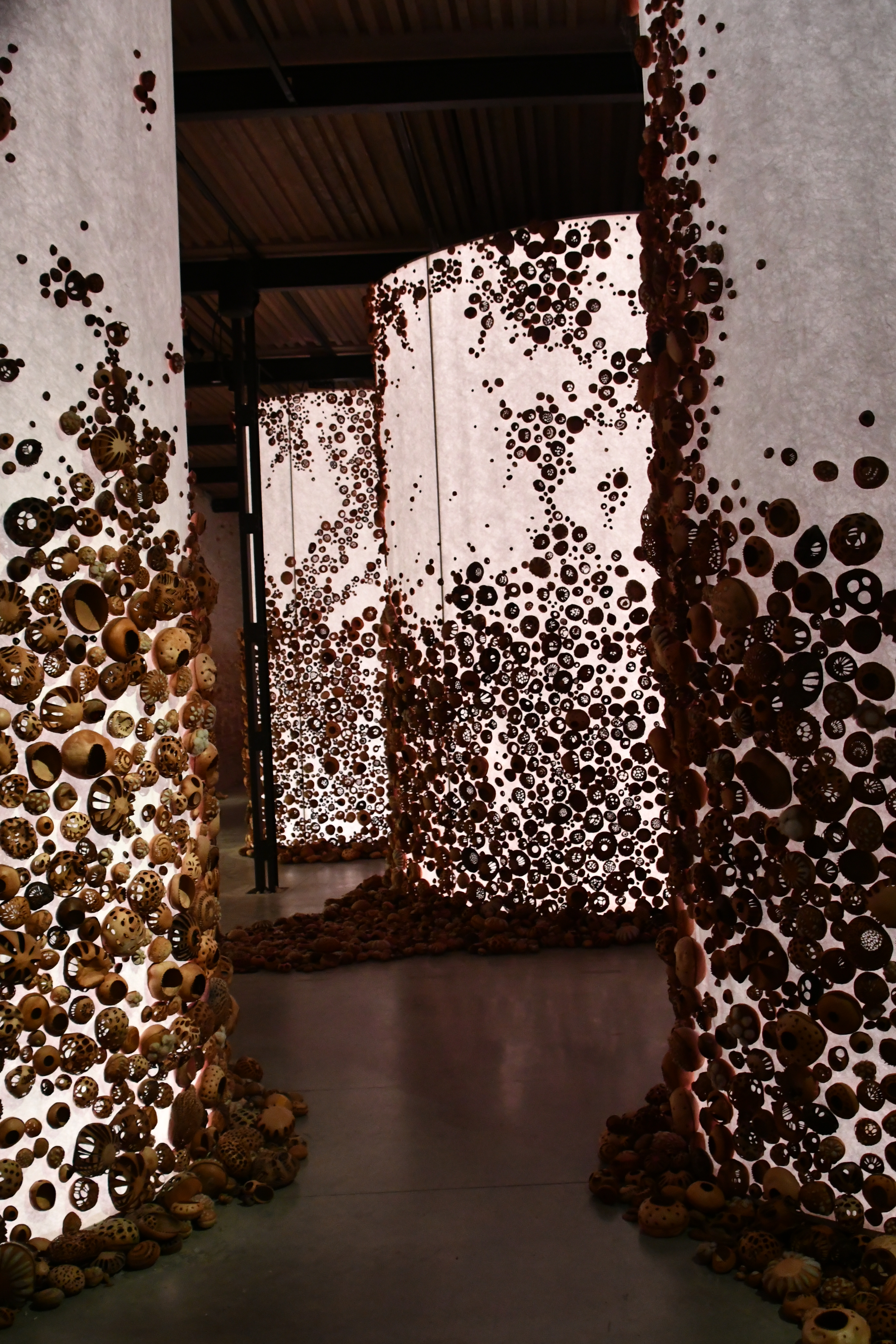
Over at the Saudi Arabian art space, entitled ‘After Illusion’, situated on the Arsenale is ‘Mycelium Running, 2018,’ by Zahrah Al Ghamdi. According to the Saudi gallery guide, “In March 2019, the Ministry [a new position since 2018] set out a new cultural vision for the Kingdom, providing a roadmap for a flourishing of arts and culture across Saudi Arabiathat enriches lives, celebrates national identity and builds understanding between people. Saudi Arabia’s presence at the Biennale Arte 2019 is an extension of that vision and reflects the Kingdom’s ambition to build new cultural bridges with the world.” Alghamdi’s project consists of 50,000 leather objects resembling sea anemones. Some are glued to very tall billowing fabric columns; the rest are heaped on the floor. The Saudi catalog continues, “As one enters this constellation, one encounters a magical space of animated objects through light and sound; [some tubes squeak when touched]; a swirling wave of playful and mysterious beings that engulfs the viewer in an immersive relocation; a virtual reality of an unknown. The interaction could induce either a positive and happy experience or a negative and foreboding one.”
Browsing through the Saudi verbiage I discovered tropes: ‘poetry, memory, imagination, and self-healing’, “To construct a conceivable space of turning fear into curiosity, to explore the unknown instead of fighting it…. a cosmos of opportunities to question perception and unpack realities through these objects...”
While the Saudi art-speak seems mainstream, I felt authors were perhaps deliberately closeted and possibly coded. However, Alghambi’s work is ‘Formally’ one of the most exquisite exhibitions in the Biennale. Saudi art students overseeing the gallery wore Western clothing, were art-informed, and incredibly polite. Alghambi’s work may be contextually restrained from the vantage point of Westerners, but she poses a nice contrast to Puryear’s art where social narrations explode. The Venice Biennale allows viewers to experience how different countries use art, either to politicize or merely address the materiality of creating.
Mini Sleuth: Catalogs, ‘May You Live in Interesting Times’ and Puryear’s Liberty, Libertà are on Amazon.
Jean Bundy aica-usa is a writer/painter in Anchorage
Email: 38144@alaska.net

By Christian Hartley Now You Know If you have ever wondered what the borough attorney actually does, you are not

By Katie Stavick Frontiersman.com In a direct response to public outrage over a horrific animal neglect case, the Matanuska-
By James Brooks Alaska Beacon State lawmakers are acting to fix technical errors affecting the boundaries of several Alaska wildlife

By Katie Stavick Frontiersman.com A man recently arrested after reports of prowling and attempting to enter a family shelter