Retiring teacher, coach urges Colony grads to ‘find their 68’
By Jeremiah Bartz Frontiersman.com A football coach using a hockey reference as the centerpiece for his keynote address may


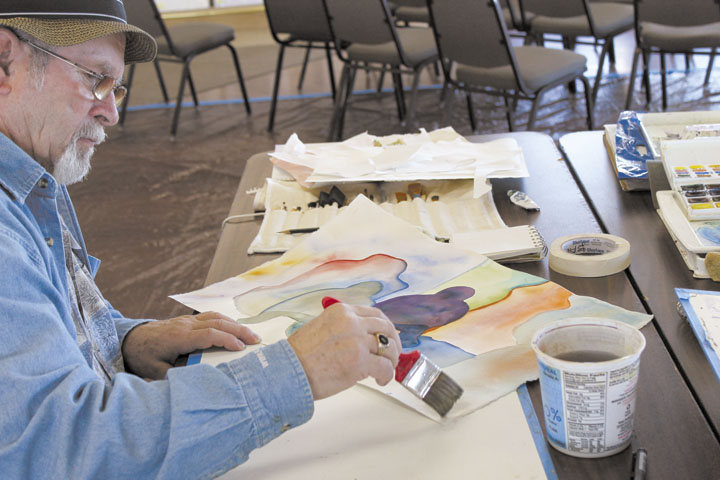
After attending the Barbara Nechis watercolor workshop in Homer Sept. 6-9, Mat-Su Valley artists Jerry P. Edwards and I are now painting abstract and loving the challenge. Artists from as far away as California attended Nechis’ workshop.
Nechis was spoken of highly by colleagues who studied under her during previous Alaska trips, and this workshop was sold out months in advance. Of the 20 artists in attendance, five had taken prior workshops from Nechis and two studied under her during her first Alaska visit in the 1980s.
The two of us from Valley came with different backgrounds and levels of experience in the arts. Both profited from the workshop, but in different ways.
Edwards, who did lots of drawing in high school, has been painting in watercolor for only one year, studying under Judi Betts from Baton Rouge at the 2011 Fairbanks Summer Arts Festival and the 2012 Machetanz Art Festival. He also studied under Vladimir Zhikhartsev, formerly of Russia, now living in Fairbanks, who taught at the 2012 Machetanz Art Festival at Mat-Su College in June.
My background includes a formal art education followed by teaching watercolor for 20 years, 10 of which were at Mat-Su College. No matter how many workshops I have attended during my career as an artist, it never diminishes the eagerness to study under someone new and learn new skills and approaches to art.
So what are some of the benefits of studying from visiting artists who come to Alaska? “Since this is all new to me, I have a lot of room for growth and enjoy getting instruction from professionals,” Edwards says.
He says he feels privileged that opportunities were there for him to study under three internationally known artists in his first year of study.
“I feel like I have studied under three of the best and all three offered a different approach to watercolor,” he says.
He confides that now the biggest challenge is to set aside the time to practice the techniques and principles taught in the workshops, reiterating that they are all different. To a novice this can be confusing, but Edwards says he enjoys the newness each workshop brings.
Instead of teaching me something totally new, Nechis began in what was for me already familiar territory, then stretching some of my existing techniques into new avenues. Being a somewhat seasoned artist, I found that I related to the Nechis workshop relative to my accumulated knowledge and experience.
For example, my background in oriental art embraces a one-stroke approach to painting, where a precisely executed stroke is motivated by a preconceived idea or conclusion of the final product.
In the abstract approach taught by Nechis, the stroke is applied wet on wet. This method allows for no preconceived visual conclusions. Instead, one anticipates the surprise created by the present stroke, which then dictates the choices one will make for the next stroke.
Mostly the choices she stressed were color and value, but also she explored intensity in a rather unique manner. Her approach to intensity was, “Don’t be concerned about ‘what is the opposite color;’ but rather think about the temperature.”
In other words, if the color is warm, dull it by adding a cool color to it. On the other hand, if it is a cool color, visa versa.
Besides the wet on wet techniques, Nechis demonstrated section painting and layering. She uses primarily transparent watercolors, but in some of her artwork she uses the opaque cadmiums” and Naples yellow paints.
For several years now, I have been working in watercolor on Yupo (pronounced u-poe) which is actually vinyl sheeting (as opposed to paper). Wet on wet techniques may introduce complications because all the paint rolls together. But the section paintings, a Nechis approach to dividing the paper into pleasing shapes and then carrying out a theme based on layering can be incorporated on Yupo. The effect is less uniform than on regular watercolor paper, but has potential worth exploring.
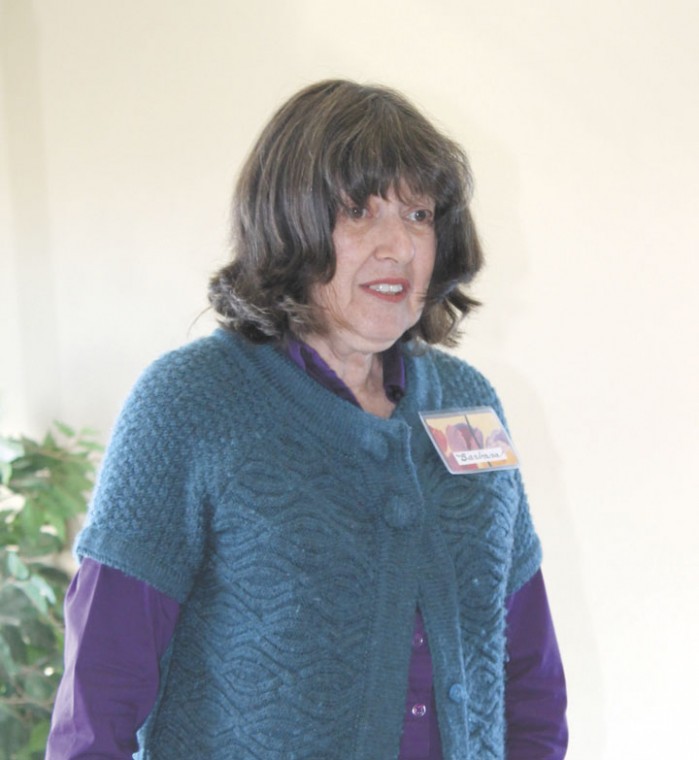
The following is from her web site: “Barbara Nechis is an artist who has developed a style known for its masterful balance of spontaneity and control of the watercolor brush.”
Besides having received a master’s degree in art, she was a faculty member of Parsons School of Design and has taught seminars at Pratt Institute, as well as in Europe and Asia.
Nechis, who resides in Napa Valley in northern California, has served as a juror and director of the American Watercolor Society. She is the author of two books, “Watercolor From the Heart“ and “Watercolor the Creative Experience.”
Workshops improve one’s skills while opening up opportunities to network with other artists. After a workshop, there is the longing to rehash the process and share the new vision that comes through new creations. Both Edwards and I will be showing our new artwork, influenced by the Niches workshop, during October at Picture Alaska, 448 E. Pioneer Ave., Homer.
Suzanne Bach is a local artist and founder of the Machetanz Art Festival at Mat-Su College.

Frontiersman.com Multi-platinum, Grammy-winning artist Amy Grant will perform at the 2026 Alaska State Fair on Monday, August

By Kyle Wilkinson For the Frontiersman Friday Fling returns to downtown Palmer this week and will continue through the summer.

By Barbara Hunt Palmer Buzz She walks in Palmer twice a day on Alaska Street from Arctic to Jenski’s.

By Russell Clark For the Frontiersman Obstacle courses. Alaska seafood. Live music. Farmers. Fishermen. Yoga. Art. Birds. Rock climbing. Kids