Retiring teacher, coach urges Colony grads to ‘find their 68’
By Jeremiah Bartz Frontiersman.com A football coach using a hockey reference as the centerpiece for his keynote address may


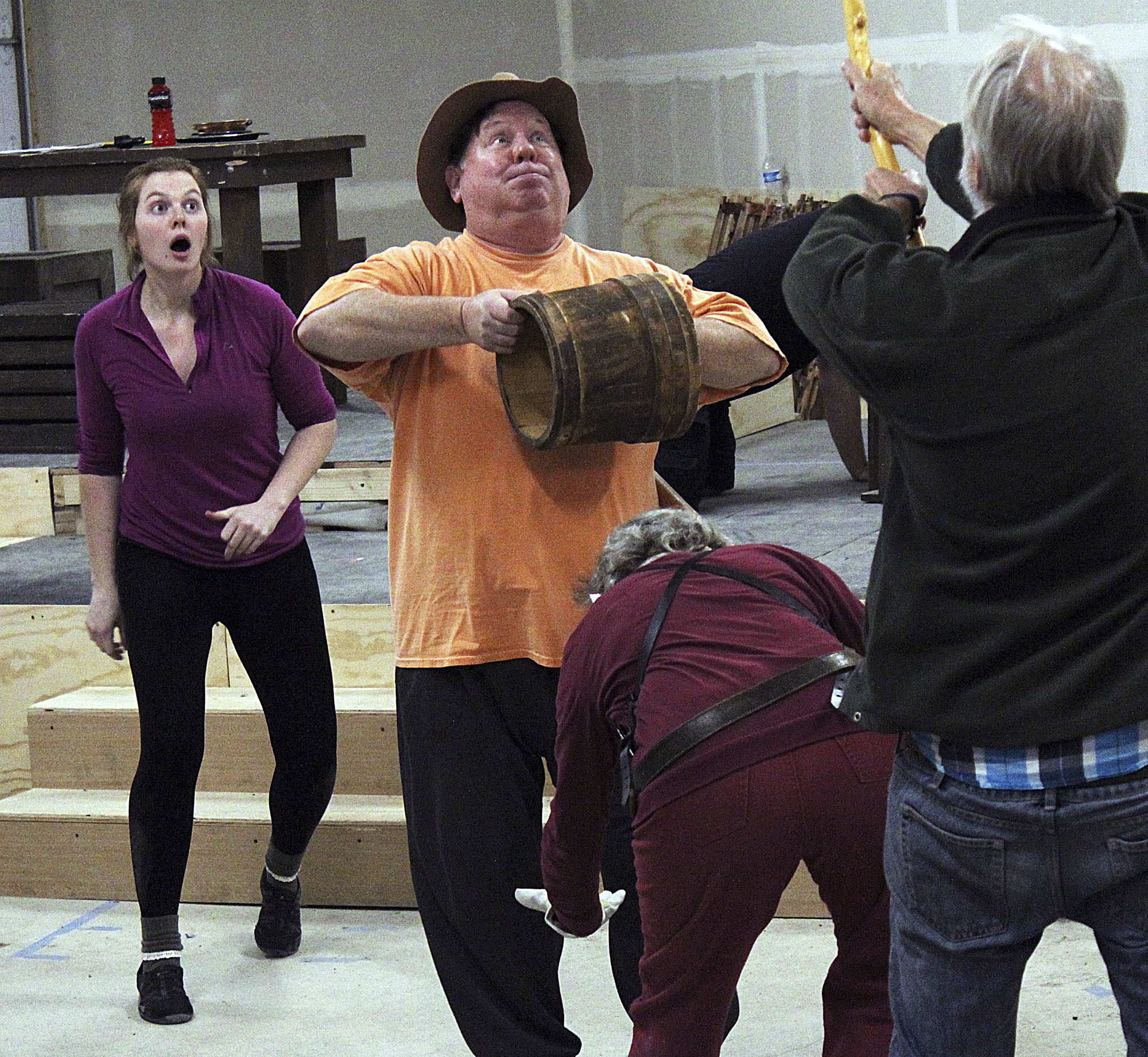
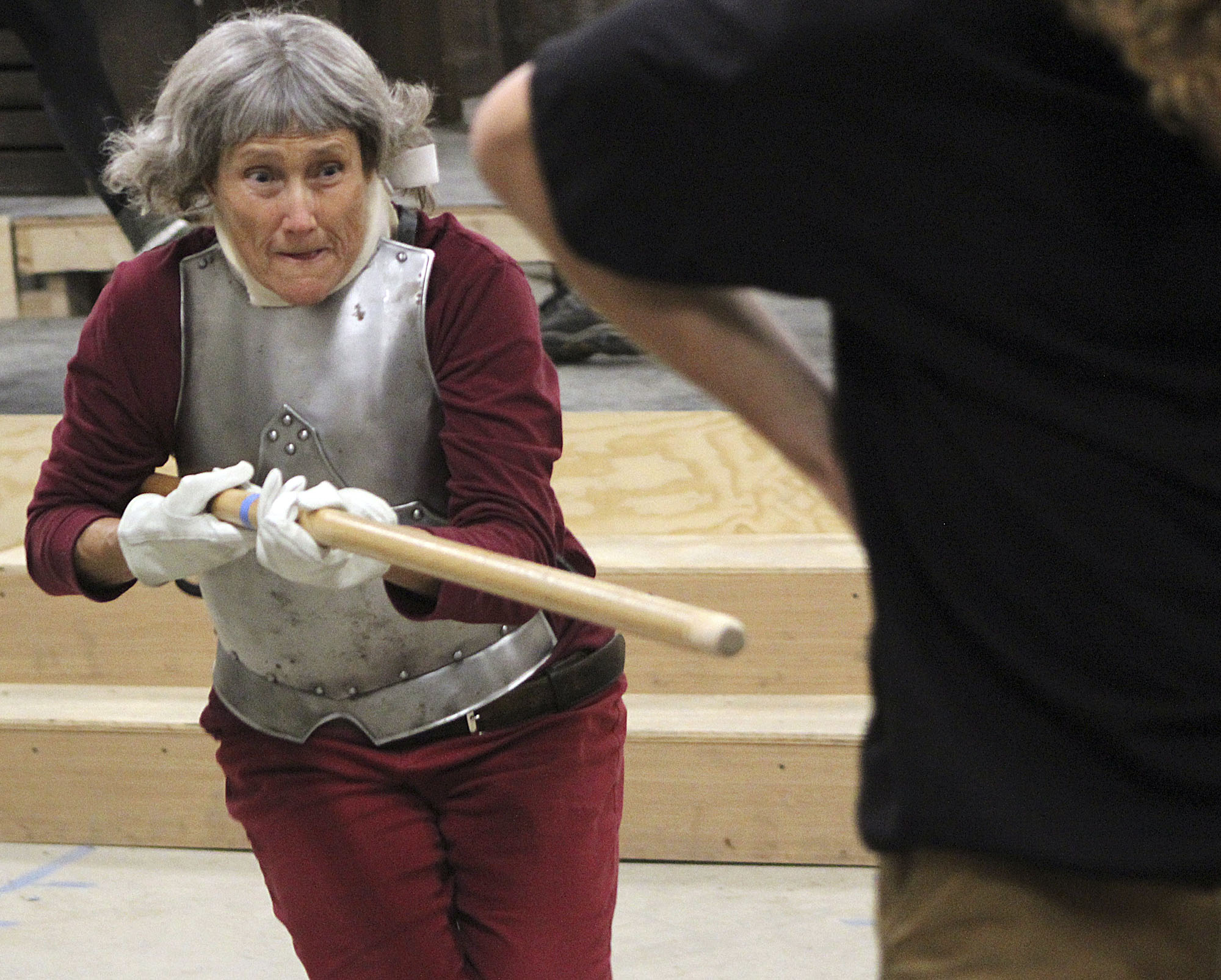
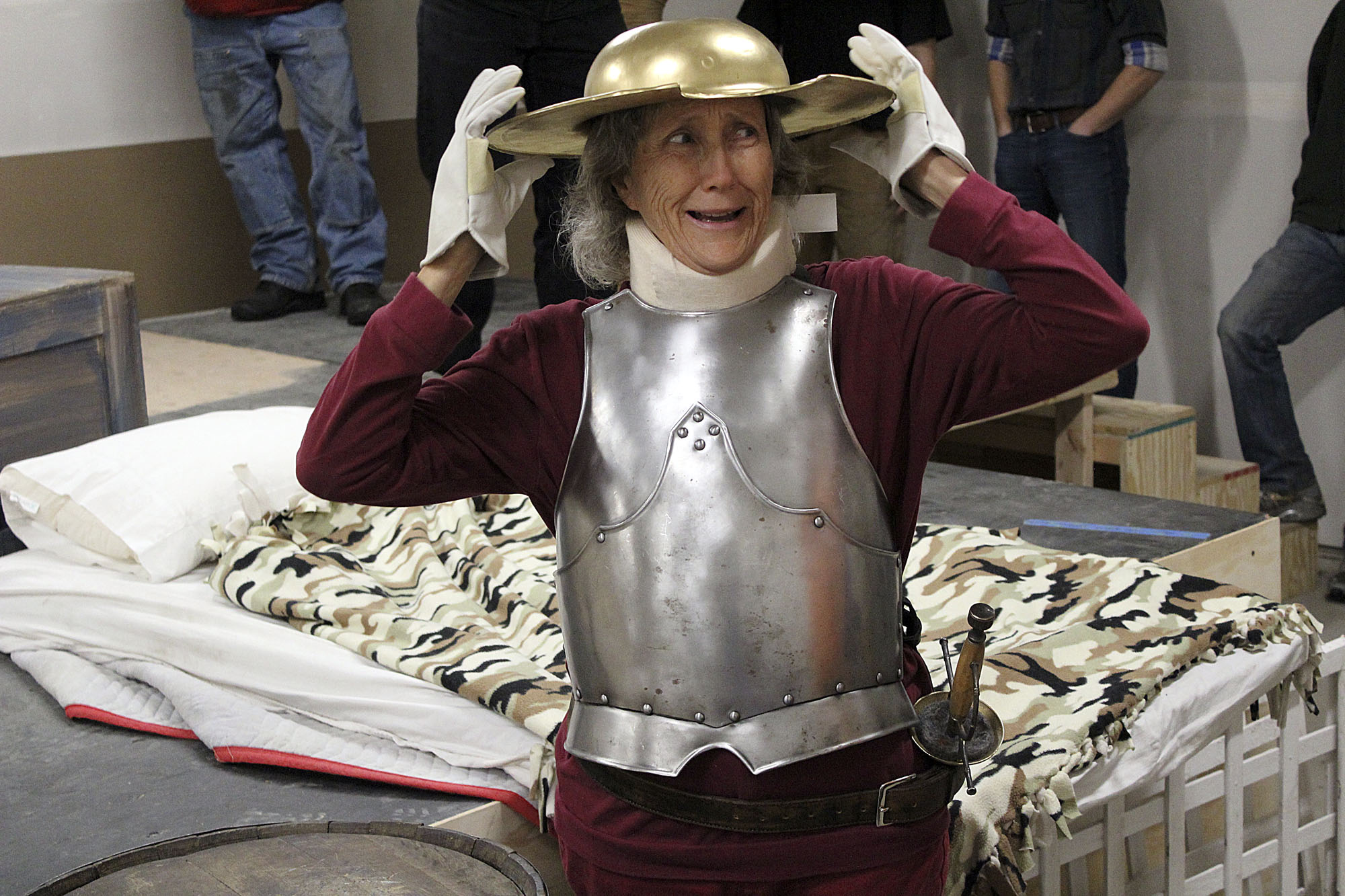
PALMER — In armor and a fine feather plume helmet, and wielding her weapon, Betsy Scott passionately charges into and alternately bounces off of churning windmill vanes until she collapses.
In this moment, Scott is the legendary, slightly mad, and idealistic knight Don Quixote.
At a rehearsal at Palmer’s Matanuska Brewery for the beloved 1964 musical “Man of La Mancha,” based on Miguel de Cervantes’ 17th century classic epic novel “Don Quixote,” the veteran actress proved she can tilt at windmills with the best of them, even though she’s not technically a “man” of La Mancha.
“She creates an iconic male Quixote, seen through a woman’s perspective,” said “La Mancha” director Dean Phipps, who is also director of marketing for the the Alaska State Fair. The play’s swashbuckling fight scenes are directed by Frank Delaney.
Scott’s role is a tricky triple play requiring a seasoned and nuanced actor capable of playing the author Miguel Cervantes, the senile old man Alonso Quijana, and Quijana’s valiant alter-ego, the knight Don Quixote.
Quixote is the literary legend who dares to dream “The Impossible Dream” of being gallant, brave and driven to fight for what’s right in a world gone horribly wrong.
When Phipps agreed to direct the play, which will be open at Mat-Su College’s Glenn Massay Theater Friday night, an intriguing query popped into his mind.
“It really started with one question: ‘What if Miguel Cervantes was a woman?’” Phipps said. “When I had that question, I thought, will it work? Because I didn’t want to change the play.”
Aside from changing Miguel to “Miguelina,” Phipps didn’t have to alter much. He simply tweaked a couple lines.
Phipps reasoned that there were unconventional women in the past who did write under male pen names and otherwise subverted gender to survive and live a more fulfilling life, so it wasn’t too much of a stretch.
Once Phipps made the gender-bending decision, he had to find an actor who could handle it with finesse.
“I thought, ‘who in the heck could play that? And Betsy is the first person I thought of,” he said. “She’s a really good singer. She’s a wonderful actor. She’s light on her feet.”
Scott, an award-winning actress, registered nurse and trained opera singer, who had taken a 20-year hiatus from acting before taking on this role, directed Phipps in a Valley Performing Arts production of “The Playboy of the Western World” nearly 30 years ago.
When Phipps approached Scott about the “La Mancha” role, Scott was a little flustered. She hadn’t seen the stage show or read the book, and wasn’t quite sure how a female Cervantes would play out.
“I said, ‘I’m confused. Am I a woman playing a man? Am I just pretending to be a man throughout?’” Scott said.
When Phipps sent her the script, Scott said the concept started to make sense.
“I saw how Dean thought we could do this. I haven’t done this in so long that I thought this (role) would maybe be a swan song,” she said. Let’s see “if I can pull this baby out of the hat and dust this old bag off.”
Scott’s initial confusion is understandable. The musical is a rather complex, layered play within a play, made even more intricate by the gender switch.
For those unfamiliar, here’s a ‘quick-ote’ summary, including the concept of Cervantes as a woman.
Cervantes, an author and actor, among other things, is thrown into a dungeon with her manservant by the Spanish Inquisition.
Upon entering the prison, Cervantes is clutching a manuscript of her epic tale “Don Quixote.”
The prisoners have a cruel tradition of putting new prisoners on mock trial and taking all their possessions if they are found guilty, which they always are.
Cervantes says she has a right to defend herself. As a combo defense and distraction, she suggests they all act out her manuscript and become the characters.
The prisoners eventually agree, and put on a show using whatever props there are available in the jail. Cervantes leads the motley cast as narrator, Quixote and the old man Alonso Quijana.
Throughout the play within a play, the prisoners/players come to see what life could be if everyone had the same noble intentions as the old knight.
So, essentially, Cervantes is a woman impersonating men in the play within a play.
Scott said she varies her tone of voice and manner depending on which of the three characters she’s portraying.
“Cervantes is more playful, more flippant,” Scott said. “She’s an actress.”
Scott said Cervantes voice is higher and more like her own, while she takes on a rich, melodramatic “King Lear”-esque tone for Quixote and Quijana.
“I have to try and be three people,” Scott said. “But the beauty is, it always is Cervantes.”
Phipps and Scott imagine Miguelina Cervantes as a cunning, creative and fearless woman who lives by her wits.
“She goes through her life being whatever she has to be to survive. And a lot of times she pretends to be a man,” Scott said. “She’s a women’s libber way back when they didn’t exist.”
In giving the role to Scott, Phipps is engaging in gender-blind casting, the sometimes controversial practice of having an actor play a role traditionally assumed by the opposite sex.
In most cases, it’s a woman taking on a male role.
Directors do it for a variety of reasons both political and dramatic; to force a perspective-shift, challenge gender stereotypes, or give women more acting opportunities overall.
If you look at theatre as a pantomime at the core, and remember that in Shakespeare and Cervantes’ time that men played all the female roles, it shouldn’t seem too odd.
Most famously done in Shakespeare plays, gender-blind productions have been popping up everywhere.
Recently, an all-female “Taming of the Shrew” was staged at the Delacorte Theater in New York’s Central Park, and Tamsin Grieg of Showtime’s “Episodes” played Malvolio (Malvolia) in “Twelfth Night” at The National Theatre in London. And in 2010, Helen Mirren played the sorcerer Prospero (Prospera) in Julie Taymor’s film version of “The Tempest.”
At its best, the acting wins out in gender-blind productions, and what may seem awkward at the beginning, just becomes natural as the play proceeds.
“If I can pull everybody else into my mad world, before you know it you get sucked into the story and care about what Don Quixote cares about, and you kind of forget that it’s a woman,” Scott said.
The mechanics of gender-blind casting can be either brilliant or extremely awkward when it comes to romantic relationships within a show.
In “La Mancha,” Don Quixote is entranced with Aldonza (Rebecca Mahar), a fierce and fiery woman accustomed to being used and abused by men.
Quixote sees her through rose-colored glasses. To him, Aldonza is Dulcinea, the pure and perfect lady of his dreams.
Quixote often histrionically exalts Aldonza in what Scott sees more as a celebration of divine femininity rather than a sexual overture.
At one point, Aldonza rebuffs Quixote, telling him he knows nothing about women. Quixote replies, “Oh, I know everything about women.”
“It’s like Cervantes is talking through Don Quixote,” Scott said. “It adds another level to it. “
Another instance in which Cervantes being a woman adds depth is when Don Quixote faces Aldonza after Aldonza has been brutally attacked and sexually assaulted.
Quixote’s compassion is compounded. He simultaneously expresses a woman’s empathy and a man’s protectiveness.
“When the woman Cervantes sees that, it’s like, ‘I know what its like,’” Scott said.
Ultimately, the story is about confronting and fighting evil, no matter the consequences, not fixating on the gender of the actors.
“It’s a beautiful script. It says a lot for right now,” Scott said. “We have to all sort of become knights; not just going out fighting and plundering just to do it, but to have a heavenly and honorable cause.”
When: Friday, Oct. 20 through Sunday, Oct. 29
Where: Glenn Massay Theater, Mat-Su College campus, 8295 East College Drive, Palmer
Tickets: $18-$21. (glennmassaytheater.com, 907-746-9300)



Frontiersman.com Multi-platinum, Grammy-winning artist Amy Grant will perform at the 2026 Alaska State Fair on Monday, August

By Kyle Wilkinson For the Frontiersman Friday Fling returns to downtown Palmer this week and will continue through the summer.

By Barbara Hunt Palmer Buzz She walks in Palmer twice a day on Alaska Street from Arctic to Jenski’s.

By Russell Clark For the Frontiersman Obstacle courses. Alaska seafood. Live music. Farmers. Fishermen. Yoga. Art. Birds. Rock climbing. Kids