Retiring teacher, coach urges Colony grads to ‘find their 68’
By Jeremiah Bartz Frontiersman.com A football coach using a hockey reference as the centerpiece for his keynote address may


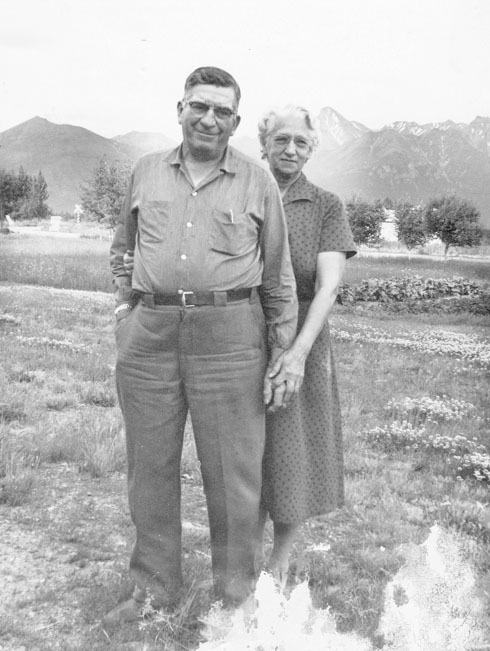
In 1950s Palmer, it took less than “six degrees of separation” to find connectedness. Archie and Sadie (Hecker) Moffitt had moved from their farm to a small white house facing the Glenn Highway just south of Palmer. In 1957 memorabilia, their nine children credited them with 32 grandchildren and three great-grandchildren.
“The clan gathered and the walls bulged,” wrote Leonard and Betty Moffitt in mini-albums made with small steno pads, recent snapshots, brief printed notes and adhesive tape. Fifty-five years later, the steno pads, photos and notes survive with darkened tape fluttering away like angel wings. Even as a child, during holiday feasts that house felt small, making the fond embrace of grandparents, aunts and uncles that much warmer. The Hecker and Moffitt children had married and were building families.
In late summer 1946, Bergie Belle Hecker moved into the teachers’ and nurses’ dormitory. Today, the building is Palmer’s Colony Inn. Bergie had served as a “Doughnut Dolly” in France for the American Red Cross during World War II, where she provided recreational services for the U.S. Armed Forces, serving coffee and doughnuts while providing conversation, hospital visits, letter writing, cigarettes, paperback books, candy and gum.
Doughnut Dollies were age 25 to 35, and had at least some college education and work experience. In addition, they had to be healthy, “physically hardy,” sociable and attractive.
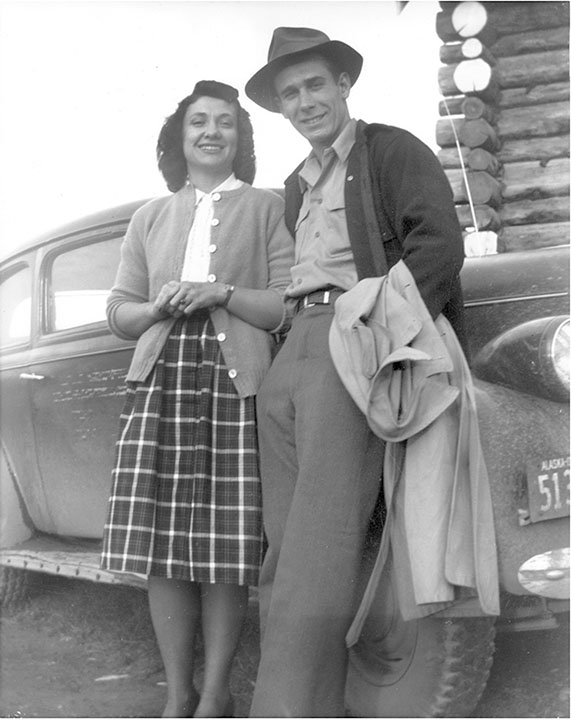
In France, Bergie applied for a teaching position in the still nascent colony town of Palmer. She was hired sight unseen. She met my father at a fall dance at the Grange Hall. They were married in November. City fathers didn’t want single young people — corrupting and corruptible — floating around the Valley. They provided multiple meet-and-greets with hopes of marrying them off as quickly as possible. It certainly worked for my folks.
Sunday’s 75th anniversary reunion of the Moffitts’ and Heckers’ 1937 arrival as “replacements” to the original Matanuska Colonists recalls ventures and images that created a significant part of my upbringing. Some stories old and familiar, some newly revealed and surprising, evoke how my pioneer family interwove with other inhabitants to form the tapestry of early Palmer.
Liz Thornlow came with daughters Debbie and Kathy. Three of Liz’s half-sisters, Pat, Genevieve and Kit, married three Moffitt sons, Owen, Tom and Leonard. All remember joining cousins for energetic play at Tom’s dairy farm.
One day, 3-year-old Tommy-O, son of Tom and Gen, fell through the outhouse seat to be quickly fished out with a long-handled rake. The boy clambered aboard the rake prongs, clinging to the handle while his Dad “elevatored” him up. After a hasty hose-off, the tyke was sent to mom for soap and hot water detail.
Among the first wave of Colonists, Maralyn (Vasanoja) Hartley, then 12, says she felt responsible for “keeping track” of new people in town. She began ninth grade at the newly constructed Central School (now the borough building), which housed grades one through 12. A fresh-faced boy named Wally Moffitt was so shy one could hardly get to know him, but his brothers Owen and Tom were far more gregarious.
She recollects frequent parties at Moffitt homes where furniture was pushed back for rambunctious dancing while Tom and Owen played a variety of instruments or records. Later, a marriage between a granddaughter and a Moffitt grandson would forge family from friendship.
Betty Jane Moffitt’s marriage to John Durand links us with the France, Stenberg, and Zaborac families, to name a few. Widowed, Betty wed widower Bill Stewart. This union made us kin with the Stewart and (Wayne) Bouwens families.
Betty’s eldest, Patrick Durand, recalls “cousins trooping from farm to farm, riding the ponies at Leonard’s, feeding and milking cows, slaughtering hogs at Wally’s, shoveling overripe potatoes for hogs and cattle at Tom’s, cutting and packing silage, being grease monkey, roughneck, tool changer and part-time operator (under close supervision), and making homemade entertainments of sports, canasta and cribbage, two-week old baseball on TV, hunting, fishing and mining with the uncles.”
The Moffitt and Hecker story is an insight into a faraway time and cultural mindset. It was part of a national and local experiment, which, at academic levels was considered a failure. At the community, family, and spiritual level, it was not.
The challenges of these times are so removed from our ease of living that they seem to bear little relevance to us today. Or, it might bear all the relevance in the world. We can travel to those times and places. They lie in the heart of every older person we know. The only passport needed is the willingness to listen. You might meet your own future by returning to your past, to your “six degrees of separation” to familial and community connectedness.
Barbara Hecker is a local writer and longtime teacher who writes “Inky Visits,” a regular history column for the Mat-Su Valley Frontiersman. Send suggestions for places, events, and persons to visit and write about to InkyVisits@gmail.com.

By Barbara Hunt Palmer Buzz It was 6:43 on Friday morning and the Plant Owner was sound asleep when

By Kyle Wilkinson Frontiersman Memorial Day Weekend was filled with a variety of events in Willow. From live music to

By Kyle Wilkinson For the Frontiersman The Susitna Valley Emergency Preparedness Fair will be held at the Willow Community Center

By Barbara Hunt Palmer Buzz Green-Up happened at exactly 9:34 am on Saturday morning in Palmer. This was