Retiring teacher, coach urges Colony grads to ‘find their 68’
By Jeremiah Bartz Frontiersman.com A football coach using a hockey reference as the centerpiece for his keynote address may


From his small forge in Houston, Forge 33 owner Kevin Adams hammers out custom knives for clients all around the state of Alaska and the Lower 48.
A bladesmith of eight years, Adams has forged everything from kitchen knives to fillet knives, period pieces dating back to World War 1 and everything in between. Adams has a hand in the entire process from start to finish forging the blade, constructing the handle and sewing together the leather sheaths by hand. Adams, a finalist on the History Channel show Forged in Fire, said that what started as a hobby has now turned into a full-blown side hustle.
“A hobby that’s out of control,” Adams joked.
While most of Adams work is on custom order, he hosts a vendor booth at the Mat-Su Outdoorsman Show. He brought 27 finished knives and their accompanying hand-stitched leather sheaths this year. Adams receives custom orders for kitchen knives, choppers, fillet knives, skinning knives and more. He works with damascus, san mai and a variety of different types of steel. He cerakotes knives to order, helping to preserve the quality of the blade in the Alaskan weather. His handle materials include antler, stacked birch bark and mammoth. In addition to his website and social media, Adams' work can be found at Great Northern Knives and Alaska Mint.
In his two room workshop, Adams process includes working on half a dozen knives at a time. When filling large orders or preparing for a show, Adams said he likes to have several knives in different stages of completion. While waiting for one set of blades to temper, Adams can sit back, listen to classical music and finish his leather sheaths with “cowboy stitching,” sewing in the final touches with his two needles and thread.
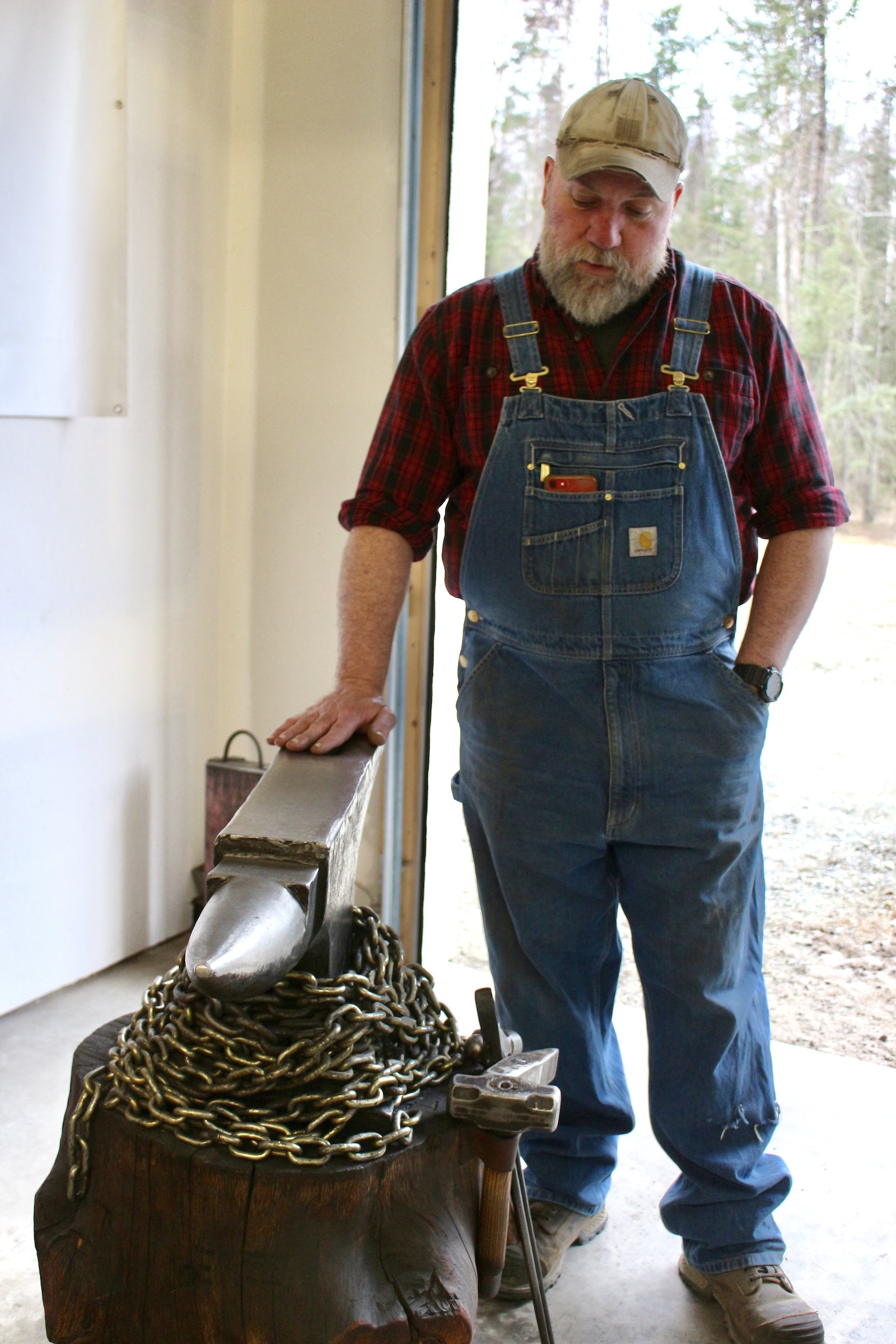
Adams started forging in 2017 at the age of 50. Coming from a family of steel workers, Adams said his father and his grandfather had a large influence when he got started bladesmithing. His father purchased a 268-pound Peter Wright Anvil dating back to the mid 1800s in Eastern Pennsylvania where Adams was from and drove it all the way to Utah as a 50th Birthday present. Included with the anvil was his grandfather’s hammer, an integral tool that he uses in the forge to this day.
Bladesmithing has also provided Adams with a natural outlet for coping with PTSD. An army veteran of 14 years, Adams served in field artillery, as a combat engineer and finally as a Military Intelligence Electronic Warfare Systems Repairer/Maintainer in the 33W3H, hence the name Forge 33. Adams said he didn’t want to take any kind of pharmaceuticals for his PTSD, and found that bladesmithing was a natural remedy for it.
“When you’re doing a blade, you’re going full circle,” Adams said. “From drawing it out, planning it, making it and then finishing it up with the leatherwork, your memories are all there. It’s all something that you’ve made and created.”
Adams caught on to bladesmithing quickly, making knives for family and friends. Early on, Adams said he made it a personal goal to audition for the television show, Forged In Fire. He auditioned in February of 2020 and was accepted, but was met with production delays due to COVID-19.
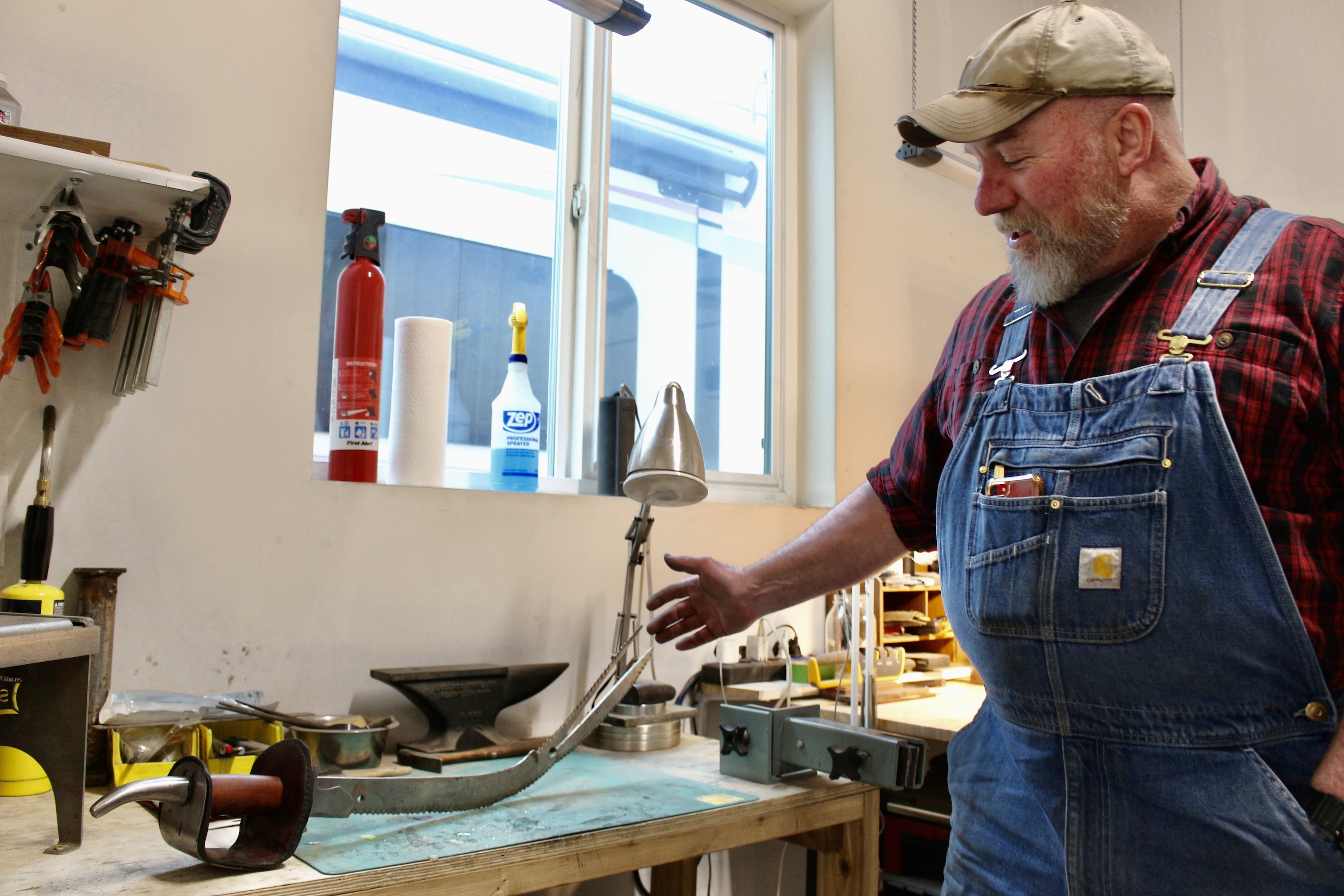
Coming from a military background, Adams said he decided to take the time to train and build different types of blades to prepare for the competition. One of the first projects he built was his first sword, which he still displays in his shop. Adams said he also timed himself and practiced working efficiently in preparation for the pressure of competition. Working in his forge in the Arizona heat, which would sometimes reach 130 degrees, also gave him an edge during the competition.
Adams traveled to Connecticut in fall of 2020 to film for the show. Adams and three other contestants put in 12 hour days forging and filming for the competition. The competition included three rounds where bladesmiths were required to construct a knife, each round being a different step in the process. Blades were inspected each round and the bladesmith who did not meet the requirements or failed a test were eliminated. Adams explained the processes he took on each portion of the competition, including the construction of his blade out of a torsion rod from a car and constructing his handle from burnt wood.
Adams would make it to the final round of competition, where he would then go head-to-head against competitor Aric Fontaine. The two were required to return to their home forges and recreate the elaborate and highly intricate 18th-century Indian Tegha sword.
“I looked at that, and I’m like, ‘Oh my God,’” Adams said.
The two smiths had to design their blades to match a myriad of parameters, including adding serrations to the curved blades, a split tip at the end and an elaborate handguard and pommel. Each had 30 hours of forge time at their homes to create the piece and return for judging of the final round.
Returning to Arizona with little sleep, Adams said he began constructing his sword from the operating arm of a tractor. He said forging was going well until the second day when his blade broke when the grinder he was using caught an edge of his blade and flung it into his chest and across the room. Pressed for time, he had to rush to finish his blade in the remaining 20 hours.
Returning to the competition, Adams competed against Fontaine in three tests that judged the blade’s lethality, durability and sharpness. The two blades were nearly equally matched and ultimately Adams was asked to leave the forge, placing runner-up in the competition. Adams said he believed he lost because a majority of the over 100 serrations on his blade broke during the durability test because of cutting a corner and not having the perfect temper in his blade.
Adams said the experience taught him a lot about bladesmithing and created lasting relationships with other smiths from across the country. The publicity of the show also boosted his own business. One of his biggest achievements was a compliment he received from one of the show’s judges, a weapons smith and prop fabricator, Dave Baker.
“Because this is the weirdest blade that I think they’ve ever had on the show, when me and Aric came back to do our testing on this, Dave Baker calls us over - he’s in the parking lot and he goes, ‘First of all guys, I want to congratulate you. You’re one of three people, three smiths in all of North America to successfully make this blade. And we’re all standing together,’” Adams said.
Adams likes to pass on the tradition of bladesmithing to the next generation. He hosts a training course for apprentices in the fall and usually instructs them once per week for 4-8 weeks. The classes are self-paced and students learn how to make a fire poker from rebar and a knife from an old railroad spike. Students will come out of the training with the knowledge of how to do most tasks in bladesmithing. Most of his students have never forged anything in their lives.
“It’s just the basics,” Adams said. “Get the motor skills down, and not be afraid of the steel but respect it. And how to understand your heat, and what to look for, and working with the handle, working with the tools. It’s stuff that today’s generation doesn’t seem to have those skills.”
Alaska is not known for being the home to many bladesmiths, and Adams said that he knows of less than half a dozen in the state. He said he hopes to connect with more smiths in the future to network and learn from each other.
Bladesmithing and working in his forge is a release for Adams. When he isn’t making blades or instructing new trainees in the fall and winter, Adams is working in his full-time profession as a computer field support engineer all across the state. In the summer he plays music for audiences, frequently performing at the Susitna Bar and Grill.
Those interested in custom knife orders or wanting to learn how to forge their own blades can contact Adams at his website: https://www.forge33.com/

By Jeremiah Bartz Frontiersman.com A football coach using a hockey reference as the centerpiece for his keynote address may

Frontiersman.com With its headquarters in Wasilla, the Frontiersman has been a primary source of news for the Matanuska-Susitna

By Katie Stavick Frontiersman.com The next generation of leaders took flight this week as the Houston High School Class

By Kyle Wilkinson For the Frontiersman Keynote speaker and Carry the Cure President Bill Pagaran’s words boomed through the