Retiring teacher, coach urges Colony grads to ‘find their 68’
By Jeremiah Bartz Frontiersman.com A football coach using a hockey reference as the centerpiece for his keynote address may


PALMER — About 30 members of the Palmer Historical Society gathered at the Palmer Moose Lodge for their monthly History Night meeting, which just happened to coincide with Alaska Day. Their meeting coinciding with the annual holiday that celebrates the acquisition of Alaska from Russia to America 150 years ago was a mere coincidence, as fate would have it.
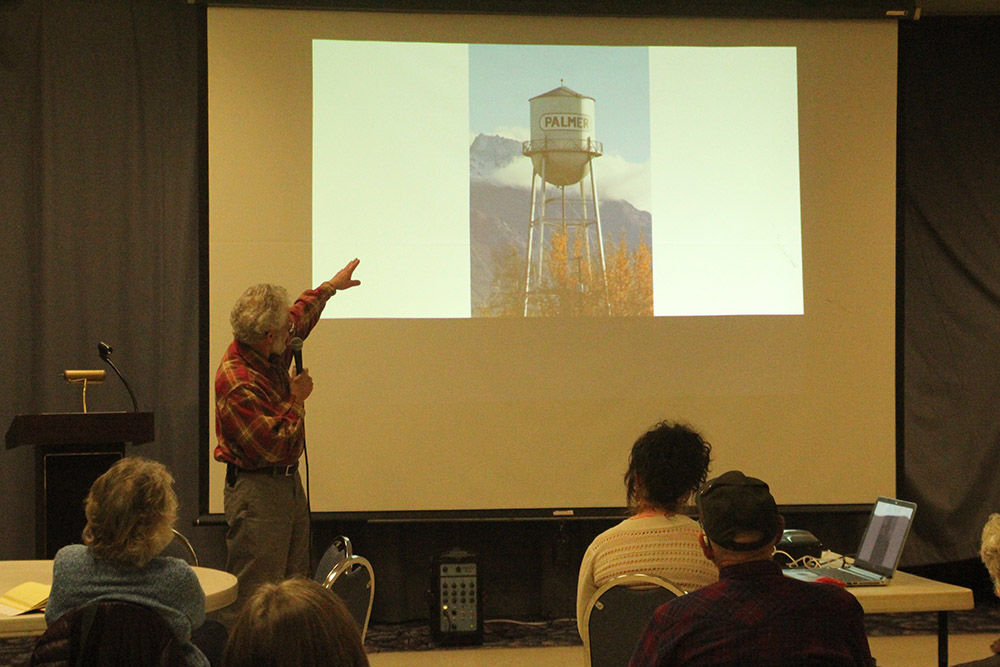
The focus of the Palmer historical society tends to revolve around the town, with occasional reaches backward or around to tie it together. It was business as usual. Hardly anyone in the room even knew it was Alaska Day until Denny Hamann pointed it out when he gave his history presentation. President of the Palmer Historical Society, Sheri Hamming said it was a “fun coincidence.”
“We’re good and didn’t even know it,” Hamming laughed.
The meeting started with an update and brief overview of the symbol of Palmer and the Palmer Historical Society’s first project and recent endeavor — the water tower. Kelly Turney and Ralph Hulbert related the past and present changes to the water tower. Some 31 years ago, the water tower was plain and rusty, no special markings. When the Palmer Historical Society formed, their first objective was to paint the tower, sprucing it up and painting on that iconic, blue Palmer lettering. That was then. Now, the finial is the focus and it has returned to the top of the tower yet again. Hamming said the story behind the paint job and finial restoration illustrates community effort in the interests of a ‘guiding mark’ for the city.
“It orients us; it’s like our compass,” Hamming said.
Palmer’s history is still fresh, according to Hamming. She said that many of the original Colony families are still around so people can learn about the town’s history by talking to people who actually lived through it. She said this is unlike most other cities and towns’ histories in the Lower 48. Most of those histories date back so far people feel “disconnected” with them. With Palmer, she believes that the history feels real because most things just happened relatively recently.
“We are living among our historians,” Hamming said. “You had colonists here tonight.”
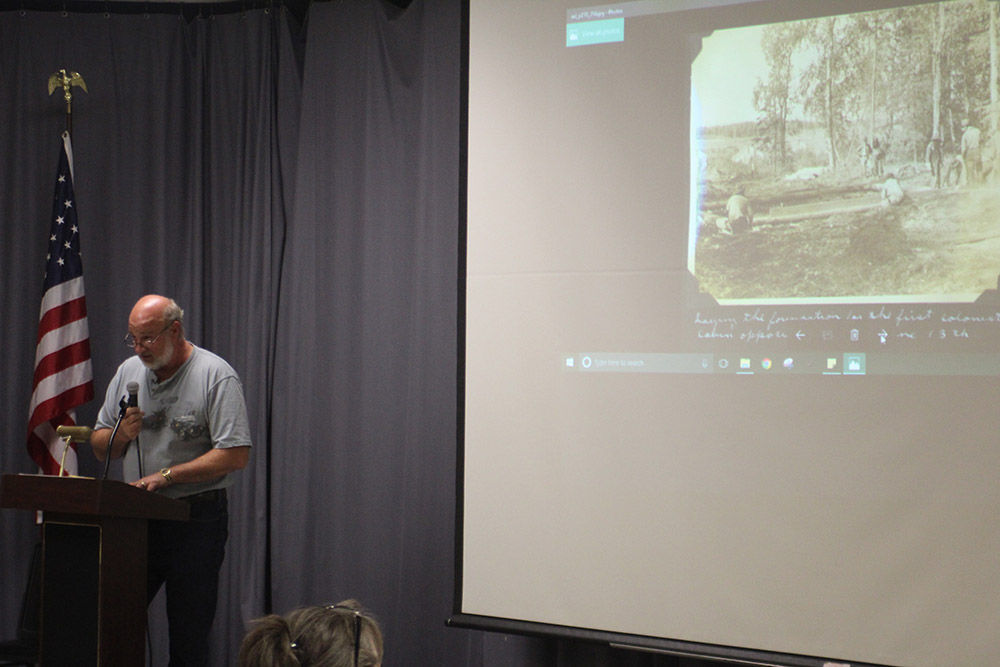
The second and last presentation was Hamann’s overview of Alaska history, starting at the purchase, the exploration, the colonization, tent city and experimental farms, the government realizing it might work to send more farmers up there — leading into Franklin D. Roosevelt’s New Deal and families like Hamann’s packing up and moving to Alaska.
“These people here lived in those tents,” Hamming said.
Hamann’s presentation, spurred by finding relics from his family’s past, was a project that set the scene when America took ownership of Alaska, and gave snapshots about milestones leading to the formation of Palmer. Apparently, the town went thorough cycle of names before Palmer finally won out.
“There was a time when you could stand at the depot and be at Palmer, throw a rock one way and hit Warton and throw another rock and hit Valley City,” Hamann said.
He used a slideshow with pictures showing his grandparents’ journey up north. Old photos of train rides and barges slid through the screen as Hamman talked about how remarkably fast Palmer was settled and built. Once his family signed up for the New Deal project in May, they were packed up and left six days later. He said that at one time, there were 900 workers hired to help establish the Colony homes. On Nov. 4, the last colony family moved into their house.
“Back in those days, when the government wanted something done, they got it done,” Hamann said.
Clyde Oberg is 93 years old. He said if it weren’t for the original colonists, he wouldn’t be here. Growing up, he always thought of Alaska as land with “igloos and Eskimos.” He later learned about the colonists’ success up north. He was swept up with the idea of making his way in a brave, new land.
“I thought, ‘golly, I want to go to Alaska,’ ” Oberg said.
In 1946, he re-enlisted in the Air Force because they would send him to an overseas location of his choice. This turned out to be his ticket to the Last Frontier. He was sent to Shemya or Simiya, a small island in the Near Islands group of the Semichi Islands chain in the Aleutian Islands archipelago in southwest Alaska, or as Oberg put it, “a big cow pie in the middle of the ocean.” He made his way inland and has called Alaska his home ever since. He said he stays here because there are not many natural disasters.
“We have earthquakes, but I can ride those out,” Oberg said.
Oberg did not know it was Alaska Day either. He and other members lingered after the presentation. Hamming said the last hour is designated for social time as mingling is a core principle for the History Nights. They hold History Night every third Wednesday of the month. It is open to the public and everyone is welcome to join in. For more information, visit www.palmerhistoricalsociety.org.

By Jeremiah Bartz Frontiersman.com A football coach using a hockey reference as the centerpiece for his keynote address may

Frontiersman.com With its headquarters in Wasilla, the Frontiersman has been a primary source of news for the Matanuska-Susitna

By Katie Stavick Frontiersman.com The next generation of leaders took flight this week as the Houston High School Class

By Kyle Wilkinson For the Frontiersman Keynote speaker and Carry the Cure President Bill Pagaran’s words boomed through the