Retiring teacher, coach urges Colony grads to ‘find their 68’
By Jeremiah Bartz Frontiersman.com A football coach using a hockey reference as the centerpiece for his keynote address may


WASILLA — Growing up the son of a homesteader in a Wasilla where running water was the luxury that separated the haves from the have-nots, Skip Coghlan never quite appreciated how good he had it until he left.
Retired, and living in Wisconsin, where he worked in the forestry service for two decades, Coghlan was well aware his hometown — now a sprawling micropolitan area of well over 30,000 — was coming up on its centennial celebration.
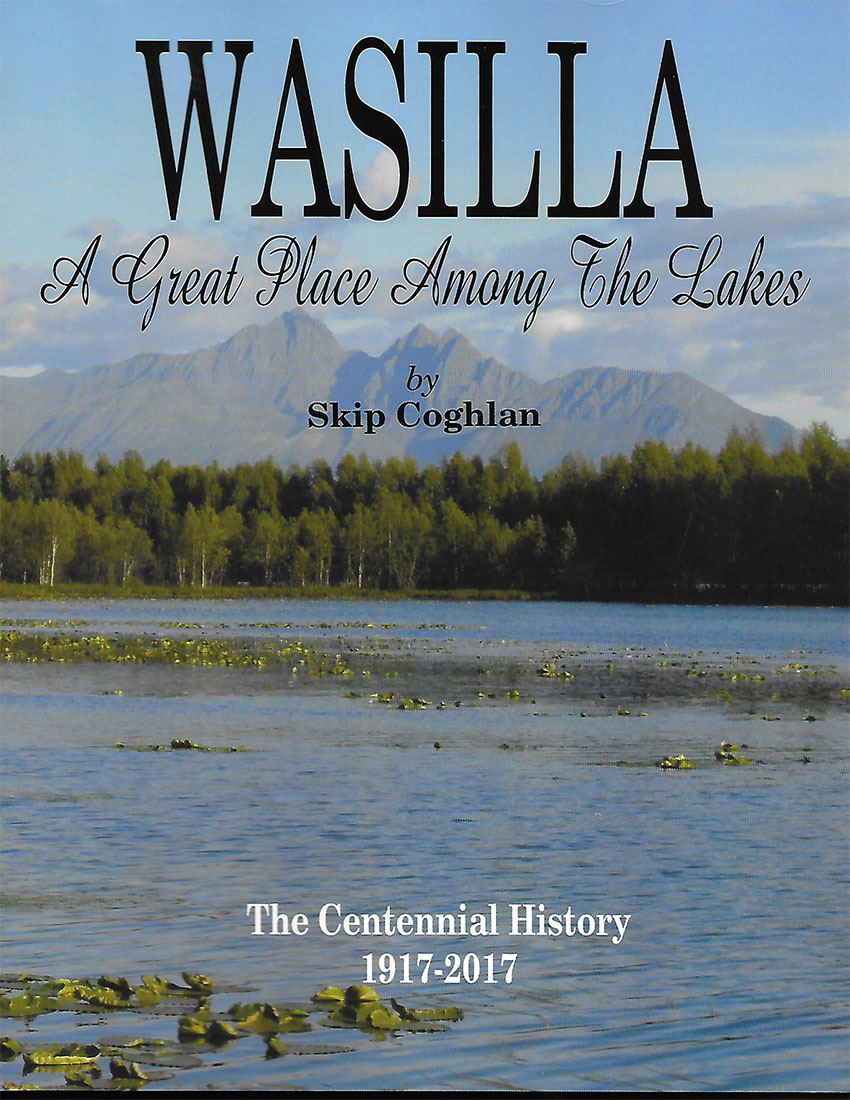
That was in 2012, and it just happened to be a week beyond 72 years since 1940, meaning that all ancestry records from that time came into public record. Armed with that, he began research for his book on 100 years of Wasilla history by building a Wasilla family tree on ancestry.com that proved to be a wealth of information, and ultimately led to his book ‘Wasilla: A Great Place Among the Lakes’, published just in time for Wasilla’s centennial celebration.
“You don’t find much information about Alaska or Alaskans in Alaska, so if you can find where somebody was born, you can find out a lot of information about them prior to 1940, which is my main focus,” Coghlan said during his July 4 visit. “I grew up here and had always been interested in the things you don’t quite know about. I grew up hearing these names and places and was always kind of interested in that. Approaching the centennial year I was trying to get folks interested.”
The idea for the book first took root with Coghlan in his sophomore year of high school where his English teacher, Louise Potter, had written a history book in Wasilla in the 1950s.
“She called it more of a history-in-progress,” Coghlan said. “She did a nice job of bringing up the Herning diaries and journals and making them available to the public… When I was working on this I was using the carbon from Potter’s transcriptions of Herning’s journals.”
Coghlan’s book takes an approach to design not common among books of its kind in that it pushes all the text to the front, and fills the back half with photos he collected from the Fleckenstein and Fritzler families, as well as the Anchorage Museum.
Coghlan said he got that idea from a centennial book written about his father’s hometown, St. John, North Dakota.
It opens with the story of Wasilla’s beginnings, which he winds back all the way to the formation of the earth itself.
“Part of that is I’m an engineer and I kind of like to do things in a structured way, and as it turns out, that’s kind of how you can explain where the gold came from, and the country around here was so shaped by the glaciers that,” Coghlan said. “As a kid I sort of intellectually knew that, but I started researching some of those things — the old geologic reports from the early 1900s, then some of the newer research that’s been done and it all sort of fit together.”
By the time humans — natives and then explorers and settlers — show up, Coghlan’s 224-page book is off and running with a fast-moving narrative that crescendo’s in the lead-up to World War II when mining was helping define a growing Wasilla community.
Coghlan’s family settled near Jacobsen Lake, west of Wasilla, 2.5 miles up Knik Road where they rented because his father didn’t have enough money to homestead.
“There was no Parks (Highway), no road, just a trail along the tracks between Wasilla and Pittman,” he said. “This was a good place to grow up. I didn’t think about it as a kid, but thinking back, there wasn’t a large social or economic span. Most everybody was eating moose meat and taters and working in the woods. Everybody was scraping the bottom of the bucket and the distinction of the haves vs. the have nots was that they had running water, flush toilet, hot shower. When I was a kid, only three families in town had running water.”
Coghlan said that only slight class difference helped mold the town’s identity.
“It was a great, big common belt of everybody’s got everything in common,” he said. “The haves were barely above the have nots, so everybody was kind of equal. There were no clans.”
In the formative years of Wasilla there was no neighboring town of Palmer. It didn’t come into existence until the New Deal and its plan to place Colony farmers in the Matanuska Valley.
The arrival of Palmer, as a town with a defined agricultural culture and adherence to a central government contrasted with Wasilla, a bastion for homesteaders, miners and prospectors, who craved a more solitary lifestyle.
That origin, Coghlan said, should have made Palmer the bigger city decades later. Instead, it’s the Wasilla area that claims the majority of the area’s near 70,000 residents.
“I don’t think anybody until the 60s thought of Wasilla as anything but a country town,” Coghlan said. “The expectation would have been the opposite —that Palmer would get bigger… and the (Wasilla) mines were going to dry up.”
The mines did dry up during the second World War, but all those G.I.’s looking for their piece of heaven came to provide a second population for Wasilla.
“There was a homestead explosion after World War II and also the Korean vets who came to the Wasilla area because that’s where the land was open. As vets, they didn’t have to cultivate their homestead, they didn’t have to live on it as long. This G.I. wave of homesteading didn’t affect Palmer at all. The Colonist farms were there; there was no more new land, so they just kind of hopped right over to Wasilla and just filled up the woods with the independent type of people we see out there now.”
Before his book switches over to photo-mode, Coghlan gives his thoughts on what the next 100 years of Wasilla will look like.
“I think the future is quiet. It will grow a little more, be a bedroom community,” he said. “I think the bridge will cross the mouth of the Knik Arm and the world will go from Anchorage straight across the Arm, take the railroad north of Willow and Wasilla will be a branchline town, like we used to laugh at Palmer being.”
Coghlan expects the demographics of Wasilla to get older.
“It will be a community of retirees and commuters, and there will be a fast-speed commuter train,” he said. “Anchorage has used up most of its available land for growth.”
‘Wasilla: A Great Place Among the Lakes’ is available on amazon.com.
Contact Coghlan at skipcoghlan@wi.rr.com.

By Jeremiah Bartz Frontiersman.com A football coach using a hockey reference as the centerpiece for his keynote address may

Frontiersman.com With its headquarters in Wasilla, the Frontiersman has been a primary source of news for the Matanuska-Susitna

By Katie Stavick Frontiersman.com The next generation of leaders took flight this week as the Houston High School Class

By Kyle Wilkinson For the Frontiersman Keynote speaker and Carry the Cure President Bill Pagaran’s words boomed through the