Retiring teacher, coach urges Colony grads to ‘find their 68’
By Jeremiah Bartz Frontiersman.com A football coach using a hockey reference as the centerpiece for his keynote address may


WASILLA — It’s no secret that living in Alaska is more expensive than most of the rest of the country. Everything from lumber and steel to a two-liter bottle of soda has to be shipped from Outside. While one may think it’s expensive here in The Last Frontier, there are other areas of the country where living costs are higher.
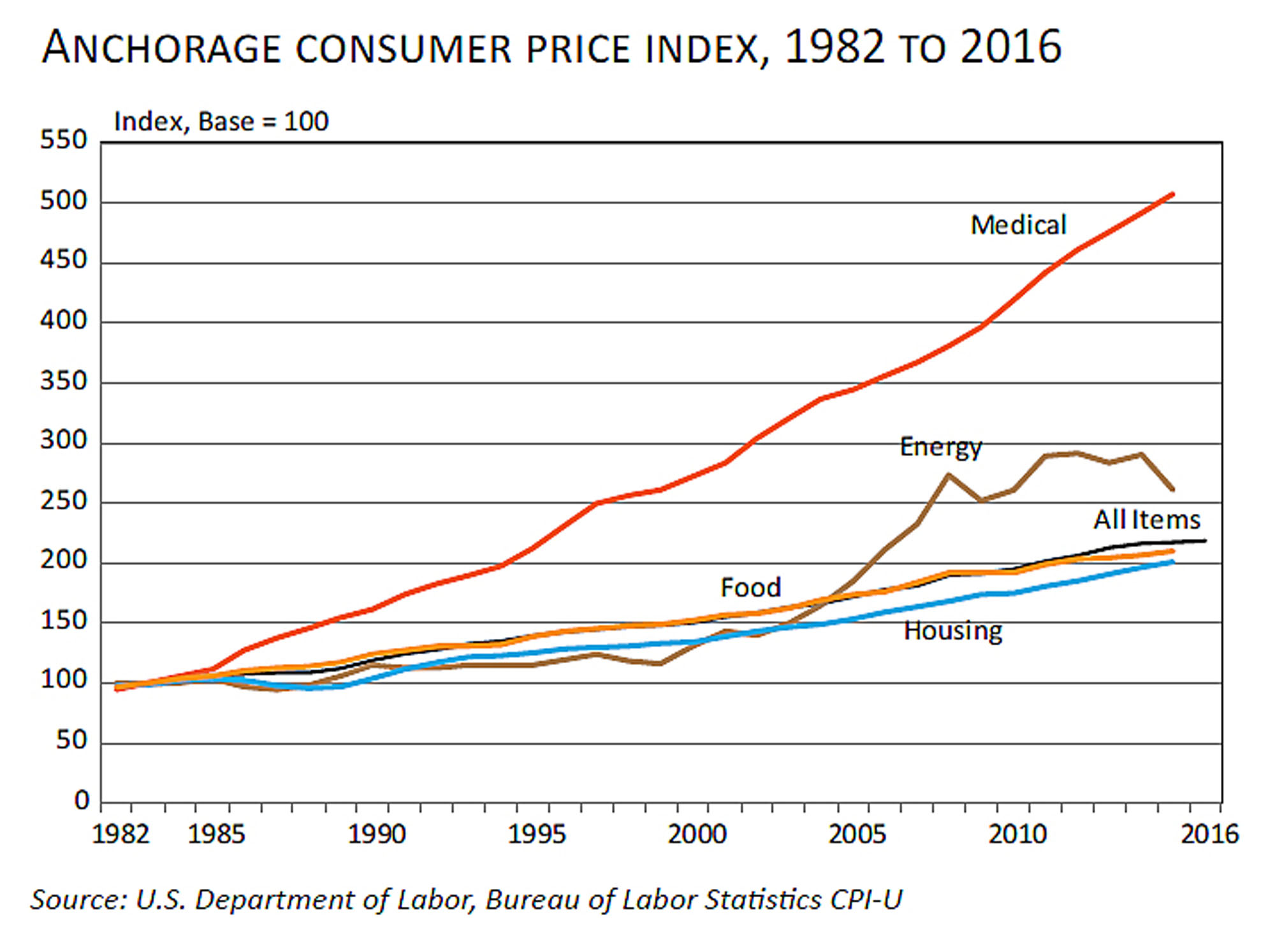
Overall inflation across the country is the lowest it’s been in almost 20 years. According to the US Department of Labor, Bureau of Labor Statistics, Anchorage— one of 27 cities nationwide and the only one in the state that Bureau includes in national averages, the 2016 inflation rate came in at less than a half (0.4) percent. According to BLS numbers, Anchorage’s rate is far below its decade average of 2.1 percent and the nation’s 1.3 percent average.
Despite what many think, the overall cost of living in Alaska is not the highest in the country, according to the Alaska Department of Labor and Workforce Development statistics. Hawaii earns that title, but few would think it more expensive to live in California than The Last Frontier.
Based on national data with a base rate index of 100 for the United States, Hawaii tops the list at 187.7 followed by California at 136.3, and Alaska at 131.5—based on consumer price indexes (CPI). Looking at it another way, what costs a dollar on average across the country costs about a $1.32 here. With the exception of Oregon at No. 8, East Coast states round out the top 10. The BLS cites continuing falling energy prices as the main reason for the rising price slow-down.
The BLS measured the costs of energy, food and beverage, clothing, transportation, housing, medical, and recreation costs to arrive at the above numbers.
Alaska, by far, holds the title for the most expensive health care costs with an average monthly premium coming in at $1,041, according to the US Department of Health and Human Services. That figure is more than 30 percent higher than West Virginia which came in second at $702 per month. At $575, Alabama comes in at number 10. According to available data, the state’s medical costs have gone up an average of 4.1 percent per year for the past decade.
According to the BLS, statistics shows energy costs dropped on average across Alaska by almost 12 percent in 2015 and 2016. The biggest cut was 2015 with an average fall of 10.3 percent. In 2016, the last year data is available, costs dropped another 5.8 percent. That compares to the period of 2006-2008 where prices rose a total of more than 41 percent compared with 2005. Data for 2017 isn’t yet available but BLS officials expect to see the price decline continue.
Using Anchorage as its sample, the BLS said 43.9 percent of a resident’s income went to housing. Of the remainder, 15.5 percent of income was earmarked for transportation and another 14.3 percent for food and beverage. Medical care, education and communication, and recreation costs came in at 7.2, 6.5 and 6.1 percent respectively, and made up all but three percent of the remaining spending.
Living in Alaska’s biggest communities — Anchorage, Juneau, Fairbanks and Kodiak for example, remains more costly than the national average but, according to national data, has been steadily dropping. US Department of Labor officials said overall state CPI rates remained fairly constant when compared with Outside, but have fallen from a high of 174.7 in the mid 1960s.
Federal data shows that the above communities are not the most expensive nationwide. Based on first-quarter 2017 CPI statistics, the cities of Washington D.C and surrounding suburbs; some of California’s major metropolitan areas; Stamford, Connecticut; Honolulu; Boston; and much of New York City were costlier. Going back to the US average of 100, Manhattan’s CPI of 230.8 topped the list. McAllen, Texas sat at the low end at 76.6.
Peering within the state, the overall cost of living in Anchorage is lower in almost every measured category than elsewhere in Alaska—with the exception of home prices. According to the Alaska Department of Labor and Workforce Development, the 2016 average price of a single-family home in Anchorage was pegged at $383,830 edging out Juneau at $373,046.
The Mat-Su Borough ranked fifth out of eight measured locations at $283,204. The state average price measured in at $323,909. In the largest state markets, Bethel’s housing costs were the reported lowest averaging $239,333.
Not in the market to buy a home and prefer renting? Kodiak’s 2016 average for a two-bedroom apartment came in at $1,429 a month. That was followed by Juneau at $1,381, Anchorage at $1,337, Valdez-Cordova at $1,294, and Fairbanks at $1,191.The same apartment in the Mat-Su costs $999 as was the second-lowest in the state just ahead of Wrangell Borough-Petersburg Census area which came in at $828 a month.
Alaska’s housing market may be among the most expensive in the country; however there are other areas that surpass it. Based on Council for Community and Economic Research (CCER) information using a base of 100 as a national average, the state averages about 140 with the Fairbanks’ 121.7 being the lowest and Juneau 145.4 coming in on top.
Nationally, New York City’s Manhattan borough far outpaced that coming in at 479.9. Other areas of the country outpacing Alaska’s housing costs include: Fort Lauderdale, Los Angeles, San Francisco, Honolulu and Portland, Oregon.
As expected, although fuel costs continue to decline, a January of 2017 survey by the Alaska Department of Commerce, Community and Economic Development (ADCCED) reveals a wide costs range for both fuel oil and gasoline across Alaska.
Surprisingly, the town of Circle came in with the lowest fuel oil prices at $2.46 a gallon, while those in Arctic Village shelled out $12 for every 128 ounces of product. Juneau tallied the lowest gasoline prices at $2.21 a gallon while residents of Arctic Village paid $10.
Food prices are another costly commodity for those choosing to live away from the state’s major population centers, according to ADCCED March 2017 figures. A dozen eggs costs right around $2 in Anchorage, Juneau, Fairbanks and Kenai. A gallon of milk runs from a low of $3.69 in Anchorage to $10.29 in Barrow. A loaf of bread ranged from $2.39 in Juneau and Valdez to just under $5 in Barrow.
Contact reporter Chris Ford at 352-2270 or chris.ford@frontiersman.com

By Jeremiah Bartz Frontiersman.com A football coach using a hockey reference as the centerpiece for his keynote address may

Frontiersman.com With its headquarters in Wasilla, the Frontiersman has been a primary source of news for the Matanuska-Susitna

By Katie Stavick Frontiersman.com The next generation of leaders took flight this week as the Houston High School Class

By Kyle Wilkinson For the Frontiersman Keynote speaker and Carry the Cure President Bill Pagaran’s words boomed through the