Retiring teacher, coach urges Colony grads to ‘find their 68’
By Jeremiah Bartz Frontiersman.com A football coach using a hockey reference as the centerpiece for his keynote address may


PALMER — It’s been said before and it’ll be said again — agriculture is a lot more than farming.
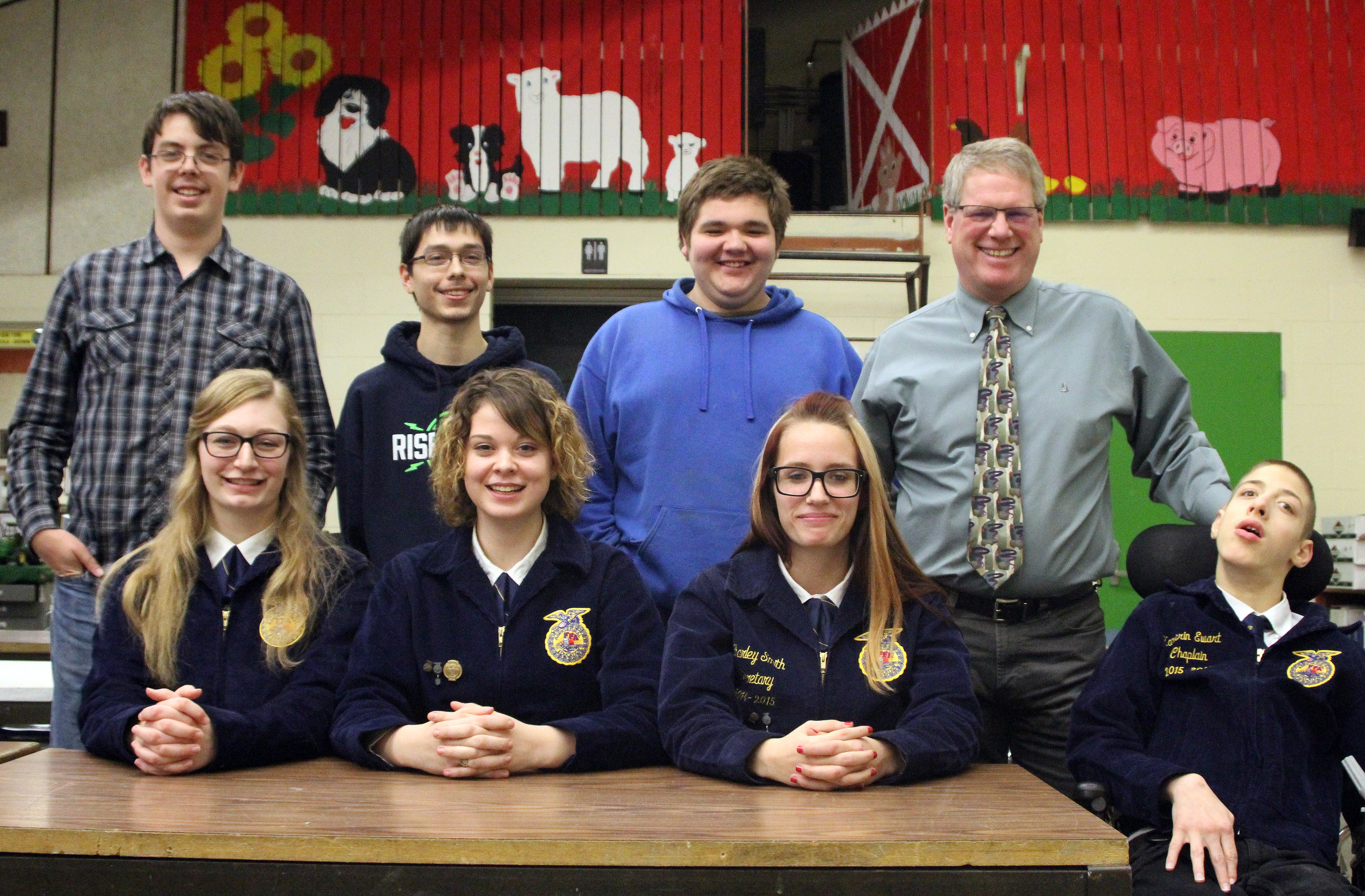
Students learn this at Palmer High School through an agriculture education program that supplements the basic high school curriculum. The program includes classes such as animal science, forestry, plant science, Geospatial Information Systems (GIS) and even customer service.
Teacher and Future Farmers of America (FFA) advisor Don Berberich has led the charge for the last 26 years at Palmer. He said the in-school and after-school programs have been in place off and on since about 1950, and consistently a part of the school since 1978.
“You can’t have one without the other,” he said.
In order for a student to participate in FFA, he or she must be currently enrolled in at least one “ag” class, but not all students in an ag class have to be a member of FFA. Of the roughly 140 students Berberich teaches, he said about 25 have chosen to become active members of FFA.
One of those is junior Hannah Hammonds, a recent transplant from Utah. Hammonds took a few days off from school in October to attend the national FFA convention in Lousiville, Kentucky with her Utah team, where she competed and won a silver medal for a Veterinary Sciences competition. (Most competitions include multiple written tests, tool or equipment identification, and some kind of presentation or practical application to demonstrate the students’ knowledge of a certain subject.)
Berberich called Hammonds “a breath of fresh air” who has “brought a ton of energy and knowledge” to the Palmer chapter.
Hammonds said she’s only been in FFA since February, but has quickly grown to love it and risen to officer status as the Palmer chapter’s reporter. She was initially drawn to FFA by a friend who invited her to some of the Utah chapter’s ice breaker-type of activities. When she heard her school had a veterinary science program, she signed up.
“Since I was little I’ve always had an attraction to animals,” Hammonds said.
But right now, Palmer doesn’t have such a program, in part because FFA is so small in Alaska. Treasurer Kyndle Kirby, also a junior, said Alaska has only seven or eight chapters total (Midnight Sun FFA, for home school students, has five sub-chapters), compared to more than 70 in Utah, for example.
“We started with farms, when the (Matanuska) Colony first started, but now … people don’t even really know what agriculture is,” Kirby said.
That’s why Hammonds, Kirby and the chapter vice president, Charley Smith (and the other officers, who were not at the year’s end meeting) are ramping up their recruitment efforts.
Smith said she’s tried to use her transfer from Palmer High to Mat-Su Career and Technical High School to the advantage of FFA. Although she’s on the engineering path there, the technical drafting class she’s taking this semester still applies to agriculture, she said, and therefore allows her to continue participation in FFA.
And as she wears her uniform around campus (required for FFA officers) during the school day there, the word about FFA inevitably gets out.
Meanwhile, the three girls and the rest of the Palmer chapter officers are communicating with the Mat-Su Borough school board to cultivate interest in a veterinary science program at Palmer High, and the planning is all on them.
“We have to actually write out a curriculum, write out why we’re doing this, what exactly we want to do and what benefits it brings to the community and to the schools,” Hammonds said.
The Palmer chapter is also looking to start “mini programs” at the Palmer and Colony middle schools, Berberich said, to get younger students involved earlier.
“A lot of kids don’t join until they’re juniors or seniors, and then they go, ‘Man, I wish I would’ve done this earlier,’” he said.
The ultimate goal is that students gain as wide a variety of skills as possible — and a little more insight into what (and how) food gets on their plates.
“I know that most of these guys won’t farm,” Berberich said, gesturing to his advisees. “But I think it’s super important that everyone knows where their food came from.”
To learn more about FFA in the Mat-Su Valley, contact Berberich at don.berberich@matsuk12.us. For general information on FFA, visit ffa.org.
Contact reporter Caitlin Skvorc at 352-2266 or caitlin.skvorc@frontiersman.com.

By Jeremiah Bartz Frontiersman.com A football coach using a hockey reference as the centerpiece for his keynote address may

By Katie Stavick Frontiersman.com The next generation of leaders took flight this week as the Houston High School Class

By Kyle Wilkinson For the Frontiersman Keynote speaker and Carry the Cure President Bill Pagaran’s words boomed through the

By Jeremiah Bartz Frontiersman.com The community of Palmer is known for a couple of things. At or near the