Retiring teacher, coach urges Colony grads to ‘find their 68’
By Jeremiah Bartz Frontiersman.com A football coach using a hockey reference as the centerpiece for his keynote address may


WASILLA — At 16, Wasilla High School junior Jasmine Otis has been shooting guns more than half her life. Her passion for target and skeet shooting is obvious as she talks easily about her love of the sport, and a desire to eventually represent the United States in Olympic Competition.
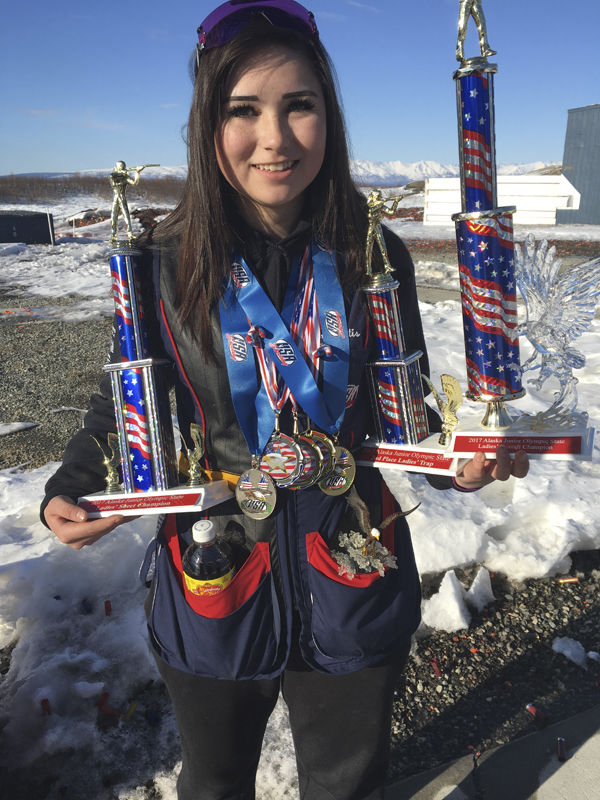
This year, Otis did something in the sport that no one else has done in the state — sweep the Alaska State Junior Olympic Ladies overall championship trophy in all divisions and disciplines two years in a row. The Alaska native started shooting skeet at the Elmendorf Base Range at the age of 8 and has developed quite the knack for the sport.
For the past several years, Otis has competed in both Olympic style — or bunker trap and International skeet competitions. She began American Trap shooting in November of 2014, Olympic Bunker trap in May of 2015 and international skeet in January 2016.
Bunker trap, also known as International trap, incorporates five shooting stations. However, while an American trap house holds one oscillating trap machine, a bunker trap house contains 15 fixed traps. In other words, bunker trap machines do not oscillate. In international skeet competition, the targets are launched with a three-second delay while the shooter holds their firearm low.
At all five bunker trap shooting stations, a target is launched from a covered bunker from any of the three traps directly in front of a shooter. In addition, bunker trap targets fly at wider angles than American trap, up to 45 degrees, and may also be thrown higher or lower. Target speeds run from 75-90 miles per hour, depending on the trajectory angle of the skeet. Each shooter gets the same targets during a round of 25, but does not know for sure in what sequence the targets will be thrown. The main difference between the two shotgun games, however, is target speed. In bunker trap, a shooter is allowed a second shot at the same target if they miss with the first.
The 2017 Alaska State Shotgun Junior Olympic qualifier was held last weekend at the state’s only bunker trap facility at Birchwood Recreation and Shooting park in Chugiak. The bunker was recently added through the work of volunteers associated with the non-profit, family oriented shooting facility. The event was officially sanctioned by USA shooting, the national governing body for US Olympic shooting sports.
Over the two days, Otis took three gold and two silver medals. Otis also claimed the Alaska State Junior Olympic Ladies overall champion trophy in all divisions and all disciplines. She also claimed the state Junior Olympics ladies skeet championship-all divisions, took second place all divisions in state Junior Olympics ladies trap and finished with the high overall ladies champion all divisions doubles trap.
In late January, Otis traveled to Redlands, Calif. to compete in the Maple Leaf Bunker Trap Championship. She garnered honors in Class D Champion Women Olympic Bunker Trap and Overall Division Olympian Women Olympic Bunker Trap competition.
The previous year, Otis competed in both Chugiak and the USA International Shooting park in Fort Carson, Colo. The complex is part of the Olympic Training facility. In July, Otis competed in the USAS Shotgun National Championships and the USA Shotgun Junior Olympic Championships the month prior. Against fellow Alaskans, she won five gold medals and the 2016 Alaska State Junior Ladies Overall Champion Trophy in all divisions and all disciplines. Otis also placed in numerous events in Colorado.
Otis explained that each year, Alaska holds state qualifiers at Birchwood. Those minimum qualification score requirements earn the right to advance to Junior Olympic competition. Junior Olympians range in age from 10 to 20 years old. The field gets much stiffer at Nationals where the only age requirement is that the participant be at least 10 years old.
Otis said she has goals to first make the junior national team. To do that, she must prove her herself at the national junior Olympic level and stick with the sport. National team members must be at least 20 years old. If she obtains that goal, Otis said many more doors open and she would be able to take aim at World Cup competition.
“I would get to travel around the world one or two times a year,” said Otis adding she doesn’t plan on stopping there. The next stop would be the national team and then a chance to go for the real gold, the Olympic Games themselves.
To make that happen she’s on the range 4 to 5 days a week. Toss in the life of a high school student with a job and it makes for a busy lifestyle. During off-competition periods, the pace slows to one or two days every other week. When she’s not taking on those tasks, Otis said she enjoys hiking, fishing, camping and backpacking.
When asked what it is that she finds so desirable about shooting, Otis said the sport’s intensity plays a large role. She also has a special role model for aspiration.
“It’s an independent sport. I could win or lose a competition by one shot,” she said, referring to the sport as “golf with a boom stick (shotgun). It’s almost all mental.”
Otis said she aspires to follow the footsteps of Eagle River’s Corey Cogdell-Unrein, who as a member of the 2016, 2012, and 2008 Olympic teams. Cogdell-Unrein took home a bronze medal in the 2016 Rio de Janeiro games, and another bronze at the Beijing games in 2008. Otis said the Birchwood complex has four pictures of Cogdell-Unrein adorning the complex.
“I saw her picture on the wall and when I found out she got to go to the Olympics, I wanted to be just like her. I met Corey. She is one of the sweetest, most pleasant people you could ever meet,” Otis said. “She let me train with her before she left for the (2016) Olympics.”

By Kyle Wilkinson Kyle in the outside Our spring bear hunt was bittersweet this year. We’re heading home without

Frontiersman.com Valley athletes earned titles during the Region III Championships track and field meet last week at Colony High

Leila Petersen Palmer Moose Leila Petersen, a member of the Palmer track and field team, has been named a Frontiersman

By Jeremiah Bartz J’s World August would have been the start of my 25th year as an editor at