Retiring teacher, coach urges Colony grads to ‘find their 68’
By Jeremiah Bartz Frontiersman.com A football coach using a hockey reference as the centerpiece for his keynote address may


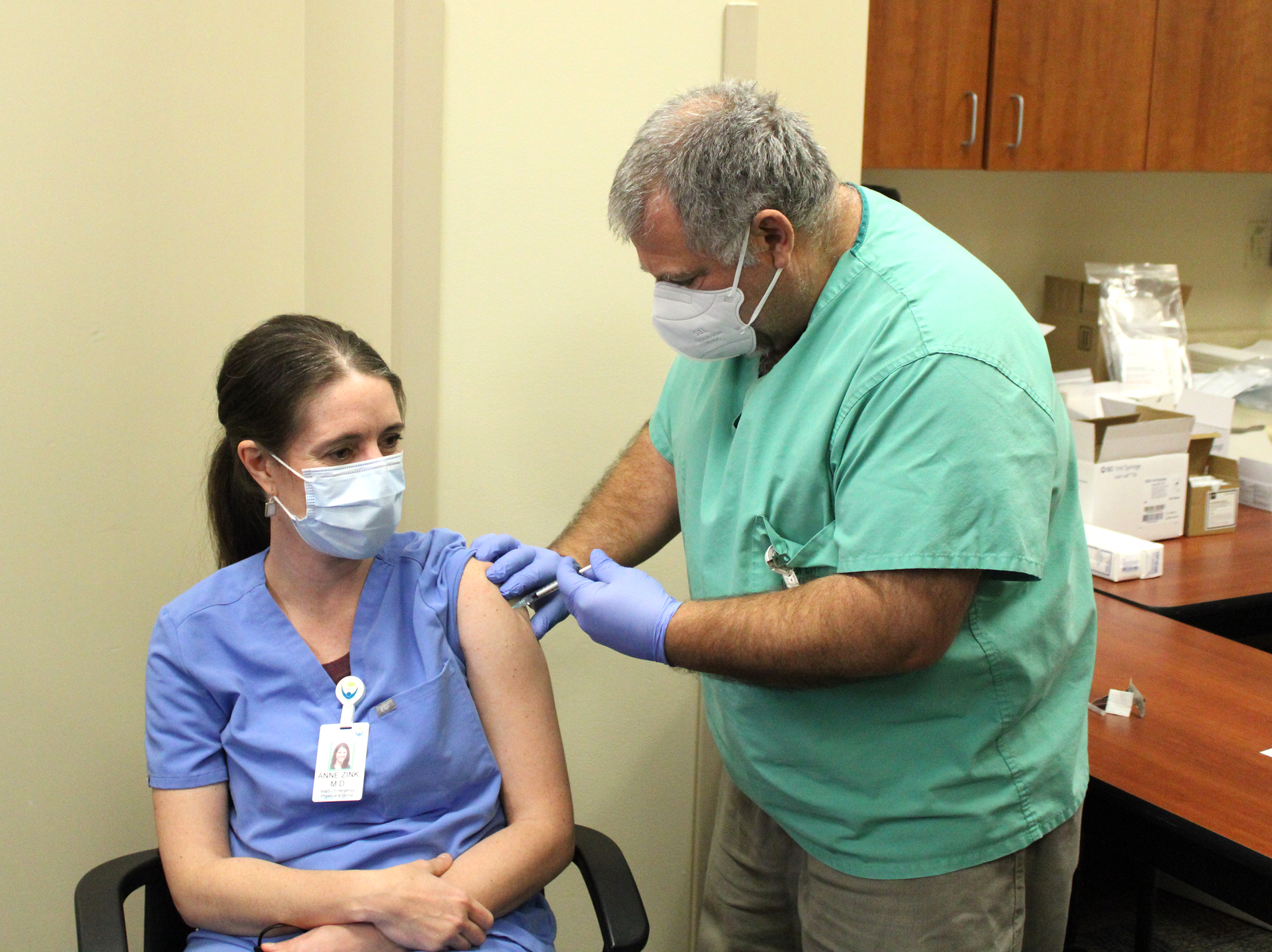
WASILLA — On her 43rd birthday, Alaska’s Chief Medical Officer Dr. Anne Zink was among those who received the Pfizer BioNTech vaccine for COVID-19 at Mat-Su Regional Medical Center on Friday.
Zink, who also works at MSRMC as an emergency medicine physician, stayed after receiving her shot to administer vaccines to two of her coworkers and friends.
“I feel full of mixed emotions. I think that I’m sad that we are losing a person a minute right now in the United States to COVID, that we’ve lost 183 people in the state and that we don’t have enough vaccine for everyone yet. I feel incredibly grateful to have the opportunity to watch science on the front hand and to see this vaccine come to date at this point. I’m incredibly grateful that we haven’t lost staff here and that my colleagues that I work with on a regular basis are okay and I’m just really grateful to the health care teams. I’m really grateful for public health who’s been working around the clock to try to slow this down and I think more than anything I just feel hopeful. I feel like this is the beginning of a new chapter in this state and in the country and in the world. I will get emotional talking about it because this is a big deal for the world to be able to be at this point with the vaccine. It’s one tool in a series of tools that we have. We still have masks, we still have distancing, those are all going to still be important and unfortunately we’re still going to lose more people before this is over,” said Zink.
MSRMC has received 67 vials of the vaccine containing 402 doses. Dr. Michael Alter originally hired Zink to work in the emergency department and administered the vaccine to Zink on Friday. During her 15-minute observation period after the shot, Zink fielded questions from reporters. After answering questions, Zink danced as she was handed a sticker commemorating her vaccination date.
“It feels like another major layer of protection. When I walk into this department I have a mask on, when I go to intubate, but that’s like my only barrier between me and the disease, but now when I walk into the emergency department once my immunity is built up to this vaccine I’ll be able to have a second major layer of protection and to have that extra backup is really important and i think is going to be a huge changing point. The staff, I remember when this all first started we were buying ponchos and crazy masks and the rest of it trying to figure out how we were going to do it. We looked at each other and didn’t know who was going to live and who was going to die and it was scary. It was really really scary and it’s been really hard as health care workers to you know I remember a really young patient who looked at me and said everyone else I knew was totally fine and I‘m not fine and he was struggling to breathe and so, so sick and to be in those rooms and looking someone in the eye and seeing what this disease can do to people, it’s overwhelming and it’s been a long haul for health care workers and so to be at this point right now to have an opportunity to have another layer of protection and to be able to share that with others who are at risk as quickly as possible is a big deal,” said Zink. “There’s a lot of people that get sick. There’s a lot that we don’t understand about the virus still and we see that on the front line every single day and I wish more people could see it. I wish more people could see, again when I saw that patient and he was young and he said everyone else was fine, why am I not okay and he was struggling so hard to breathe and we could not get his oxygen up, I was like how could I have communicated this message better. How can I let Alaskans know what this really looks like because you don’t want covid. You don’t want to take that chance and we have a chance to help protect our community and to stay safe and to stay strong and this vaccine is a huge step in that direction.”
To date, five health care workers in the state who have received the vaccine have had adverse reactions. Each health care employee has fully recovered and been treated for anaphylaxis. Zink said that she was on a long call with the Centers for Disease Control discussing the cases earlier on Friday.
“All of those patients have done very very well, got treated and improved quickly. I think it’s important to put it in like a larger context particularly with what’s happening with covid. Were trying to understand exactly what happened,” said Zink. “We see allergic reactions to all sorts of things. Every time someone gets a UTI or pneumonia and needs antibiotics there’s a risk of an allergic reaction. Any time they get any sort of injection and this is bread and butter emergency medicine in treating it and responding. It’s been fascinating science to try to understand what about this vaccine is causing it so that we understand it better, but it’s treatable particularly if you’ve got the medications right there. We’re making sure that those who are giving vaccines have medications right there for everyone who has had any sort of reaction has gotten treated right away and has done great.”
During the pandemic, Zink feels that her roles as Chief Medical Officer and emergency department clinician have both benefited from the other.
“The entire kind of structure and way that healthcare had to be delivered had to change as a result of it and it’s been neat to see the hospital, the clinicians and the community be able to really respond to that as well,” said Zink. “After being out of the ER for a short bit of time I missed it. It’s important to see what it looks like on the ground. It’s one thing to say these things, it’s one thing to think about it, it’s a totally other thing to hold the syringe and be like how is this going to be in the emergency department and see what it looks like and so I think my work as an emergency medicine physician makes me a better Chief Medical Officer and I think my work as a Chief Medical Officer makes me a better clinician and they’re both integral. I couldn’t’ imagine doing one without the other and so I wanted to make sure that I was doing both.”

By Jeremiah Bartz Frontiersman.com A football coach using a hockey reference as the centerpiece for his keynote address may

Frontiersman.com With its headquarters in Wasilla, the Frontiersman has been a primary source of news for the Matanuska-Susitna

By Katie Stavick Frontiersman.com The next generation of leaders took flight this week as the Houston High School Class

By Kyle Wilkinson For the Frontiersman Keynote speaker and Carry the Cure President Bill Pagaran’s words boomed through the