Retiring teacher, coach urges Colony grads to ‘find their 68’
By Jeremiah Bartz Frontiersman.com A football coach using a hockey reference as the centerpiece for his keynote address may


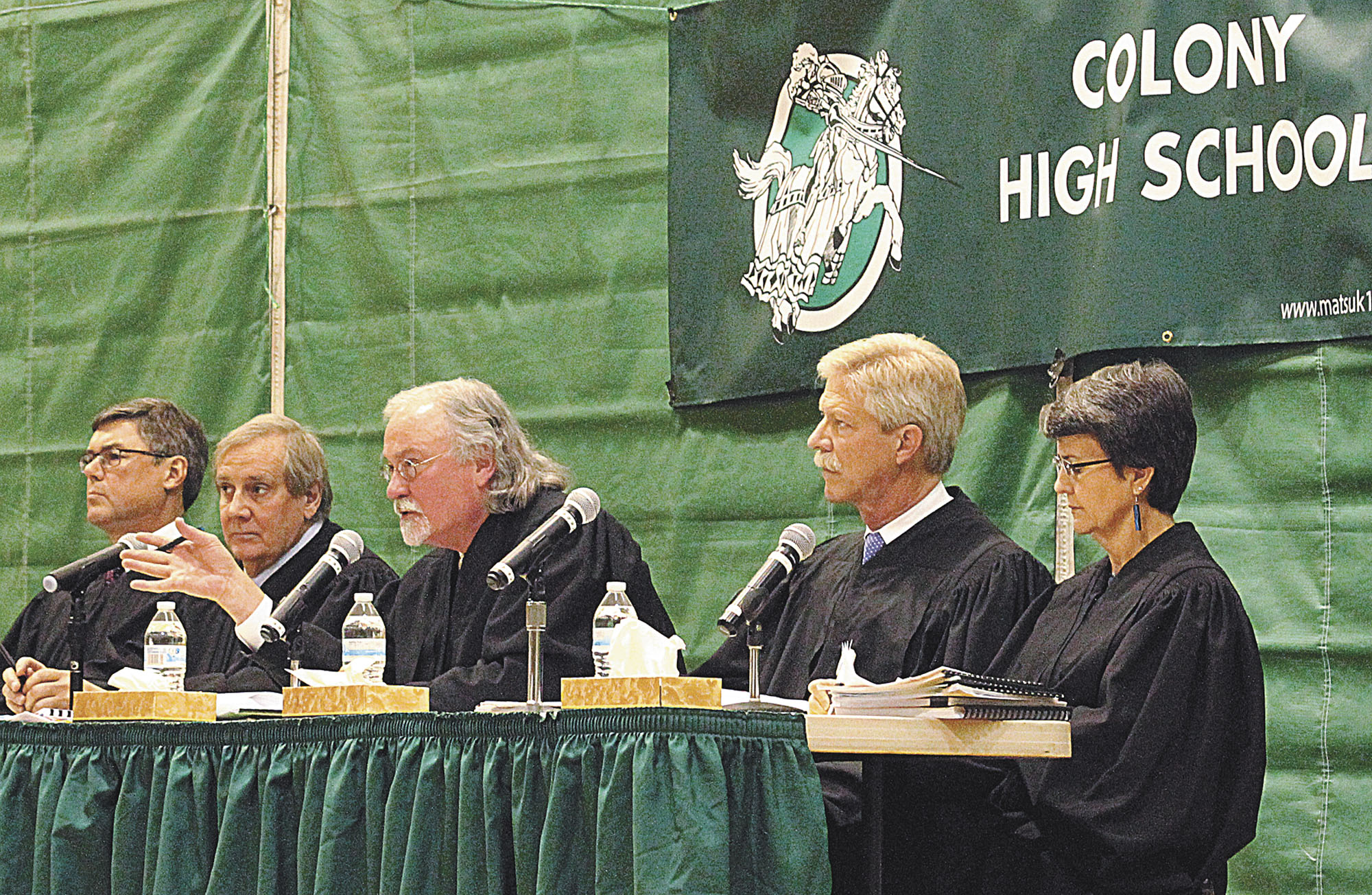
PALMER — High school students from across the Valley had an opportunity to see first-hand how the state’s Supreme Court operates Wednesday morning. Palmer’s Colony High School hosted the five justices, both parties and their legal counsel as it heard oral arguments of what could be a landmark case.
The event is part of Alaska’s Supreme Court LIVE outreach program where all aspects of the court are brought to into schools across the state. It was also the first time the program included a stop in the Mat-Su. The particular case, Robert Riddle, dba Fairbanks Pumping and Thawing vs. Eric Lanser, seemed well-suited to be heard in Palmer.
Although the case is North Pole-based, it pertains to a farmer, Riddle — who utilizes part of his 500 acres to store septic wastes from his business to use as a fertilizer — against Lanser. Lanser purchased 115 acres adjacent to Riddle, constructed nearby homes. Several years later, Riddle began accepting additional wastes from another company and that’s when the Lanser filed suit over the offensive smell generated from the slurry.
In 2011, Lanser asked Alaska’s Superior Court to have Riddle eliminate the odor as nearby neighbors found it offensive and complained. Riddle invoked the state’s 1986 Right-to-Farm Act, but it didn’t fly in court. In addition to ordering him to stop or at least minimize the smell, the Court awarded approximately $90,000 to Lanser. Legislators enacted the law to protect farmers against potential nuisance law suit.
Colony government and Alaska History teacher Karen Bloxsom, explained attorneys and members of the Alaska Bar Association, as well as the Mat-Su, volunteered their talents with “team presentations” to help the attending students get more familiar with the both the case as well as the court system. Bloxsom explained those volunteers spent.
Bloxsom referred to the two large binders chocked full of legal paperwork each participating class received. Included was a summary to the case to be argued and other information. Copies of actual court briefs and additional documents were available to the classes online.
“It was a great opportunity for the students to see how the judicial system really works,” Bloxsom said. “We’re not sure why they chose Colony, but we were honored. I think part of it is because of our location, which is very agricultural based.”
Bloxsom said participating students didn’t do it just to get out of class. Those attending had to make up a half-day of class time. In addition to the approximately 300 students in the bleachers, the event was live-streamed to several schools across the state. Students from Colony’s advance media program set up two anchored cameras and one remote camera in the school’s gymnasium where the Court addressed the case.
The students were granted unprecedented access to the process, more so than would be allowed in the regular court room in Juneau. The feed was also sent to KTOO-TV Alaska Public Media in Anchorage where it is expected to be utilized on the air at some point.
Colony student Sam Curlin was one of the media class participants. He said it took two days to set things up. The cameras, cords, sound equipment and related items all had to be ready to go early the morning of the hearing. He, and fellow media students Karl Croswhite and Devlyn Huska, said a bit of panic struck shortly before airtime.
“We had to have the network set up two days before. We came back and checked it the day before and everything was good,” Curlin said. “But IT (integrated technology) students came in that night. We came back in the next morning and (the network wasn’t available),” Curlin said.
Digital Communication teacher Brian Mead said it appeared just prior to the judges hearing the case, that the live feed hookup was not going to happen. Last-minute scrambles seemed to have not paid off. Mead said he walked into the office shortly after the program’s introduction and was happy to see the event made it to the internet before oral arguments began.
Two of Bloxsom’s Advanced Placement students, seniors Marcus Lorentz and Anthony Brouhard, said having the opportunity to see the judicial process in action live was special. Lorentz said the event has caused him to consider his options after high school. Lorentz said his interests lean more towards the sciences, but after the classroom pre-hearing work and actually seeing the event take place, it has piqued his interest in law.
Brouhard said he spent time in a farming community in Idaho prior to arriving in the Valley. He found the case interesting on several fronts. First was the farming issue and the fact that the Palmer area is probably the state’s premiere bread baskets. The second was his comments on septic waste.
“That is a problem. Currently (the septic waste storage capacity) in Anchorage is at 85 percent. Where are they going to put it?” asked Brouhard. “There’s talk they want to bring it to the Valley.”
Both students said it was an honor having their school chosen to host the event.
“It was cool that they chose to do it at our school and to make us more aware of how the court works.,” Lorentz said.
“It was cool that the administration and staff gave us the opportunity. It was a great idea,” Brouhard added.
Bloxsom said most students dressed for the courtroom with many wearing suits and dresses. Following the arguments, those wishing to ask questions were given two opportunities—one with the attorneys and one session with the justices.
The question that got the best response was asked of Chief Justice Craig Stowers. When asked how proceedings at the high school’s gymnasium differed from actual courtroom.
“We can’t shoot hoops in the courtroom,” he said.

By Jeremiah Bartz Frontiersman.com A football coach using a hockey reference as the centerpiece for his keynote address may

Frontiersman.com With its headquarters in Wasilla, the Frontiersman has been a primary source of news for the Matanuska-Susitna

By Katie Stavick Frontiersman.com The next generation of leaders took flight this week as the Houston High School Class

By Kyle Wilkinson For the Frontiersman Keynote speaker and Carry the Cure President Bill Pagaran’s words boomed through the