Retiring teacher, coach urges Colony grads to ‘find their 68’
By Jeremiah Bartz Frontiersman.com A football coach using a hockey reference as the centerpiece for his keynote address may


Alaska's Primary Election is now behind us. Now, we're all left sitting here in jubilant anticipation of those things we love: campaign signs! We need tons more of them, right?
Why did your eye just start twitching? Okay, switching topics.
Let's talk about a lawsuit! (Why is your other eye twitching now, too?)
A little money can go a long way in a small-population state like Alaska. That's good news to those of the deep pockets, because a lot of money can go even further. The 2014 elections suffused our mailboxes, doorknobs, cell phones, computer monitors, and television screens with malarial ambushes of last minute campaign literature, advertisements, and robocalls, which permeated our everyday life all Fall. It was yucky.
Yard signs don't vote, as the adage goes. And it's impossible to use yard signs with any semblance of the pinpoint accuracy offered by targeted Facebook, Google, and Twitter ads. The power of online messaging is undeniable: President Donald Trump, as the most notable example, had a digital campaign staff of over 100. The Digital Marketing Institute noted that through “the digital operations division was the Trump campaign’s largest source of funding.” Advertisement agency Zenith projects that “political social media ad buys will overtake newspapers by 2020.” The growing blind allegiance to cyber-utopianism is palpable, if overly-dismissive of its increasingly divisive, perfidious nature. This year's gubernatorial field genuflects to this reality: Incumbent Gov. Bill Walker (I-Alaska) has spent $22,691.53 (4.37 percent of his campaign's total income) on Google and Facebook ads. Former State Senator Mike Dunleavy (R-Wasilla) spent $13,611.74 (4.3 percent) on Google, Facebook, and Twitter ads. And former U.S. Senator Mark Begich (D-Alaska), who didn't start campaigning until June, shelled out $16,288.14 (9.32 percent) to Well & LightHouse – a digital marketing firm based out of Washington, D.C. – to overcharge him for an online footprint.
But in a state as small as Alaska, population-wise, yard signs really do matter. They are a significant and very literal component of a campaign's ground game. That's why Walker spent $29,147.22 on them ($6,455.69 more than social media ads); $12,132.74 for Dunleav and $2,680.33 for Begich.
I know many think yard signs are antiquated relics, but I stand behind their usefulness and will fight you over it. "[T]he implication is that thousands of voters would have voted for someone else if not for the signs," Alex Coppock told Politico after an exhaustive Columbia University study in 2015. “We were surprised by these findings, because the conventional wisdom is that lawn signs don't do much — they're supposed to be a waste of money and time.”
But they're not. Yard signs are different than online click-bait ads: they are a self-chosen goal set by an individual (a neighbor, a friend, a family member, a stranger) as an expression of their values. And you share the block with those values; that expression of values; that physical action and presence.
Yard signs might not change many minds – save for those blessed souls who simply fill out the only name on the ballot they recognize. But they galvanize supporters, rally volunteers, and put butts in seats at phone banks. In that sense, yard signs absolutely vote.
That's why Eric Siebels is particularly pissed off at the Alaska Department of Transportation (DOT) right now, and why he joined the Alaska Civil Liberties Union (ACLU) and “Dunleavy for Alaska” – an independent expenditure group funded by Texas resident Francis Dunleavy (Mike's brother) and Bob Penney, a longtime Kenai-based real estate investor – over local, state, and federal laws restricting a four-by-eight foot “Dunleavy for Governor” sign he erected on his property. (The sign was provided by Dunleavy for Alaska at Siebels' request. The group has spent roughly $50,000 on signs.)
Four states – Alaska, Hawaii, Maine, and Vermont – ban billboards. Alaska's laws date back to territorial days. Federal law established by the 1965 Highway Beautification Act instituted a 660-foot setback for temporary signs from state roads and highways. The exact distance – 660 feet – was arbitrary. There has never been a study done proving signs within that perimeter to be hazardous to traffic, nor has one ever been conducted in Alaska. Some states have omitted that clause entirely in state law. But somebody offered that number at the time, and states eager for the federal funding offered as an incentive signed off. Those incentives were, and remain, crucial. Compliant states receive one-half of one percent of the federal highway construction costs on interstate highways.
When the 1965 bill came before Congress, Rep. Ralph Rivers (D-Alaska) was the lone member of Alaska's delegation to vote in favor. Senators Bob Bartlett and Ernest Gruening (D-Alaska) opposed it; the latter testifying that the state had been excluded from federal-aid highway programs “for 40 long years, from 1916 to 1956.” Bartlett and Gruening wanted more funding, given that most states had a couple hundred years' jump on Alaska in regards to infrastructure.
Current Alaska statute stipulates that “The people of the State of Alaska find that the presence of billboards visible from Alaska's highways endanger Alaska's uniqueness and its scenic beauty,” and establishes that “It is the intent of the people of the State of Alaska that Alaska shall forever remain free of billboards” (AS 19.25.075.). Siebels, the Dunleavy for Alaska independent expenditure group, and the ACLU say it's a violation of the First Amendment. They are seeking an injunction against enforcement of the law prohibiting his sign (which was not questioned when it stood in the same place, in 2014, with Gov. Walker's name on it).
“There is no right more fundamental to a democracy than the right of an individual to express their personal political views,” said ACLU of Alaska Executive Director Joshua A. Decker in a press release last Thursday. “If the government wants to seize that right by barring Alaskans from displaying political signs on their own property, they need a more compelling reason than ‘because somebody might see it.’”
And they have a point. Despite Anchorage's motivation, expressed in Title 21 – the city's land use code – to afford the “community an equal and fair way to advertise and promote its products and services,” let's not kid ourselves. There's nothing equitable about telling someone 660 feet away from a highway they cannot visibly support a candidate with a yard sign while telling his neighbor, 661 feet away, they can.
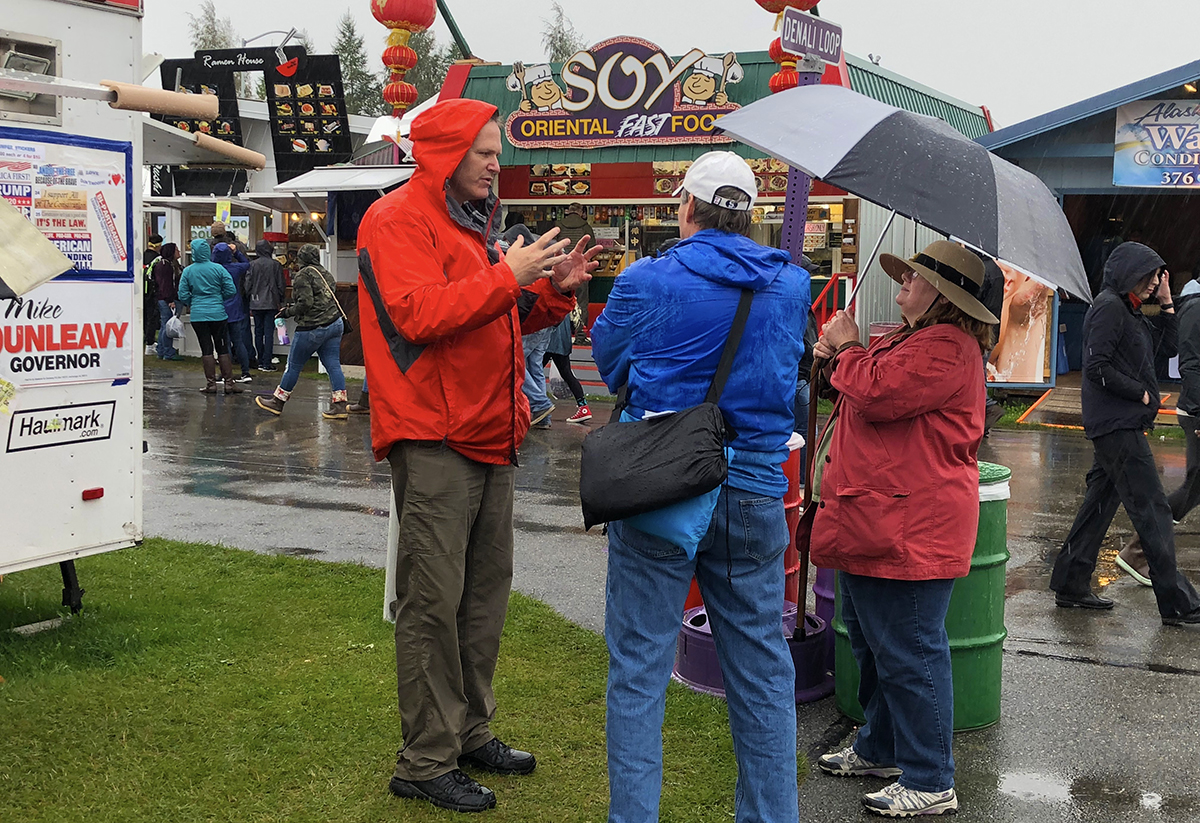
“If you're going to remove signs, remove all of them – not just political speech,” Dunleavy told me over the weekend. He noted that several political signs had been tagged as in violation of the law while a similarly sized sign, placed among the others and advertising vegetables, had not. “The issue with DOT is it shouldn't be there if it's blocking [traffic]. Well, it shouldn't matter if it's a political sign or a veggie sign.” Dunleavy concedes that some regulations need to be in place. He compared some signs in intersections to the hazards of brush collecting along the highway. “They try to keep the brush out. I don't think you should have situations where it's dangerous. But what's interesting is, what happens when you own a private piece of property or a building right on the road? Does that mean you can't put a sign on the building?”
The state will have a difficult time arguing the merits of the prohibition on signs like Siebels'. Pulling teeth to find a compelling state interest in the removal of temporary campaign signs (especially while omitting other nonpolitical, temporary counterparts) will be a lofty task. I have no doubt that if there were a ballot initiative tomorrow banning campaign signs outright, it'd pass easily, as did a 1998 measure rejecting legislative changes to the existing billboard ban. That vote went against billboards with over 72 percent of the vote. But, beyond the will of the people is the First Amendment. The courts have repeatedly sided to defend free speech, even when it comes via abundant signage accosting us on our way back and forth to work each day. It is a right, Dunleavy says. “If they're not removing the other signs, you would tend to think it's a free speech issue. It's a political speech issue.”
Don't expect to see any crackdowns. If anything, place your bets on the prospect of seeing even more signs in the near future.

By Jeremiah Bartz Frontiersman.com A football coach using a hockey reference as the centerpiece for his keynote address may

Frontiersman.com With its headquarters in Wasilla, the Frontiersman has been a primary source of news for the Matanuska-Susitna

By Katie Stavick Frontiersman.com The next generation of leaders took flight this week as the Houston High School Class

By Kyle Wilkinson For the Frontiersman Keynote speaker and Carry the Cure President Bill Pagaran’s words boomed through the