Retiring teacher, coach urges Colony grads to ‘find their 68’
By Jeremiah Bartz Frontiersman.com A football coach using a hockey reference as the centerpiece for his keynote address may


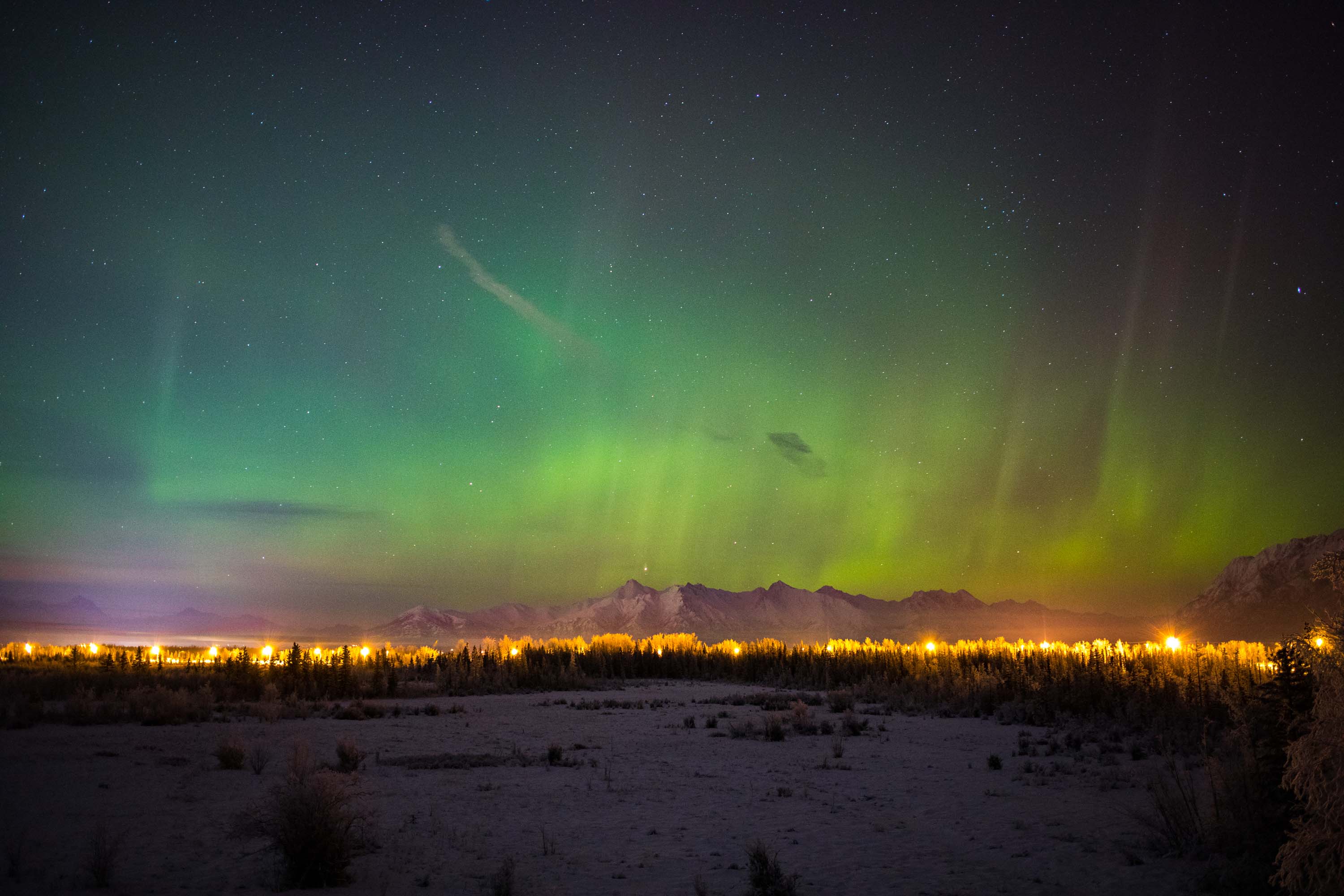
MAT-SU — When the Valley winds hit just right and clear the cloud cover, you may be able to see a spectacular display of light that is not caused by any human. Since technological advancements a half century ago, scientists are discovering more and more about the aurora borealis, or northern lights.
Katherine Rawlins, a particle astrophysicist who teaches physics and astronomy at the University of Alaska Anchorage, offers some explanation on why that happens. The sun constantly spits out particles that make their way towards earth’s atmosphere.
“There can be periods where it’s especially active or where it hiccups a big burp of particles all at once. When those particles get here, they’re charged so they feel forces from earth's magnetic field. Most of the charged particles get diverted away from the earth, but there are a few places where the orientation of the magnetic field is coming straight out or into earth and the charged particles spiral around that field,” Rawlins said. “Most get deflected, but near the poles some don’t… Take an atom of oxygen or a particle and bombard it with a charged particle from the sun, it glows.”
Mark Conde, who works as a physics professor and at the Geophysical institute in Fairbanks with a focus on space physics and aeronomy, says to imagine that the earth has a large bar magnet inside of it.
“How the particles get into the magnetic field is complicated. When they relax down to lower energy states they emit light,” Conde said. “They’re acting like an old television screen.”
Two types of elements are found in the upper levels of atmosphere 60 miles above the earth’s surface that cause the aurora. Oxygen found in altitudes where emissions are occurring are found in atomic form, not molecular form. Nitrogen, particularly the ion N2, is also present in the ionosphere, the level above 50 miles where many molecular ions are found. The most common color of aurora seen by Alaskans is a lime green color caused by atomic levels of oxygen.
“Depending on what they hit, they’re a different energy level and the transitions that occur translates to different colors. Depending on the exact transition they cause, you see different colors,” Conde said.
The most common colors that occur naturally when charged particles interact with the earth’s magnetic fields are green, a red color that occurs when aurora instances are particularly active, and purple. These extremely exuberant displays of aurora that occur sometimes in just minutes are referred to as the ‘Hollywood Aurora.’ A pink color that can sometimes be seen is caused by molecular nitrogen ions. A newly discovered type of aurora has been identified within the last few years by a group of Canadian photographers. Witnessing a particularly thin strip of red aurora that only occurs under certain circumstances, they, being Canadians, named it ‘Steve.’
“It’s a great case of where citizen scientists can actually make a difference,” Don Hampton of the Geophysical Institute said.
Hampton said that advances in technology have not only aided the scientists at the Geophysical Institute in Fairbanks, but also amateur photographers and aurora hunters. Camera equipment employed by the GI used to cost nearly $80,000, but can now be found for under $5,000.
“The amazing thing is an embarrassment of riches in really amazing cameras,” Hampton said.
Hampton said that satellites measuring solar wind observations help scientists to know how likely a display of aurora is within a day or two. This is in stark contrast to when Hampton began his work in Fairbanks in the 1980’s. When the internet was in it’s early stages, there was no up to the minute display of solar wind observations or ionosphere density. Scientists found themselves heading out to Poker Flat Research Range 30 miles north of Fairbanks to hope that they were lucky. The explosion of satellite network capabilities, assets in space, and an increase in ground measurement technology has allowed scientists to get real time information, just seconds after the measurement was taken. Now that the GI has a live stream of one of their cameras, viewers worldwide can see the aurora happening in Fairbanks even if they are not there. Hampton says that the GI will get dozens of messages within minutes if the live stream has been interrupted. Conde says that since the international geophysical year in the late 1950’s and 60’s, much more understanding of how the aurora works has happened, but scientists are still trying to figure out the why. This answer requires a lot of complex plasma physics, according to Conde.
“We’re chipping away at it. The ability to predict is another place where advances are being made. With new spacecraft, our observations are better,” Conde said.
Conde and Hampton are part of a dedicated group of scientists working to uncover the mysteries of the bright lights in the night sky.
“The Geophysical Institute is definitely a world leader,” Conde said.
Conde’s research is focused on the upper atmosphere and determining what effects the aurora has on United States assets in space.
“When the aurora is occurring, it’s an indicator of much larger phenomenon out farther into space, which is a considerable disturbance,” Conde said.
When northern lights flash across the night sky, it produces the equivalent of a storm in the atmosphere, changing the direction of the wind and temperature. Atmospheric weather patterns can change dramatically as a result of the aurora. Conde says that the effects of the aurora are of important technological interest to the United States and other countries with spacecraft traveling through the atmosphere that may have to avoid debris or other spacecraft with costly use of fuel.
“Three hundred kilometers and above is where spacecraft fly. It’s a tiny wisp of atmosphere, it’s not nothing, those spacecraft do experience some atmospheric drag and get pushed around,” Conde said. “Hundreds of times a week people that operate spacecraft have to be predicting where there spacecraft will be in a couple days time and whether they need to make evasive action.”
While the glowing charged particles may create weather change in upper levels of the atmosphere, there is no correlation between the weather patterns we experience on the ground level and those occurring hundreds of miles above the earth’s surface. Any instances of cold clear sky on the ground that make the aurora more visible are coincidental, and aurora can be occurring much higher in the atmosphere than cloud cover that hides it from human view. Valley residents may have noticed an uptick in aurora activity following the earthquake that hit Point MacKenzie on Nov. 30. Hampton says that while weather patterns and aurora visibility are purely coincidental, earthquakes may also have an effect on the upper levels of atmosphere.
“If you shake the atmosphere at the bottom, that actually shakes the atmosphere all the way up depending on the frequency,” Hampton said.
Following the earthquake that struck Fukushima, Japan in 2011, scientists observed modulations in the density of the ionosphere. Aurora displays can also cause difficulty in radio wave communications, according to Hampton.
“If you try to send radio through plasma, they get affected. If you talk to ham radio operators they like it sometimes, they don’t like it other times. It can skip off the ionosphere and it effects communications with satellites,” Hampton said.
Predicting the aurora comes in two different forms. The sun rotates once every 27 days, and Hampton says that the best way to predict if an event is going to occur is see what particles came out of the sun 27 days ago. The sun changes slowly, but over each 27 day period, there are active areas that equate to the same thing as a long term forecast. However, predictions that are not the same as forecasts can be gathered from the solar wind conditions that are an hour ahead of when the earth’s atmosphere will feel the effects at the ‘Lagrange’ point.
“When the sun is active, it’s tougher keep track of some of more dynamic parts of the sun, whereas on a daily basis we can look at solar wind and know what’s going to happen in the next two to three hours,” Hampton said. “We’re still trying to tease out when the aurora impacts the ionosphere, there are changes in conductivity, changes in how the winds blow, and at what scale that matters.”
While changes in the ionosphere and the emission of particles from the sun may seem like a foreign language to the average Alaskan, every sourdough has a seen the aurora a few hundred times. And seemingly every Alaskan has one instance of a particular aurora that was more spectacular than the others. Scientists are no different.
“Even professional scientists can be wowed by a specific display,” Conde said.
Conde grew up in Australia and has been fascinated by the lights for more than 30 years. Conde had seen small displays of the aurora australis, the southern hemisphere’s display, while in Australia. He made his first trip to Antarctica in 1984 and was assigned the task of monitoring the fuel line of a ship in the harbor for the midnight to 6 a.m., shift. Back in those days, sled dogs were still the main mode of transportation on the continent made entirely of ice and snow.
“I was standing on top of giant fuel farm at 4 a.m., looking up at truly spectacular aurora released over harbor,” Conde said. “We had the sled dogs all howling at it.”
On a trip in 1993 where Conde was headed to the airport to take a trip to install instruments in Scandinavia, he was stopped on Gold Hill Road. Conde said that as he was driving, he looked up to notice the lights across the sky, and when he looked down, a half-dozen cars on the road had come to a halt. All of the drivers had stopped to look at the aurora.
“That was still most spectacular one I’ve ever seen,” Conde said.
Two decades after Conde worked in Antarctica, Rawlins worked at the South Pole station.
“Because it was dark all the time, you could go outside pretty much twice a day and they would appear almost like clockwork. I was out there almost every day when it was clear,” Rawlins said. “Pictures seemed spectacular at the time in the day when the digital camera was in its infancy. Still the most brightest most vibrant aurora was in the middle of the afternoon after lunch at the South Pole station.”
Hampton’s favorite experience in seeing the aurora also helped to save his career.
“When I was in grad school at UAF, I was trying to do a special measurement. Nothing had happened, I was frustrated, and in 1989 a large solar storm occurred and a special kind of aurora, a deeper red aurora had a lot of particles coming down,” Hampton said.
Hampton called his parents on the Seward Peninsula and alerted them that the lights were out. That was also the night that saved Hampton’s masters degree thesis. Hampton said that there was some specific information about the aurora he could not release until they publish their findings.
Contact Frontiersman reporter Tim Rockey at tim.rockey@frontiersman.com.

By Jeremiah Bartz Frontiersman.com A football coach using a hockey reference as the centerpiece for his keynote address may

Frontiersman.com With its headquarters in Wasilla, the Frontiersman has been a primary source of news for the Matanuska-Susitna

By Katie Stavick Frontiersman.com The next generation of leaders took flight this week as the Houston High School Class

By Kyle Wilkinson For the Frontiersman Keynote speaker and Carry the Cure President Bill Pagaran’s words boomed through the