Retiring teacher, coach urges Colony grads to ‘find their 68’
By Jeremiah Bartz Frontiersman.com A football coach using a hockey reference as the centerpiece for his keynote address may


MAT-SU — Alaska Grown means something special in the Mat-Su Valley. Often, it means that the lettuces, potatoes, carrots or cabbages were nurtured from seeds on family farms that stretch back generations.
Mat-Su Farm Tour press secretary Don Berberich said showing people the farms where their food comes from is the point of Mat-Su Farm Bureau’s annual tour.
“People are so far removed from the farm they want to reconnect to where their food comes from,” he said.
About 100 people from Anchorage and the Valley bought tickets for this year’s sold out tour, Berberich said. He said the tour includes different farms each year, though some farms — like Little Pitchfork Ranch — have been featured multiple years.
“This is a wonderful place,” he said Aug. 1 during a lunch break at the farm on Lazy Mountain in the Chugach Range. “It’s very popular. No one cares if we come here every year.”
Other stops on this year’s tour included Rempel Family Farm, Pyrah’s Pioneer Peak Farm, VanderWeele Farms and Havemeister Dairy.
Tour participants loaded onto two tour buses and staggered their arrivals at the farms, and for an outdoor lunch of Alaska Grown products served in the sunshine at Pitchfork Ranch. After lunch, visitors also had time to peruse the hundreds of antiques — some with mysterious uses — collected by Jack Seemann and displayed in the ranch’s array of buildings.
Grandson Todd Pettit grew up in Anchorage, but said he spent every possible second at his grandfather’s ranch since he was just a boy.
“I’ve spent every summer out here since I was big enough to chase my grandpa around,” Pettit said.
He moved to the mountain full time in 1993. For much of Little Pitchfork’s existence, it sold hay and cattle. But in 1999, the ranch headed in a new direction with the acquisition of five bison. A few years after that, three elk were added to the exotic herd. Now the ranch sells hay and meat from its elk and bison herds.
Each hay field is ringed with 8-foot-high fence to keep the elk in, as required by state law. The fields are connected, but a series of gates can restrict bison and elk access to specific areas for grazing, Pettit said during the tour.
Pettit, and wife Roxann, are the third generation of his family to farm this land. It was his grandfather who started carving out the farmland from the forest, acre by acre.
On the bus Thursday was Pettit’s daughter Kyra, the fourth generation of her family to farm on Lazy Mountain. She was eager to share details of her family’s operation and introduce folks on the tour to an ornery elk named Mr. Kramer.
Her dad said the giant elk is big enough he has flipped a bison and killed it with his rack.
“He’s a great guy when he’s not in rut,” Pettit said. “The day he comes in rut, everything is a threat.”
In many ways, he said bison are more suited to living in Alaska than cattle are.
Cattle don’t know how to paw through snow, they need open water to drink and the herd is no match for Alaska’s big predators like wolves and bears, he said.
“Cattle don’t protect each other. These guys will protect anyone’s calf,” Pettit said. “With bison, if someone gets grabbed, you don’t just get the mom, you get the whole herd.”
The plains bison Pettit raises also do fine eating snow and their metabolism slows down to about a third of normal during the winter, he said.
“If there is green grass under that snow, the buffalo will get it,” he said.
In the field, Pettit uses a bucket of tasty grain to draw the animals nearer the tour bus.
At its peak, Pettit said his herd of plains bison reached 100 animals. But now it’s down to about 80 bison and 20 elk, he said.
The ranch’s abysmal hay crop for the past three years has everything to do with the reduced size of his bison and elk herds, Pettit said.
First came two years of steady rain that made it difficult for the hay to dry and be baled before molding. Then this year, out came the sun.
Cooperative Extension Service District Agriculture Agent Steve Brown said Pettit and the rest of the hay growers in the Valley saw a first hay cutting with yields of 25 percent to 50 percent below average.
“All of this beautiful weather has an ugly side that won’t rear its head until wintertime,” Brown said.
Some farmers have irrigation systems for their hay fields, but most Mat-Su hay farmers don’t.
“What that means is it could cost as much as $2,000 to feed a horse this winter if prices really spike,” Brown said. “That could cause a lot of horses to starve or even get abandoned.”
He suggested folks begin planning now for how they will feed their animals this winter. He said for some people, it might be an impetus to sell their horse.
Pettit said hay sales represent a sizeable chunk of the farm’s income.
“We sell a lot of hay,” he said. “That’s my cash crop.”
In addition to the hot, dry summer, Pettit said this year’s harvest was also hampered by hard frosts that persisted through the end of May. That left large areas of his fields with frost kill, but it was June 4 before he could get out into the fields to fertilize, he said.
Brown said the key this growing season seems to be irrigation. If people can irrigate, he said they are seeing a bumper season.
“To quote Ben Vanderweele, ‘I can make it rain, but I can’t make the sun shine,’” Brown said.
Contact Heather A. Resz at 352-2268 or
heather.resz@frontiersman.com.
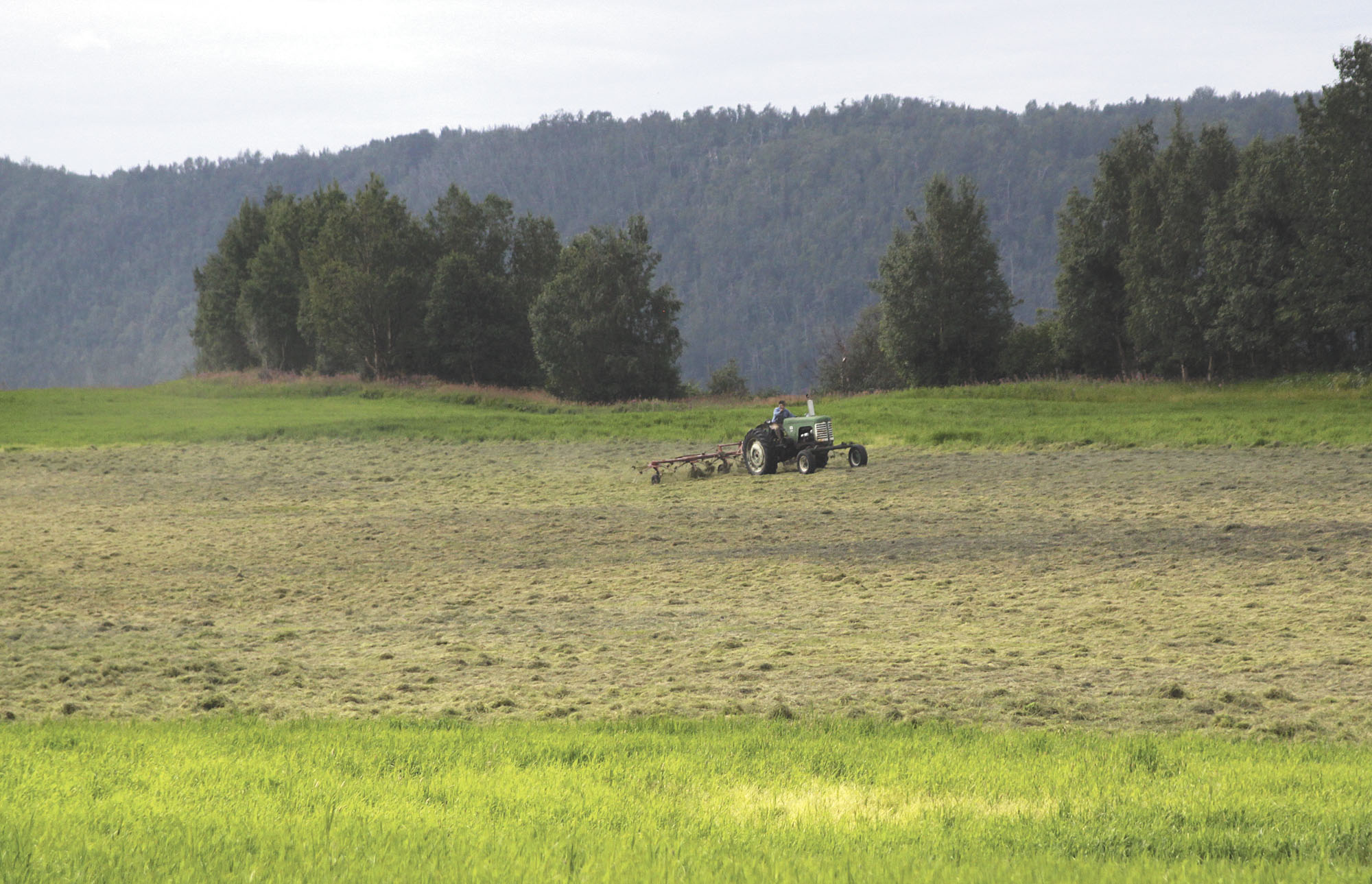
HEATHER A. RESZ/Frontiersman

By Jeremiah Bartz Frontiersman.com A football coach using a hockey reference as the centerpiece for his keynote address may

Frontiersman.com With its headquarters in Wasilla, the Frontiersman has been a primary source of news for the Matanuska-Susitna

By Katie Stavick Frontiersman.com The next generation of leaders took flight this week as the Houston High School Class

By Kyle Wilkinson For the Frontiersman Keynote speaker and Carry the Cure President Bill Pagaran’s words boomed through the