Retiring teacher, coach urges Colony grads to ‘find their 68’
By Jeremiah Bartz Frontiersman.com A football coach using a hockey reference as the centerpiece for his keynote address may


HATCHER PASS — “Can you help me? My two friends have been buried by an avalanche.”
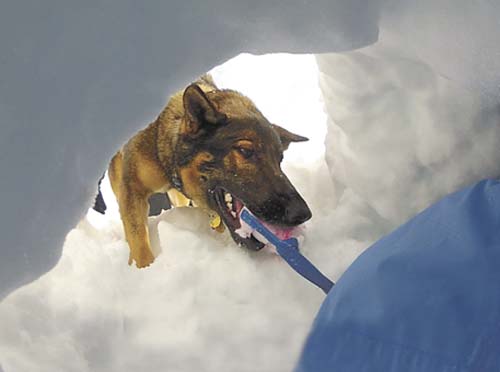
That was the cry that echoed off the mountains in the Hatcher Pass area just off Archangel Road Saturday afternoon as more than a dozen volunteers with MATSAR Search and Rescue K9 and Alaska Search and Rescue Dogs gathered for an avalanche training workshop.
The scenario: A slab of snow breaks loose and buries two skiers. Only one person witnesses the slide, so information on what exactly happened is shaky at best. The avalanche debris spans an area from 300 to 400 yards up the mountain.
Preparations for the training exercise started a couple weekends ago. Volunteers dug snow caves about 200 yards apart. One was located under some brush, one on the top of a small ridgeline and another near some small rocks. The caves varied from shallow to deep and just big enough for one person.
The area sits just off the road to Archangel Valley, where the slopes vary in steepness and are littered with small sluff avalanches. It can be dangerous out here, said workshop organizer and MATSAR K9 Training Committee chairperson Stacy Burkhart.
“All those organizations out there that give you snowpack reports and avalanche reports you got to check them all the time. Be real careful about it,” Burkhart said. “There are areas you do not want to be, but people still go out there. People push it.”
According to the Alaska Avalanche Information Center, the 2011-2012 season so far has had two avalanche-related fatalities. Both were in Haines during a backcountry helicopter skiing trip. More recently, a wind slab avalanche caught two skiers in the Turnagain Pass area. One was a full burial and the other a partial burial. Both survived. Each of the previous two seasons saw five fatalities.
For search and rescue personnel like Burkhart, an avalanche usually becomes a body recovery.
“Absolutely we are body recovery,” Burkhart said. “By the time we get transported out to where we need to be via snowmachine or helicopter, and unless there is some odd chance maybe someone is buried with a snowmachine and there is a huge air pocket, it mostly becomes body recovery.”
But like Saturday’s scenario, where a mock avalanche has occurred, there might be rescue personnel in the area. Burkhart said crews are always training two or three weekends a month all over the state. And while out training, they always notify the proper authorities. Burkhart said they also call rangers and let them know about trainings in case there is an emergency in the area.
But being prepared for that call is what it is all about, she said.
“Our searchers are going to have to approach the area like they would need to during a real avalanche,” Burkhart said. “They need to learn how to read their dogs. Figuring out when those alerts mean there is someone underneath the snow.”
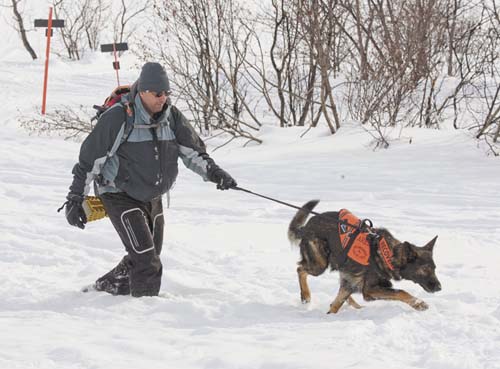
The avalanche exercise becomes another building block for the dog and handler to build on. For newcomer Vicky Parks and her 3-year-old German shepherd Bettles, the training exercise is a great opportunity to get out and build their skills.
“It also gives me something to do with my dog,” Parks said. “A definite purpose.”
Parks became interested in working with dogs when she lived in Missouri. A friend did urban search and rescue.
“I just didn’t have the time or the money,” Parks said.
She said when she moved to Alaska, she decided to get involved and went out and got a dog. She really had no idea about the search part of it.
“I did not know I had to get trained as well,” she said. “I bought the highest drive puppy I could find and I showed up and they said, ‘OK lady, you need to learn all this other stuff.’ As it turned out I really liked the search aspect of it as well.”
Burkhart said that when a person decides to become a search and rescue volunteer with a canine, you’re committing to a partnership that includes a series of steps and classes.
“It’s a team,” she said. “The handlers have to have good wilderness skills. When you’re out here you have the avalanche awareness training. You have to know how to use that beacon and that probe. Out in the wilderness, you have to know how to navigate. You have to be able to take care of yourself and your dog if something happens. You have to have first aid. You have to have all the search and rescue techniques and survival training.”
For people like Dan Govoni and his dog Dugg, it becomes another part of his lifelong rescue training. Govoni is somewhat new to MATSAR, but is a 15-plus-year veteran with Mat-Su Borough Emergency Services and is a captain with the West Lakes Fire Department.
“It’s another phase of my emergency services development,” Govoni said as he played with his 6-month old partner. “I’ve got rescue certification and fire certification. I teach for the borough and I do a bunch of other stuff. I have always wanted to work with dogs. I have always had dogs, and this has become just a natural extension of that.”
For Dugg, the training is new, but it is also about playtime. Govoni said they are going to run him on some simple tracking drills up the mountain.
“He’ll do a couple of them which is all he needs to do then we will stop. At this point it is keep him happy and play with him as much as possible because it’s all a big game,” he said.
The reward for the dogs is the fun they get out of the trainings, Burkhart said. To them, it is just another game of hide-and-seek. But for search and rescue volunteers, it’s still about learning.
“We’ll have people working with their beacons, probe and shovels just like they would out on the slope, treating it like the real scene,” she said. “The real deal here so they are ready to respond when the call outs come.”
You can learn more about MATSAR Search and Rescue k9 by visiting matsarK9.com. To learn more about MATSAR Search and Rescue, visit alaskasar.org. To learn more about Alaska Search and Rescue Dogs visit asard.org.
Contact Frontiersman photographer Robert DeBerry at Robert.deberry@frontiersman.com.

By Jeremiah Bartz Frontiersman.com A football coach using a hockey reference as the centerpiece for his keynote address may

Frontiersman.com With its headquarters in Wasilla, the Frontiersman has been a primary source of news for the Matanuska-Susitna

By Katie Stavick Frontiersman.com The next generation of leaders took flight this week as the Houston High School Class

By Kyle Wilkinson For the Frontiersman Keynote speaker and Carry the Cure President Bill Pagaran’s words boomed through the