Retiring teacher, coach urges Colony grads to ‘find their 68’
By Jeremiah Bartz Frontiersman.com A football coach using a hockey reference as the centerpiece for his keynote address may


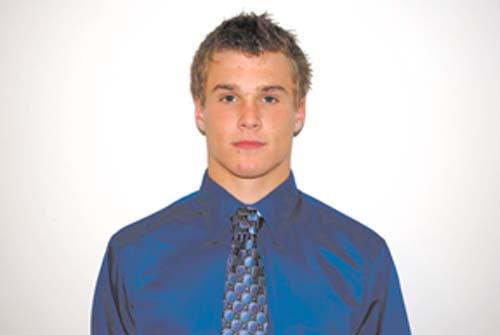
WASILLA — When Matthew Friese committed to play college hockey at UAA he was 16 years old.
The former Wasilla High School hockey standout, who on Thursday graduated as part of Wasilla High’s class of 2010, had just began his junior hockey career with the Alaska Avalanche. But after two seasons with the North American Hockey League’s Avs, Friese, now 18, has decided to pursue other options. The UAA recruit, who could have joined the Seawolves in either 2011 or 2012, officially decommitted earlier this week.
“It was a tough decision. UAA is (Division I). It’s a great school. But in my heart, it’s not exactly what I wanted to do,” Friese said Wednesday afternoon.
Friese weighed his options, and ultimately the chance to play hockey in the Lower 48 was too much of a draw. Friese said he wanted to make his decision sooner, rather than later.
“I’ve been playing hockey in Alaska for 15 years,” Friese said. “UAA is a great school and has a good team. I love Alaska and want to come back, but I’d really like to get out of Alaska to play hockey.”
Friese would like to start by playing for the Tri-City Storm of the United States Hockey League. Tri-City owns his rights after drafting Friese in 2008. He’d also like to find an opportunity with a major Division I program in the near future.
Alaska general manager Dave Boitz, who coached Friese for the last two seasons, praised Friese for being up front about his change of heart.
“He wanted to be honest about it,” Boitz said. “I’m really proud of him.”
By committing to UAA as a 16-year-old, Friese basically missed the recruiting process, Boitz said.
“We was a pretty young kid and made a decision he wasn’t ready to make,” Boitz said.
One of Friese’s teammates for the last two years, Jake Parenteau, committed to the University of Minnesota late in the season. At one point, Parenteau was caught in a bidding war between Minnesota and St. Cloud State, a pair of Division I programs from the Western Collegiate Hockey Association. Boitz said Friese saw that and may have thought he missed out on something.
Friese said he’s not sure whether watching Parenteau chose between top DI programs played a role in his own decision, but doesn’t deny he’d like to have the kind of opportunities that Parenteau had. Boitz said Friese certainly has the potential to catch the attention from college scouts that Parenteau received.
“I think he’s going to be a top-end guy and play at a high-end school,” Boitz said.
Friese’s path to DI hockey could include time with the Storm, a USHL program based in Kearney, Neb. He will attend a team camp on June and try to land on Tri-City’s final roster.
Boitz would obviously like to see Friese back in an Avalanche sweater for a third season, but understands the decision to take a stab at the USHL, which is still considered the country’s elite junior hockey league.
“We’ve given him our blessing, whatever he decides is best for his development,” Boitz said. “He’s played here two years and may have a great opportunity in the USHL. He’s got to do what’s right for him.”
Obviously he’d love to see Friese, who finished among team leaders with 43 points, return.
“He just turned that corner of being a bonafide player high-end player in this league,” Boitz said. “Next year, he has the possibility of becoming a super star in our league.”
Playing in the USHL is his preference, but Friese didn’t rule out the possibility of staying in Wasilla for another season.
“It wouldn’t be a bad deal,” Friese said.
Friese emerged as a top forward on the Avalanche roster during his second season with the team. After posting modest totals as first-year player, four goals and four assists, Friese exploded during the 2009-10 campaign.
Friese finished third on the team in scoring with 43 points.
His 19 goals ranked him second on the squad. His totals on the power play, 4-4-8, equaled that of his entire first season.
Friese said the improvement had a lot to do with simply getting the chance to play. He went from a fourth-liner who rotated in and out of the lineup, to a first-line caliber forward who saw action in 56 of the team’s 58 games. Friese also played more on special teams.
Contact Frontiersman sports editor Jeremiah Bartz at sports@frontiersman.com.

By Kyle Wilkinson Kyle in the outside Our spring bear hunt was bittersweet this year. We’re heading home without

Frontiersman.com Valley athletes earned titles during the Region III Championships track and field meet last week at Colony High

Leila Petersen Palmer Moose Leila Petersen, a member of the Palmer track and field team, has been named a Frontiersman

By Jeremiah Bartz J’s World August would have been the start of my 25th year as an editor at