Retiring teacher, coach urges Colony grads to ‘find their 68’
By Jeremiah Bartz Frontiersman.com A football coach using a hockey reference as the centerpiece for his keynote address may


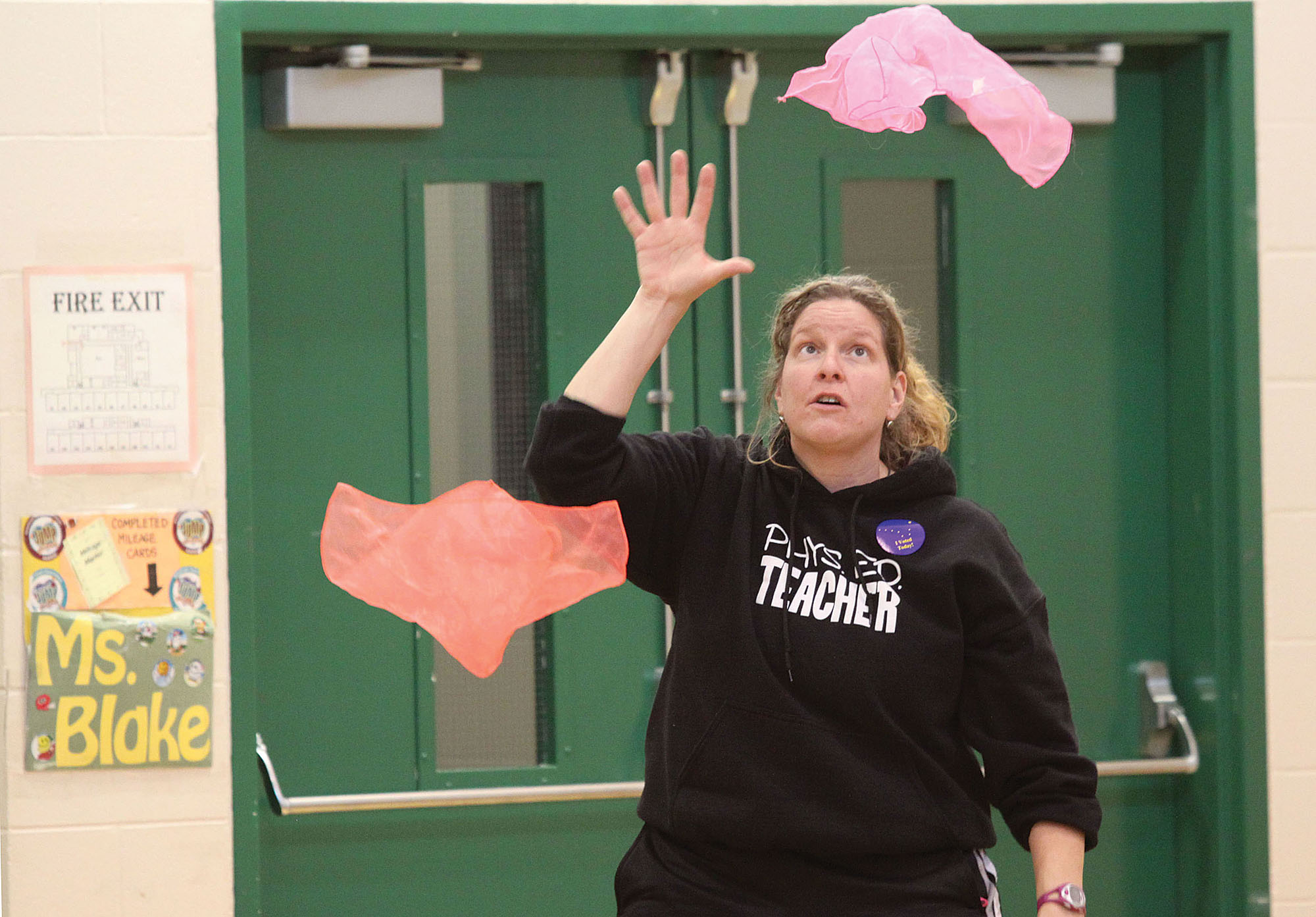
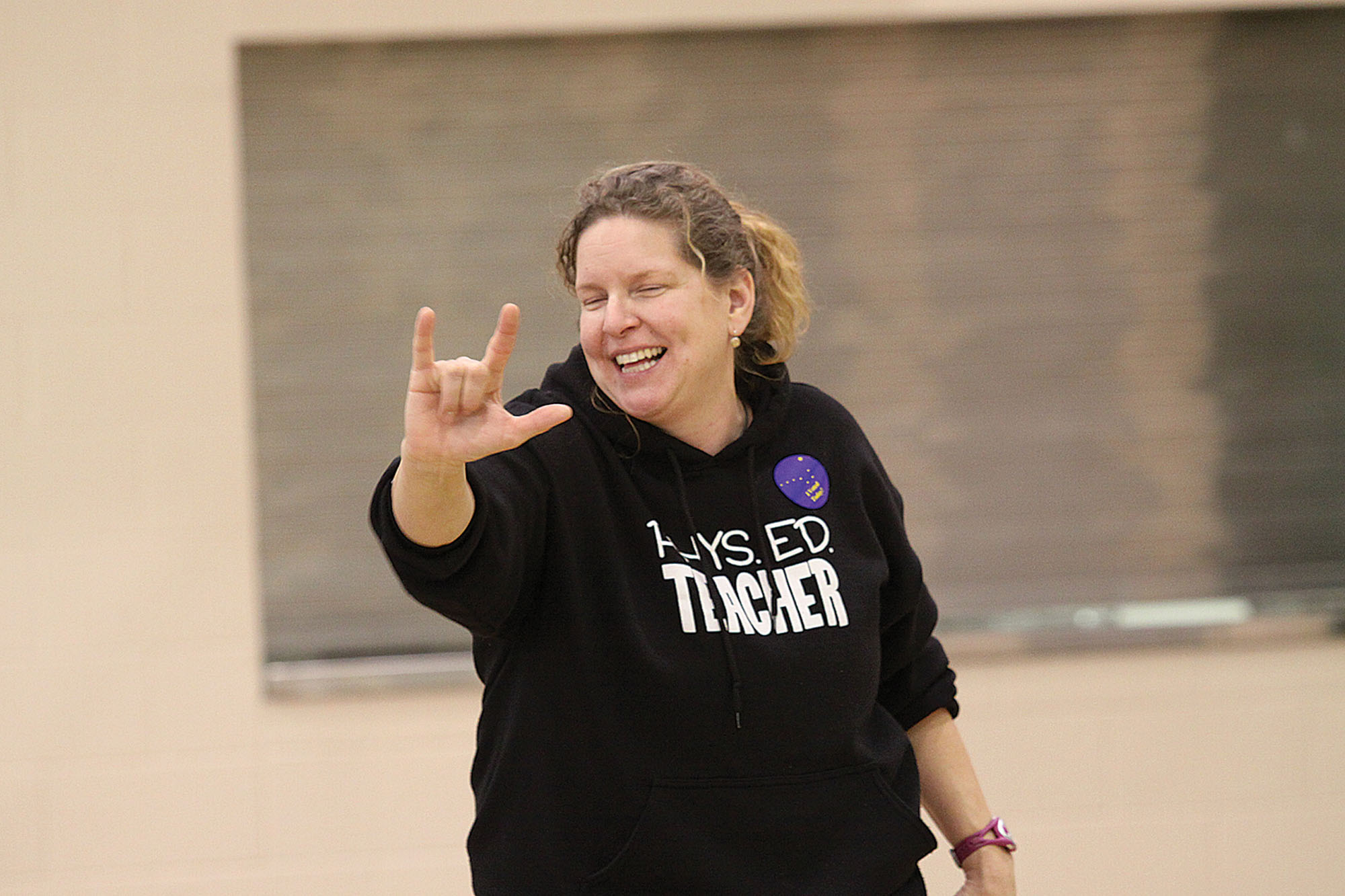
MAT-SU — What happens in gym class doesn’t stay in gym class, according to Goose Bay Elementary School physical education teacher Nancy Blake.
Last month, Blake received the Teacher of the Year award from the Alaska chapter of the Society of Health and Physical Educators, or SHAPE AK.
“I am able to witness first hand the extraordinary magic that Ms. Blake puts into her daily lessons and into each healthy activity for our school community,” said principal Rourka Spatz in a SHAPE press release. “During her 23 years in education, Ms. Blake has proven herself to be a phenomenal teacher and an instrumental leader in the field of Physical Education.”
Blake is one of the writers for the Chalk Talk column on the Frontiersman’s Schools page, which publishes Tuesday. Her most recent column she alerted readers to what she has identified as a serious under-appreciation of physical education.
“It’s so much more than learning to throw and learning to catch,” Blake said by phone, on her lunch hour, Friday. “It’s about developing confidence in your body.”
Blake wrote in her column not only of the benefits of physical education — Harvard neurobiologist Dr. John Ratey, she said, calls exercise “Miracle-Gro for the brain” — but the importance of exercising throughout the day and not substituting that one class period for extra academics, for example.
At Goose Bay, Blake started the Mileage Club and Early Morning Movers for students to get in some “extra” exercise — it all improves attention, behavior and learning in the classroom, she said — as needed. Blake also has invested time in Juggling Around the World, afterschool sports programs, and Alaska’s Healthy Futures Challenge to motivate students to keep activity logs.
But simply “rollin’ out the ball” isn’t enough, she said. Many people are very self-conscious engaging in team sports activities, from elementary school students to adults, and that should be taken into consideration when designing class activities.
When an uncoordinated child steps up to play kickball, for example, and they swing at the ball and miss, she said, there’s a lot at stake.
“That’s a moment that, how it’s handled will change the rest of their life,” she said.
Imagine, then, how a student with a physical impairment might feel, coming into that class.
Blake is something of a specialist in what is called adaptive P.E., having obtained a dual-emphasis master’s degree in Movement Studies for the Disabled and Exercise and Sport Science at Oregon State University. Her focus, she said, was wheelchair athletics, and her future job, she said, would be to teach P.E. students and teachers how to include children with disabilities in class activities. If possible, she could turn an activity aimed at a child with an individualized education program, or IEP, into a regular classroom activity for those with or with out a mobility impairment.
“It’s all about finding the least restrictive environment for kids with an IEP,” she said.
For three years she taught adaptive and middle school P.E. in Oregon, spending her summers in Alaska. During graduate school, a friend had encouraged her to work at Denali National Park — instead of working as a clown in a pizzeria and selling sewing machines on the weekends — and soon the trek up north with her dog and her truck became an annual tradition.
In 1995, she decided to make the move.
“The hardest phone call I ever had to make was to tell the people in Oregon I wasn’t coming back,” she said.
Despite not being tenured at her previous school, the principal there guaranteed her she could return to her position if she didn’t like the Alaskan winters, but she quickly settled into her new home. For five years she worked out of an office in Wasilla High School, traveling to schools within the district on a weekly basis to teach adaptive P.E.
Wheelchair basketball, she said, was a particular favorite. She taught kids how to pop a wheelie and use the chair to their advantage.
“In Oregon I had access to the best titanium sport chairs, where you could really use it as a piece of equipment,” Blake said.
Wheelchair athletics are not exactly new, and they demonstrate the viability of a more integrated P.E. class.
“It shows them how they fit in the bigger picture,” she said, of the less-mobile students. “They’re not the only kid out anymore, they’re the expert.”
For such activities to be effective, however, it helps for students to first know how to win and lose gracefully, and how to encourage their classmates to try again when they fail.
To teach this, Blake said she used a simple game of rock-paper-scissors on the second day of school at Goose Bay. There was a winner’s circle and a loser’s circle, and after the first round, the winners challenged the winners while the losers challenged the losers.
“I don’t shy away from the word lose,” she said, because at some point, “you’re going to lose.”
Students continued to compete with each other for the majority of the class, resulting in constant migration between circles as students won and lost their battles.
A question and answer period followed, during which Blake asked the students what they did when they lost. “I changed what I did” was the general response, and to that she said, “That’s called a strategy.”
So between strategy, sportsmanship, working together to achieve a goal and encouragement versus discouragement, concepts learned in P.E. can make a lifelong impact, especially for young students.
“They can have a humiliating moment or a great moment in P.E. but they’ll carry that with them forever,” Blake said.
The future of P.E., however, stands primarily with the teachers, she said.
“I think we need to pay attention to the emphasis and not just how much they’re sweating,” she said. “In my crazy idealistic way, I do believe that can change the world.”
Contact Caitlin Skvorc at 352-2266 or caitlin.skvorc@frontiersman.com.

By Jeremiah Bartz Frontiersman.com A football coach using a hockey reference as the centerpiece for his keynote address may

By Katie Stavick Frontiersman.com The next generation of leaders took flight this week as the Houston High School Class

By Kyle Wilkinson For the Frontiersman Keynote speaker and Carry the Cure President Bill Pagaran’s words boomed through the

By Jeremiah Bartz Frontiersman.com The community of Palmer is known for a couple of things. At or near the