Retiring teacher, coach urges Colony grads to ‘find their 68’
By Jeremiah Bartz Frontiersman.com A football coach using a hockey reference as the centerpiece for his keynote address may


WASILLA — Birders around the state are mourning the loss of an old feathered friend, according to local bird rehabilitator Randi Perlman.
At the end of February, Perlman said goodbye to Artemis the great horned owl, a bird she called “a beautiful, mysterious and engaging wild creature who taught me more about life than any human being ever could have.”
Though born and raised in Brooklyn, New York, Perlman was an active animal and nature lover from a young age, and city life often chafed her.
“I was always a country girl,” she said. “I was always looking for that little spot of dirt where I could find a worm or a bird or something that moved.”
However, living in an apartment that didn’t allow pets made it difficult to take her finds home, so she made do with a few fish and a couple of parakeets until she moved to Connecticut. That state seemed more like the country to Perlman, but as a young professional she was soon swept up in the corporate bustle of New England.
After 40 years on the east coast, she decided to take a vacation to Alaska. She spent six months in The Last Frontier — she had originally planned for six weeks — and returned home with the nagging sensation that she was leaving something behind.
“More probably happened to me in that six months than in my whole entire life before then,” Perlman said.
Eight years later, she came back to Alaska for good.
It was 1998 when Perlman started volunteering at the Anchorage Bird Treatment and Learning Center (Bird TLC) — the same year Artemis was found in a box with a broken wing by the Alaska Department of Fish and Game.
“Birds have hollow bones, so once they break, and they set, you can’t reset them like you can sometimes in a human,” Perlman said.
Artemis was declared un-releasable because of the injury — the wing hung awkwardly at her side and she could not fly — so the owl stayed at the center until a permanent home could be found.
Meanwhile, Perlman had been personally taking care of a colorful kestrel named Kenya, and had learned how to work with several types of wild birds in captivity.
“You wash a lot of dirty dishes and scrub a lot of dirty cages and handle a lot of weird, different foods,” she said. “It’s not really glamorous, but you get close to the birds and you learn … how to handle them and how to treat different ailments.”
After a couple of years, Kenya went to a different home, and Perlman became any empty-nester, of sorts — but not for long. Artemis still needed a home, and Perlman said she had always been drawn to raptors.
So she and her husband Steve had a decision to make: create a space for a hot tub or build a 10-by-8-by-8-foot mew (enclosure) for a great horned owl.
“(We) went with the owl and I’m not sorry,” Perlman said.
Thus began the cultivation of an unparalleled bond between bird and birder.
Over the next several months, Perlman worked to maintain Artemis’s wildness, emphasizing to others that her new friend was not a pet.
“We don’t try to tame them,” she said.
Instead, the goal is to stimulate the birds with little changes and challenges every so often, like putting their food in a different place or introducing a new perch from time to time.
Even naming a wild bird or animal is a kind of risk, Perlman said, even though few understand or respond to their name. The main reason it’s done, she said, is to engage children in educational presentations.
“Kids always wanna know, what’s the bird’s name … (but) I want them to know first she’s a great horned owl,” Perlman said.
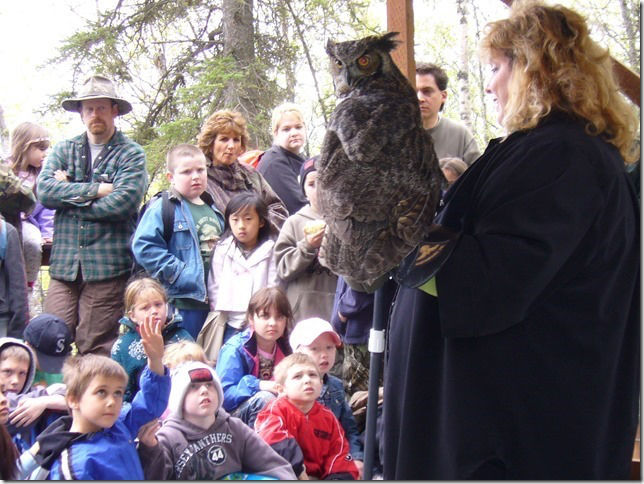
Once Artemis had adjusted to her new way of life, she began to participate in educational forums around the state, from health fairs on the North Slope to International Migratory Bird Day celebrations on Kodiak Island. The bird traveled by bus, by boat, by plane and by car, and none of it seemed to bother her.
“She was a really mellow girl, as far as wild birds go,” Perlman said. “They're solitary creatures and they always like you to leave them alone, but she was very tolerant.”
Not surprisingly, people loved her for it, and her fan base quickly grew.
Artemis met hundreds, if not thousands of people in her 18-plus years of living before she had to be euthanized due to age-related health issues last month. Many of those people felt the loss of the bird, including Kristine Abshire with Alaskans for Palmer Hay Flats.
“Artemis will be missed, and we will always be grateful for the enrichment provided by her and Randi,” Abshire wrote in an email.
“It was like losing a public figure,” Perlman said, of Artemis’s death. “Everybody knew her. Everybody loved her.”
Though Artemis is gone, Perlman continues to work with Bird TLC in Anchorage, as well as the Alaska WildBird Rehabilitation Center in Houston, promoting education, treatment and volunteer opportunities within the organizations.
For more information on Bird TLC, visit www.birdtlc.net or call 907-562-4852. To learn more about the Alaska WildBird Rehab Center, visit www.akwildbird.org or call 892-2927.
Contact reporter Caitlin Skvorc at 352-2266 or caitlin.skvorc@frontiersman.com.

By Barbara Hunt Palmer Buzz It was 6:43 on Friday morning and the Plant Owner was sound asleep when

By Kyle Wilkinson Frontiersman Memorial Day Weekend was filled with a variety of events in Willow. From live music to

By Kyle Wilkinson For the Frontiersman The Susitna Valley Emergency Preparedness Fair will be held at the Willow Community Center

By Barbara Hunt Palmer Buzz Green-Up happened at exactly 9:34 am on Saturday morning in Palmer. This was