Retiring teacher, coach urges Colony grads to ‘find their 68’
By Jeremiah Bartz Frontiersman.com A football coach using a hockey reference as the centerpiece for his keynote address may


WASILLA — The night before the big show, Kenzie had the gulps, and that may be why she touched the narrows Saturday.
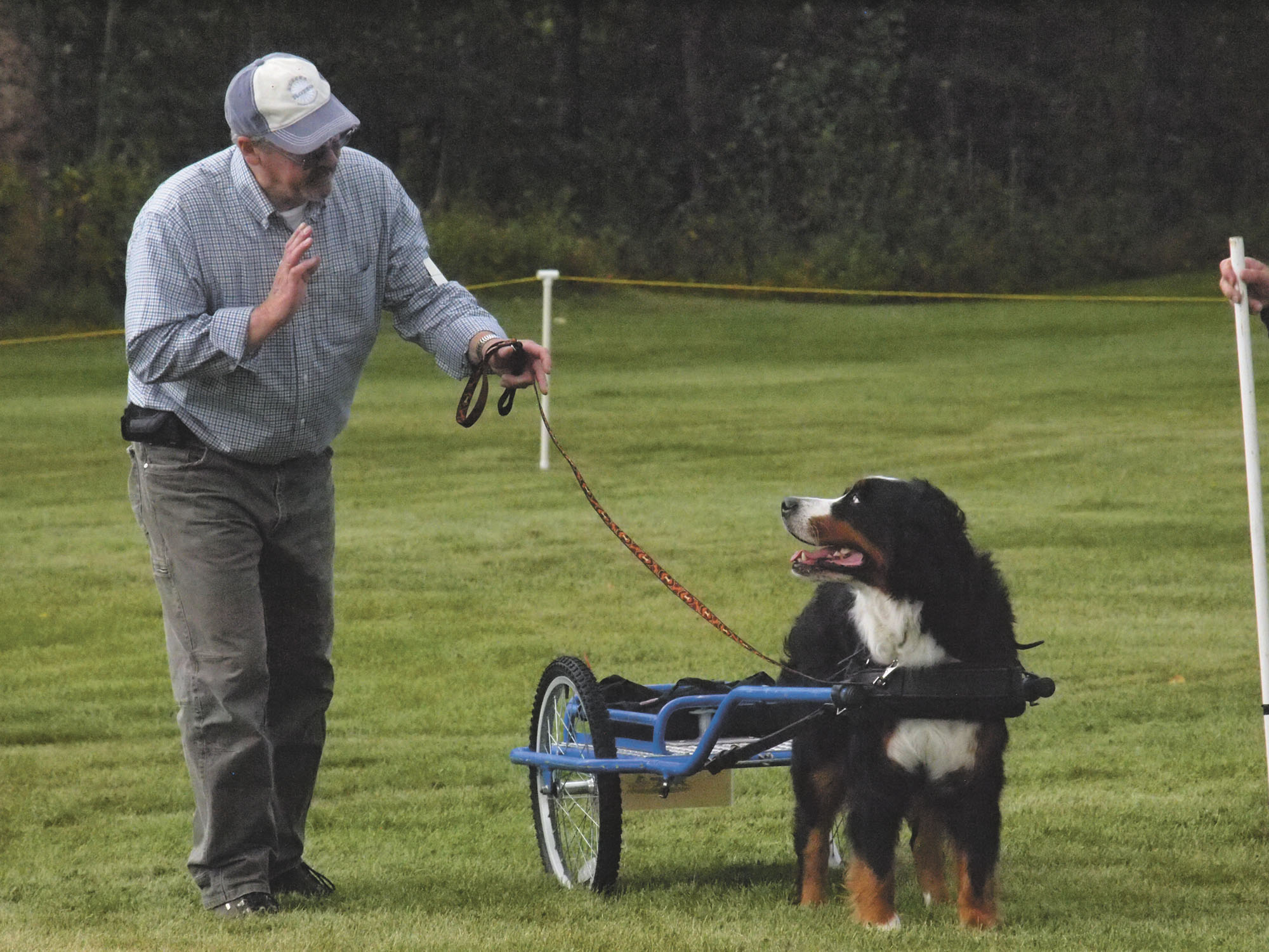
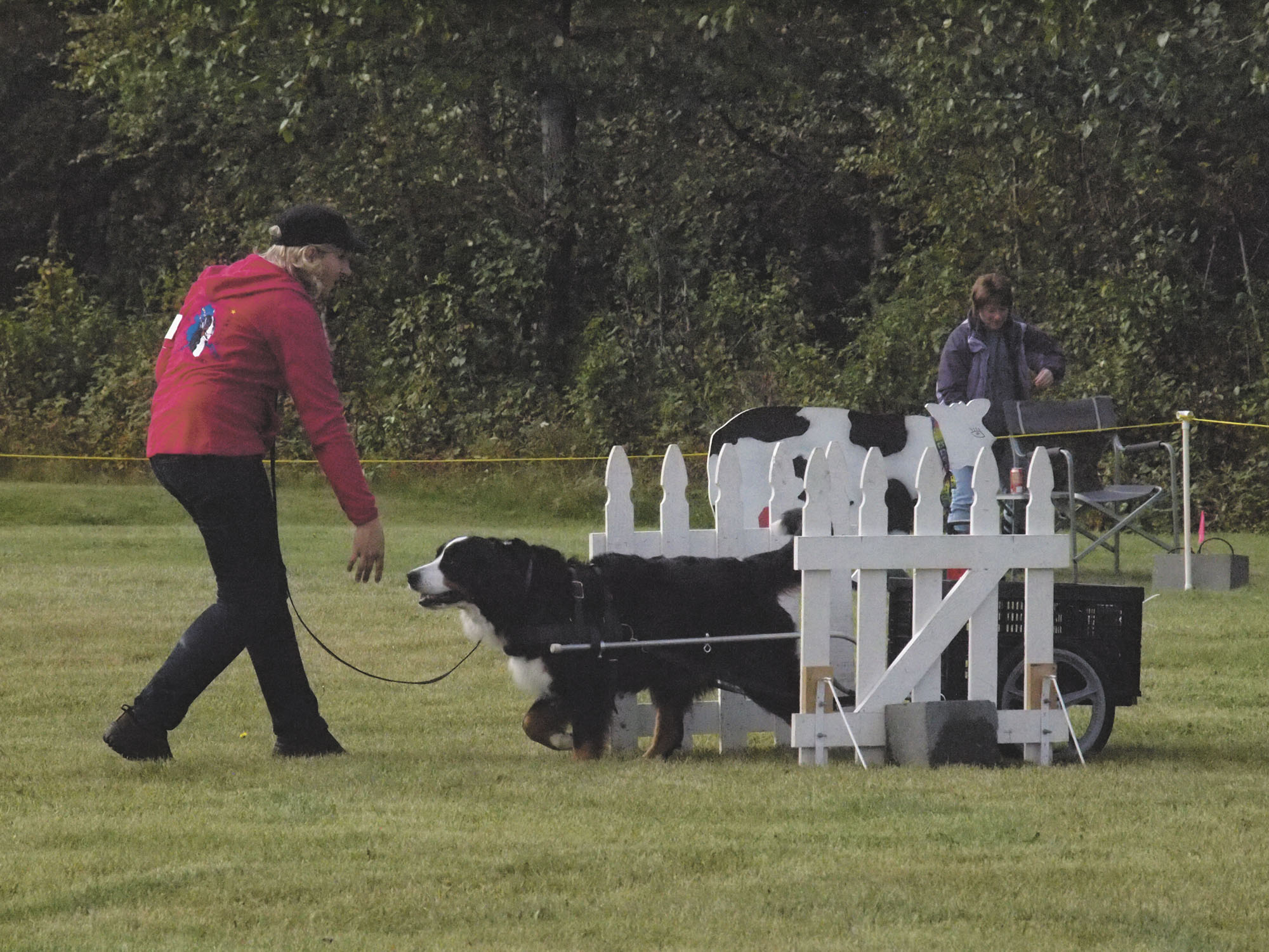
In the world of drafting — or hitching dogs to carts — that sentence makes perfect sense. Kenzie (whose full name is Dmitrious Cody’s Majestic Mackenzie) was a four-and-a-half-year old Bernese Mountain dog, and the show was a test draft held in Wasilla. The “gulps” are a syndrome common to Bernese Mountain dogs — known affectionately as “Berners” — sparked by stressful situations or excitement. The narrows are a challenging part of the obstacle course dogs are expected to navigate during the test draft, where a dog and cart must fit through a space between two fences with six inches to spare on either side.
While that means that Kenzie (and owner Bob Schmidt of Chugiak) failed one part of day one of the test draft, it doesn’t mean she will be punished in any way, Schmidt said.
“We did everything very good, but we touched the narrows, which is a no-no, so that’s a fail, but she doesn’t know that, so we treat it like it was still good,” he said. “She didn’t do anything bad or wrong or not minding, it was just a little narrow spot going through there and we got a little crooked and touched it, but she did good.”
That may be understandable. Of the pair, Kenzie is the rookie, according to Schmidt.
“I’ve been doing it for quite some time,” he said. “I had a ten-year-old boy that just passed away, and we did all the competitions and got all the titles we could with him. He was kind of my shining star.”
Training a Bernese is better done on a continual basis for small increments, Schmidt said. Bernese respond better to positive reinforcement than they do to negative stimuli, he added. Besides, the test drafts are more about the community of dedicated Bernese owners than scoring a ribbon or smashing rival dogs.
“It’s not really about the competition,” he said. “It’s the rally of all of our friends that are Berner owners. We all love the breed. They’re a working dog, this is what they like doing.”
Trainers typically begin by introducing the dog to the harness without the cart attached. However, some dogs — like Packer, Bill and Kathy Mailer’s three-year-old Bernese — take to the sport naturally. They had taken Packer — named by Bill, a Wisconsin native, for the team that won the Super Bowl in the year he was born — to a picnic of between 40 and 50 Bernese owners.
“They had harnesses and carts there and they hitched him up and he was a natural,” Bill said.
The Bernese is a follow-up to a golden retriever that was the belle of the neighborhood.
“The neighbor came and said ‘Bill, you need a new dog. You need another dog,’” he said. “A couple years after Nick (the retriever) passed away, we went over to Tracy (Corneliussen) and of course we had to go over and meet her and pass the test of ‘Are you going to be good with these dogs?’”
Eventually, Corneliussen chose Packer, a low-key, eager-to-please dog. They got another puppy from Corneliussen some time later that was the exact opposite: lots of energy and enthusiasm. How did they get along?
“Better now,” Bill said. The Mailers both laughed.
Bill echoed Schmidt’s sentiment about the meet.
“In my opinion, one of the nice things about the drafting competition is that it’s me and Packer as a team. We need each other to do this properly and pass, but it’s not like I’m not in competition with Tracy or Bob or anybody else,” he said. “There’s no ranking of people who pass.”
Not all of those at the meet were strictly attached to their dogs. Kelly Boyle spent a significant portion of the early going opening an umbrella, despite the absence of rain and the presence of blue skies. Boyle was tasked with being a visual distraction for dogs as they rounded a corner with the cart attached. That ability to avoid distractions (dogs also faced an auditory distraction at the following corner) was critical to the dog’s original role on Swiss farms: transporting milk containers from farms to crowded marketplaces.
“When the dog comes around that cow out there, at a certain point I’m to slowly open the umbrella,” she said. “Not noise so much as the visual. Everything’s gotta just kinda flow.”
While being a distraction might come naturally to some, Boyle required practice.
“Just for a few minutes,” she said, and laughed. “I’ve done it a couple other times, but it’s fun because you’re part of it. You’re not out training with the dogs, but you’re part of the whole thing.”
Contact Brian O’Connor at brian.oconnor@frontiersman.com.

By Barbara Hunt Palmer Buzz It was 6:43 on Friday morning and the Plant Owner was sound asleep when

By Kyle Wilkinson Frontiersman Memorial Day Weekend was filled with a variety of events in Willow. From live music to

By Kyle Wilkinson For the Frontiersman The Susitna Valley Emergency Preparedness Fair will be held at the Willow Community Center

By Barbara Hunt Palmer Buzz Green-Up happened at exactly 9:34 am on Saturday morning in Palmer. This was