Retiring teacher, coach urges Colony grads to ‘find their 68’
By Jeremiah Bartz Frontiersman.com A football coach using a hockey reference as the centerpiece for his keynote address may


PALMER — After 32 consecutive years in Alaska, Connecticut born-and-bred author Bill Sherwonit has come to understand the Alaska wilderness in a way that bespeaks an immersion in the state’s indigenous culture.
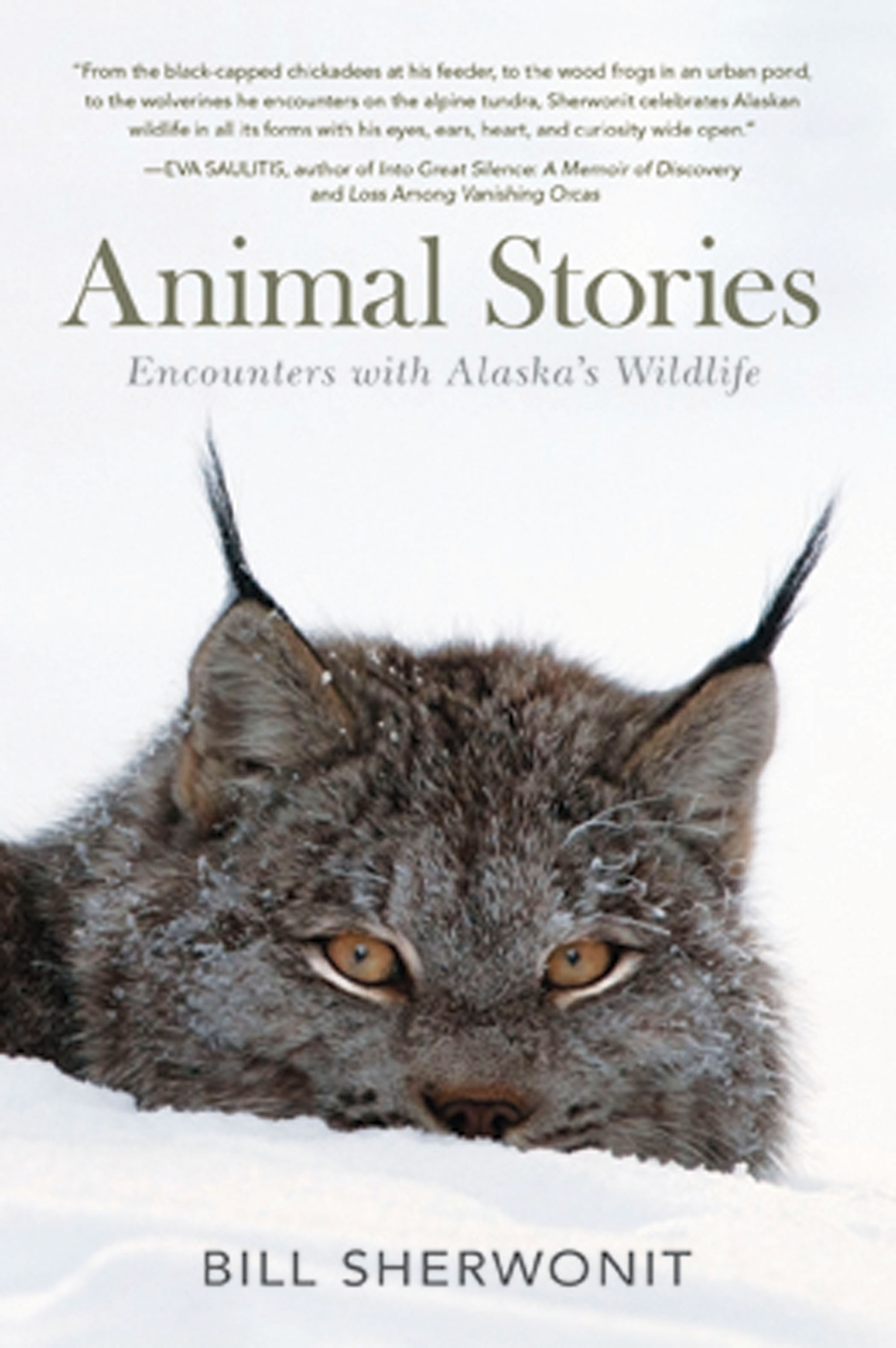
His latest book, “Animal Stories: Encounters with Alaska’s Wildlife” is a compilation of essays about just that: Sherwonit’s encounters with wildlife all over the state, and especially near his home on the Hillside by Turnagain Arm.
From charging moose and bears to quiet bird-watching and beluga-counting, Sherwonit’s stories paint a many-faceted picture of the relationships between animals and humans in Alaska.
“The essays are intended to be thought-provoking as well as entertaining: to increase readers’ awareness and get people thinking about their own relationship with our wild neighbors, our wild relatives, and the inherent value that these animals have, irrespective of what they give to us,” Sherwonit writes on the book’s webpage.
Sherwonit wasn’t always so aware of the wildlife around him. After graduating high school in Connecticut, he went on to obtain a bachelor’s and master’s degree in geology from Bates College in Maine and the University of Arizona, respectively. It was as an exploration geologist that he happened to come to Alaska in 1974, looking for mineral deposits in the Brooks Range with a small team of geologists from Outside.
Once there, he soon noticed a significant gap between his enthusiasm and that of his colleagues.
“Over time, once I was out in the real world working as a geologist, I guess I gradually realized that I wasn’t as passionate about geology as my friends,” Sherwonit said in a phone interview.
He didn’t realize why he was not as passionate about geology until he had spent a few summers in Alaska. One day, when he finally found significant traces of minerals in the range, he experienced something of an ethical dilemma.
“Of course it was exciting at first ’cause that was my job, but the more I thought about it, I was like ‘wow, if this actually did turn out to become an economic development,’ it would be…ruined, to me,” he said.
So he went in search of a new career.
“What was more important to me than mineral deposits was the wilderness, so I decided to see if I could find something that I could love as much as my buddies loved geology,” he said.
Photojournalism, he thought, was the solution — what better way was there to preserve and continually appreciate the nature of his surroundings?
So he began work as an amateur wildlife photographer. “Life” took him down to southern California, he said, and he went back to school to learn the ropes of news writing, a key component of photojournalism. As he honed his writing skills, a professor invited him to write for the sports section of the school newspaper, and photography seemed to fall by the wayside.
But Sherwonit was determined to return to Alaska, so when a sports writer position opened up at the Anchorage Times, he jumped at the chance.
He moved to Anchorage in 1982. Once there, an editorial position for a writer in the outdoors section also opened up — a better fit for Sherwonit, he thought, but he had been hired for sports writing. It took two years for him to make the switch.
Sherwonit remained the outdoors editor until the Times folded in 1992, at which point he had two thoughts, he said: I want to stay in Alaska, and I want to continue being a writer.
But not at a newspaper.
He began teaching creative nonfiction writing classes at UAA, and he toyed with the idea of freelancing on a larger scale — he had written a little for Alaska Geographic and Alaska Magazine while working at the Times — but something held him back.
Then, someone asked him a very important question:
“Are you willing to do whatever it takes?”
“Somehow, that just crystallized it, it all became clear and I (said), ‘yeah, I’m gonna do whatever it takes, I’m gonna give it my best shot,’” Sherwonit said.
That mindset took him farther than he had imagined. Before the Times was laid to rest, the editor of Alaska Northwest Books, Kathy Howard, encouraged Sherwonit to write a lengthier piece about Denali (which was later realized as “To the Top of Denali: Climbing Adventures on North America’s Tallest Peak”). Howard had seen Sherwonit’s writing over the years, and he had written enough, in her mind, to fill a book.
“Until I wrote my first book, I never imagined I’d be writing a book,” Sherwonit said. “In my case it was unusual in that a publisher came to me.”
Perhaps it was unusual, but also fortuitous in terms of building his career. Sherwonit has written 11 books and contributed to numerous guidebooks and other publications in the past 24 years, some of which seem to detail his life and personal philosophies as much as the world around him.
Sherwonit was raised Lutheran in school and in church, but had something of a “religious crisis,” he said, when he went to college. He still respects religion, but now claims a certain spirituality informed by pantheism.
“I guess I’m open to the possibility that everything has a spirit,” he said.
In a chapter of Animal Stories, he pauses, while relating the story of his first close encounter with a dead moose, to voice his opinion (not uncommon in the creative essay form). As he looks into the moose’s clouded eyes, he remembers the old adage that eyes are windows to the soul, and wonders if it is true for animals.
“These ideas resonate with me and even though it’s not the culture in which I was raised, I guess…it makes some sense to me,” he said in the interview.
Sherwonit’s writing also is informed by scientific research, however, in addition to natural history, spiritual beliefs and indigenous perspectives.
“I believe there’s room for all those different things,” he said. “There’s a big part of our culture that believes science has all the answers. Science is one way of looking at the world, and a very valuable one, but I think it would be wrong to be dismissive of the other ways of knowing.”
“From my perspective, we’re part of a much larger mystery and we humans too often think we do know it all,” he said. “I don’t think we know nearly as much as we think we know.”
Sherwonit will be signing his works from 11:30 a.m. to 1:30 p.m., Nov. 22 at Fireside Books in Palmer in celebration of the publication of Animal Stories.
To read excerpts, visit facebook.com/AnimalStoriesbyBillSherwonit.
For more information about the author, visit billsherwonit.alaskawriters.com.
Contact Caitlin Skvorc at 352-2266 or caitlin.skvorc@frontiersman.com.

By Barbara Hunt Palmer Buzz It was 6:43 on Friday morning and the Plant Owner was sound asleep when

By Kyle Wilkinson Frontiersman Memorial Day Weekend was filled with a variety of events in Willow. From live music to

By Kyle Wilkinson For the Frontiersman The Susitna Valley Emergency Preparedness Fair will be held at the Willow Community Center

Frontiersman.com Multi-platinum, Grammy-winning artist Amy Grant will perform at the 2026 Alaska State Fair on Monday, August