Retiring teacher, coach urges Colony grads to ‘find their 68’
By Jeremiah Bartz Frontiersman.com A football coach using a hockey reference as the centerpiece for his keynote address may


BUTTE — Mat-Su Borough officials met with more than 50 concerned community members at Butte Elementary to discuss air quality on Tuesday. Following a change in EPA standards for particulate matter (PM) 2.5, the borough partnered with the Department of Environmental Conservation to attempt to educate citizens on what they can do to improve air quality.
“Primarily we’re looking at issues in mid November through February, and as many of you know if you’re from this area, that’s obviously our cold months when we see these inversion conditions. We happen to be in an area that sees pretty strong inversions in the winter months and that can last for several days at a time. That’s when you see those cold calm air and we don’t have a lot of wind movement. And that is unique to the Butte area,” said Brianne Blackburn, environmental planner with MSB.
Blackburn and Barbara Trost, from the DEC, gave a brief history of air quality monitoring and how the monitoring in the Butte has changed. A permanent air quality monitoring site was established in 1998 on Harrison Court in the Butte.
“It was mainly there also to catch the windblown dust from the Knik River,” Trost said.
In 1999, EPA came out with new standards that required the state to set up permanent monitors. At the time, not much was known about how PM 2.5 differs from PM 10. PM 2.5 measures at 1/28 the diameter of a human hair and is often caused by vehicle emissions, wood stove, slash and garbage burning. However, contrary to what is happening in Fairbanks, there is no regulation coming to prohibit use of wood stoves.
“Absolutely not,” Blackburn said.
The EPA aligned their standards in 2006 with those of the World Health Organization, lowering their allowable PM 2.5 to 35 over a three-year average. That change in regulation brought the borough closer to violation, but MSB is not in a state of non-attainment. Non-attainment would require further action from MSB to curtail poor air quality, and possibly result in a loss of road funding. In 2016, the Butte reached a PM 2.5 high of 35, but that number has been steadily dropping.
“We have not violated the national health standard for pm 2.5,” Blackburn said.
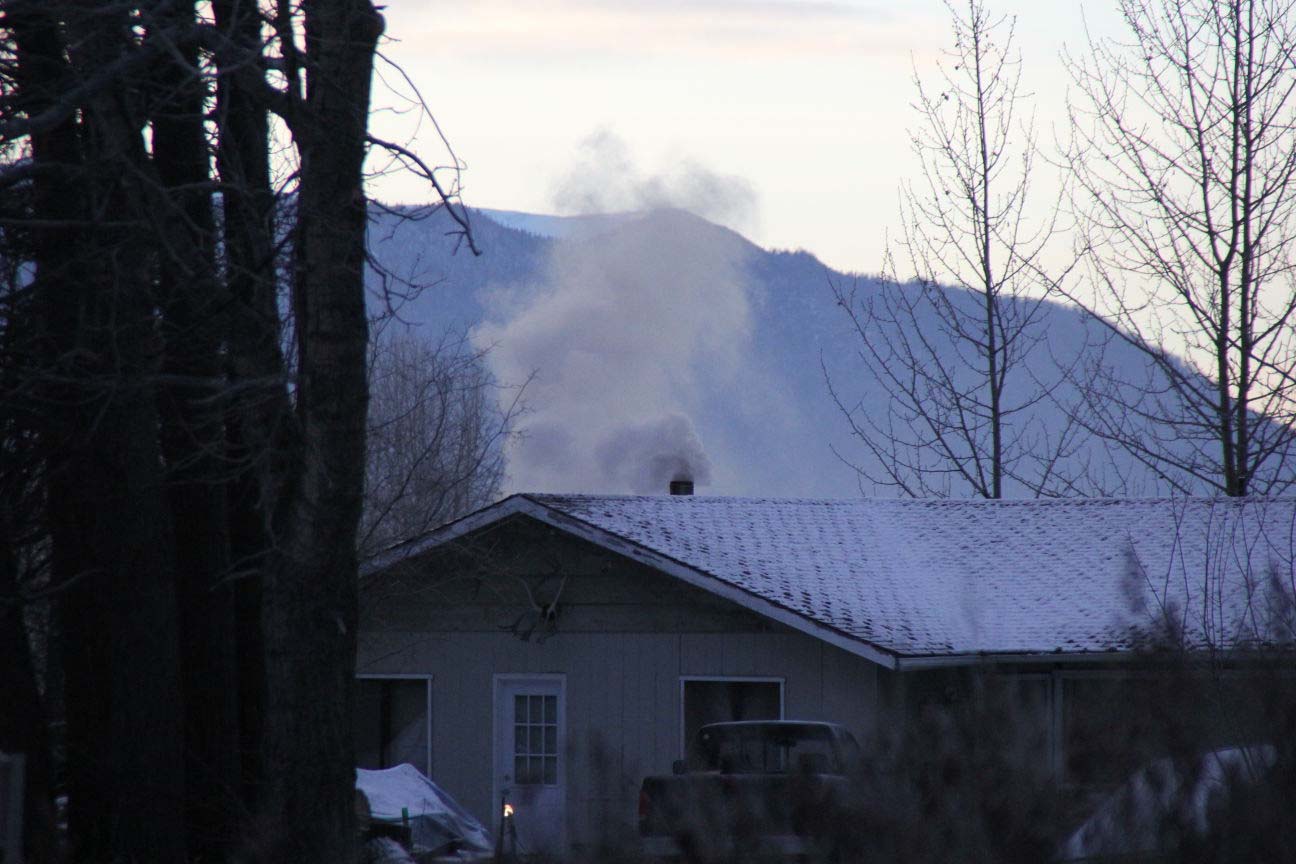
The Butte had a preliminary measurement of 25 in 2018. Air quality is measured both in Palmer and in the Butte, but the Butte suffers unique weather conditions that prohibit emissions from moving out of the area. On two to four days a year, cold, calm, windless conditions result in an inversion, trapping the emissions in the Butte. Those are the days that the borough has worked to educate residents in issuing advisories not to burn outdoors.
“What we’re trying to do is help keep us from going into a situation where the EPA gets involved and requires more stringent regulations,” Blackburn said.
Literature on how to burn with less emission was available during a question and answer session before and after presentations by Blackburn and Trost. Dry wood creates less emission than wet wood, and officials ask that Butte residents do not burn outdoors on inversion days when MSB has issued an air quality advisory. MSB does not have enforcement authority on burn violations. The state does have regulations prohibiting fires emitting black smoke, which is mostly caused by burning plastic. In the event that a homeowner was creating black smoke, a DEC enforcement staff would have to be called out to respond, and could result in a $100 fine.
While PM 2.5 is often caused by cold winter conditions and wildfire smoke in the summer, PM 10 is made up of much larger particles that are mostly caused by spring and fall winds coming off of the Matanuska and Knik River beds.
“It really depends on where your winds are coming from. Your air quality can change drastically within an hour, it can change drastically as soon as the wind changes. So air quality measurements are always sort of more long term and that’s why it’s a three year standard that we’re working with,” Trost said. “They’re not trying to penalize us for a bad day or two bad days.”
If MSB were to enter non-attainment and require further regulatory measures to curtail poor air quality, the Federal Government could put a clock on MSB where they would be required to improve air quality. If MSB continued to have poor air quality, road funding could be withheld.
“The relationship with road funding is kind of the carrot and stick relationship that the Federal Government uses to keep us away from violating that health standard,” Blackburn said. “The clean air act requires the government to step in and try to improve the air quality. If that doesn’t happen, they can sanction the transportation funds that go to that region.”
While possible, Blackburn said that it is highly unlikely. Health effects from PM 2.5 were called into question by aggravated community members who attended the meeting. Jennifer Brandt, from the American Lung Association, said that PM 2.5 can penetrate deep into the lungs and start to break down the tissue and be harmful to children or anyone with pre-existing lung conditions. Blackburn said that 22 percent of Valley residents suffer from conditions that would be aggravated by elevated PM 2.5 levels. A law before the MSB Planning Commission is aimed at revising language to help improve air quality.
“Our proposed legislation is really looking at local targeted efforts to manage our air quality resources,” Blackburn said. Accusations came from the crowd that the location of the monitor was being polluted by nearby neighbors.
“You can’t just decide to move a site. There’s regulations against that. There’s a lot of studies that we would have to do and by now it probably would cost in the tens of thousands of dollars to move the site even if we believed that we should move it and currently we don’t think that we should be moving the site,” Trost said.
Contact Frontiersman reporter Tim Rockey at tim.rockey@frontiersman.com

By Jeremiah Bartz Frontiersman.com A football coach using a hockey reference as the centerpiece for his keynote address may

Frontiersman.com With its headquarters in Wasilla, the Frontiersman has been a primary source of news for the Matanuska-Susitna

By Katie Stavick Frontiersman.com The next generation of leaders took flight this week as the Houston High School Class

By Kyle Wilkinson For the Frontiersman Keynote speaker and Carry the Cure President Bill Pagaran’s words boomed through the