Retiring teacher, coach urges Colony grads to ‘find their 68’
By Jeremiah Bartz Frontiersman.com A football coach using a hockey reference as the centerpiece for his keynote address may


The Matanuska Susitna Borough Assembly took another step Tuesday evening to establish a financing mechanism for energy improvements and renewable energy for commercial and industrial properties.
Under the proposal put forward by assemblywoman Stephanie Nowers the borough would create a PACE, or Property Assessed Clean Energy Program.
Property owners would be able to finance energy efficiency or other improvements through a bank or other financial institution and make payments through an assessment on local property taxes similar to the way utility improvements are often funded.
A local government – in this case the Mat-Su Borough – would acts as a go-between by collecting the money through the tax assessment . However, the borough would not otherwise be involved in the transaction, or liable.
The arrangement is provided for in state law but until now only the Municipality of Anchorage has established a program. Mat-Su would be the second municipality to develop a program. Several other municipalities are considering it.
Using the procedure property owners would typically get a better interest rate in financing than through a typical bank loan because there is less risk for the lender.
If a default occurs a tax lien is placed against the property. Tax liens are first in line to be repaid and ahead of conventional loans.
For the bank the administrative ease of working through a municipal tax assessment, with the local government acting as collector rather than the bank administering the loan, is another advantage.
A big advantage for the property owner is that it allows an improvement to be done without a big up-front cost, and with the financing repaid over a set term such as 10 to 20 years.
Payments are made along with the owners’ normal property taxes.
The assembly adopted a resolution Tuesday that amounts to its second approval under a three-step process required by the state. Nowers said there is one more approval to be made before the borough can set up and operate the program.
Property owners made their own arrangement with banks. The borough provides what is essentially the repayment mechanism.
There has been discussion of establishing similar programs for private residential property owners but it must be established in state law, as has been done with PACE for commercial and industrial owners.
In another action, the assembly unanimously voted down a proposed change in the Road Service Area contract method for Big Lake, a matter that has stirred considerable local opposition.
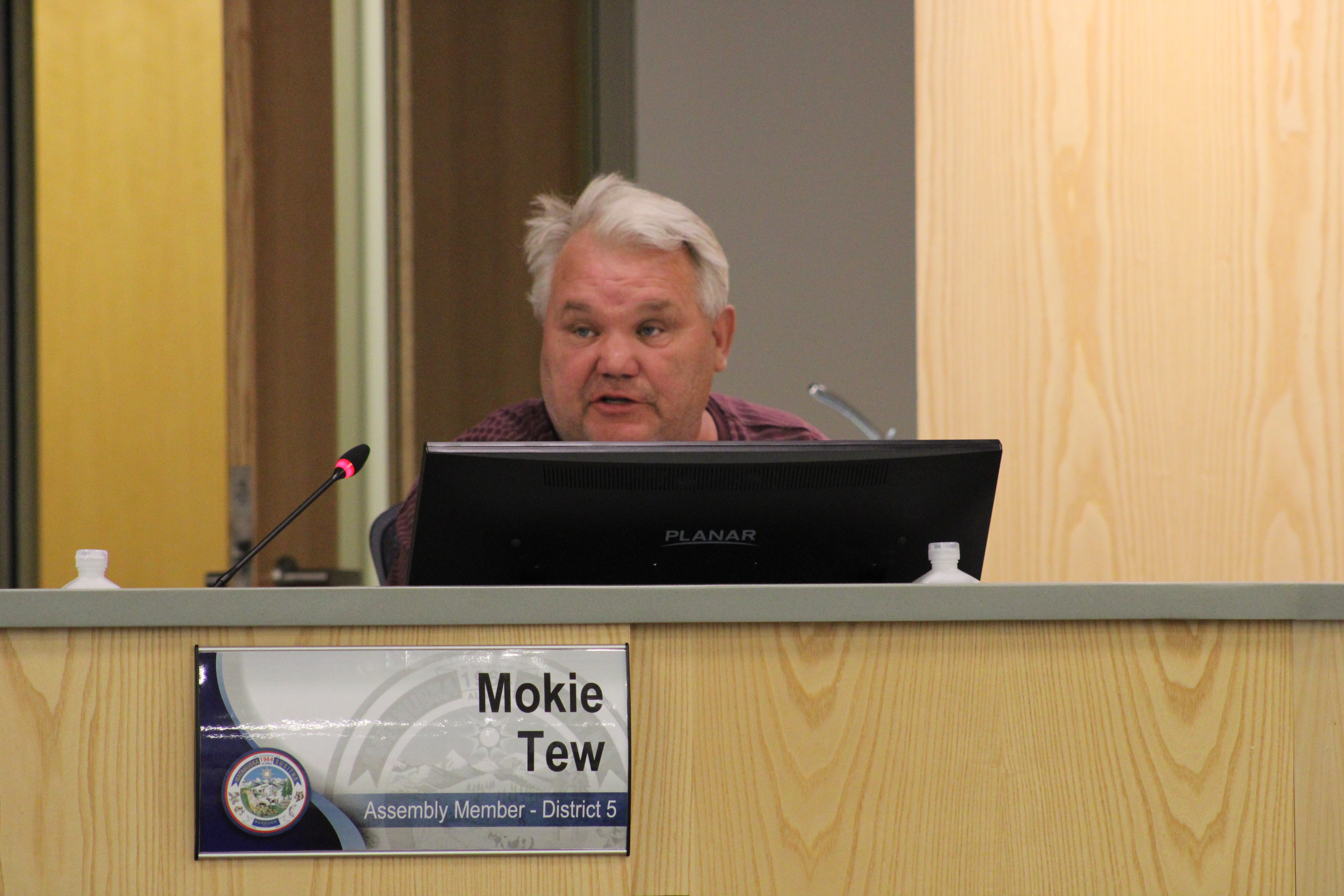
Assemblyman Mokie Tew, who represents the Big Lake area, had proposed a pilot project for a “time and materials” contract system to be tried in lieu of the current system of a negotiated set price for annual road work and snow clearing.
Tew also proposed terminating the current contractor as part of the pilot, a move that prompted criticism from local residents who accused Tew of carrying out a vendetta.
The matter hasn’t gone away, however. A new proposal by Tew is for a task force to be appointed by the mayor and borough manager Mike Brown to study the idea.
A draft of a new resolution setting up the task force was discussed Tuesday. Brown, the borough manager, suggested some changes and Big Lake resident Terry Gorlick, who spoke at the assembly meeting, also suggested changes.
A major concern for Gorlick and others who spoke Tuesday was that a Big Lake resident be included on the task force along with or in addition to Tew, the local assemblyman.
Gorlick argued thar Tew, who has operated a contracting business, has a vested interest in the matter as the chief proponent of the time-and-materials approach.
D.J. McBride, another Big Lake resident, expressed concerns to the assembly Thursday that the wording of the resolution creating the task force could construed in a way that a recommendation for a time-and-materials pilot from the panel would automatically have it effective.
McBride said the final decision should be by the assembly with the task force just making a recommendation. “We’re very concerned about this because a ‘time and materials’ contract would break our budget,” McBride said.
Gorlick said Mat-Su residents will get a taste of the procedure will cost in a report soon to be issued on costs of load road services during the recent winter storm.
Time and materials payments were allowed during and immediately following the storm under the state’s emergency disaster declaration, Gorlick said.
Gorlick said Tew hasn’t made clear why he is backing time-and-materials because experience of other municipalities, such as on the Kenai Peninsula, has shown it to be more expensive.

By Jeremiah Bartz Frontiersman.com A football coach using a hockey reference as the centerpiece for his keynote address may

Frontiersman.com With its headquarters in Wasilla, the Frontiersman has been a primary source of news for the Matanuska-Susitna

By Katie Stavick Frontiersman.com The next generation of leaders took flight this week as the Houston High School Class

By Kyle Wilkinson For the Frontiersman Keynote speaker and Carry the Cure President Bill Pagaran’s words boomed through the