Retiring teacher, coach urges Colony grads to ‘find their 68’
By Jeremiah Bartz Frontiersman.com A football coach using a hockey reference as the centerpiece for his keynote address may


BUTTE — A “patchwork quilt” of grants may be the solution to the slow-motion disaster that has eaten houses, property, and riverbank here, borough officials said Thursday.
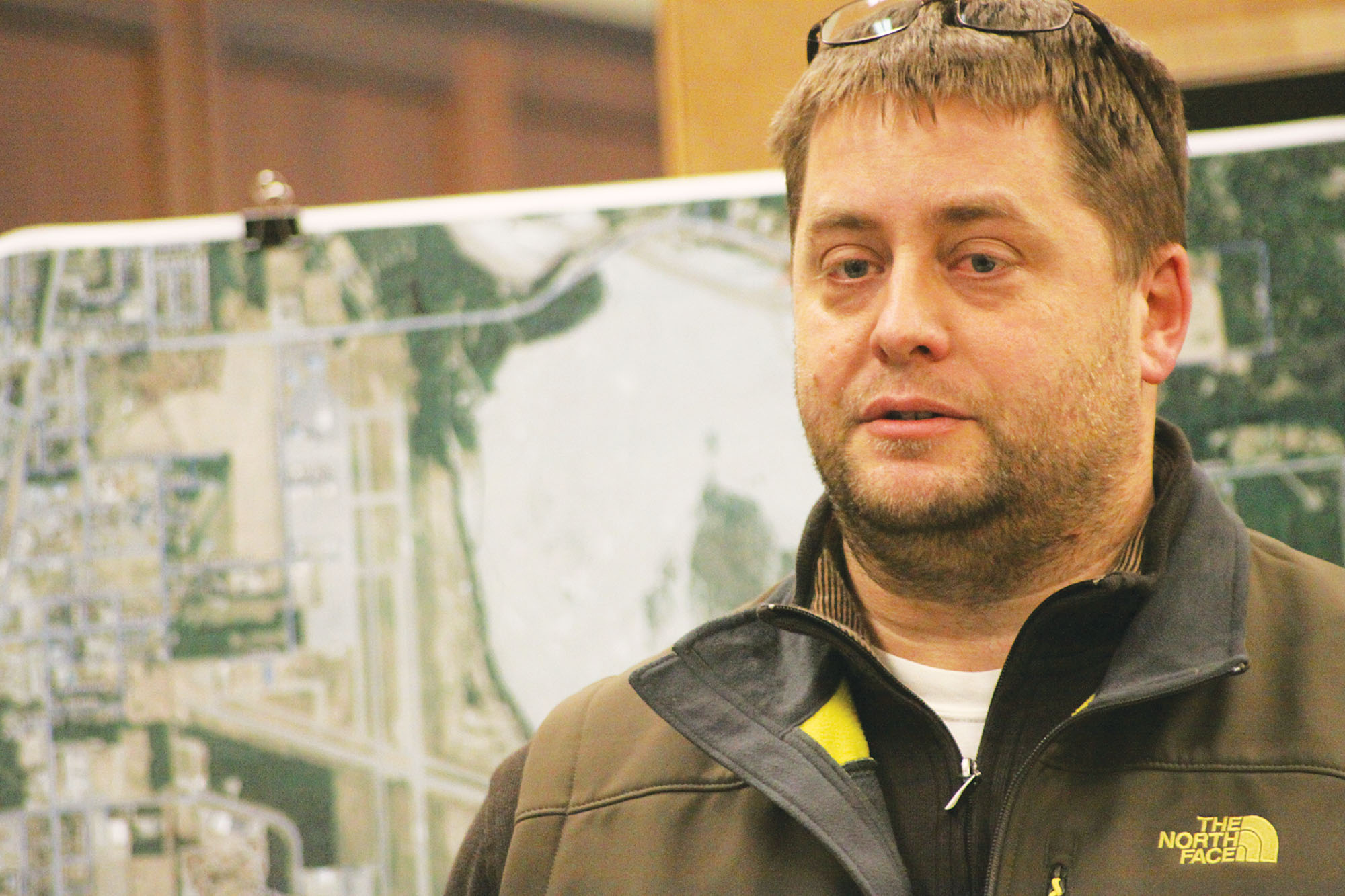
At a flood property buyout meeting at the Butte Fire Station, officials introduced a representative from a contractor the borough has hired to help residents of the flood-stricken areas of the Butte obtain grants. The money from those grants will buy property, allowing residents to either relocate their houses to other areas or demolish them at their own expense. Grantors could include agencies as varied as the Alaska Department of Transportation and Public Facilities, the US Department of Agriculture, the Department of Housing and Urban Development and the Great Land Trust, Jim Jager told residents here. Jager is a planner with Anchorage-based Boutet Company, hired by the borough assembly to seek grant money for a buyout.
“We’re talking to all sorts of folks,” he said. “One of the challenges is, each one of these funds has its own strings attached, its own questions, its own requirements. They have some commonality.”
While grant applications aren’t a guarantee — different grant organizations may choose other disaster areas, for example, or may decide the properties don’t meet the requirements of their particular grant — they also allow officials to put the same property through two or three applications at once, meaning they aren’t dependent on a single yes or no to expedite a move if the situation gets worse, Jager said.
Borough officials have already selected five properties ahead of an Oct. 1 deadline to apply to the FEMA-run Flood Hazard Mitigation program. Those properties are places where people still reside, and include the site of the former Fireside restaurant and Butte properties owned by Amir Lena, Pat Wake, and Scott Easler, and a single property in Sutton, owned by Evelyn Johnson. Additional properties will be approved for a second round of FEMA funds when they open.
Residents asked whether they would get fair money for their properties, damaged in part by what they say is state and borough inaction to prevent floodwaters from damaging homes and lives.
Residents wouldn’t want a fair market value, Jager said.
“Realistically, the fair market value for most of these properties is close to zero,” he said. “Because who wants to buy a piece of property that’s about to erode away?”
One requirement of the FEMA program is that residents obtain flood insurance through the national flood insurance program, Jager said. Some residents admitted at the meeting they didn’t presently have the insurance.
That’s not a problem, Jager said.
“If you have flood insurance when we apply, just because of the delays in the system, we’ll be able to get you in,” he said. “What we can’t do is we can’t make an application and then they go, ‘hey, we’ve got money for this house,’ and then we go up and that house doesn’t have flood insurance. You basically have to make the decision that you’re in before you apply for the grant.”
“It’s the one time bureaucratic delay helps you,” Jager added.
Officials had prioritized the properties based around the extent of the flooding damage during internal deliberations early in the process, borough emergency manager Casey Cook told residents. However, borough officials eventually decided to prioritize properties with actual residents over those without. Those properties have been numbered from the Old Glenn Highway Bridge going south, and will not be further prioritized, according to Cook.
The buyout has been in the works since the 2012 floods, Cook said.
“We’re finally getting to this process where we’re able to put things on paper,” he said.
Money awarded from the federal government to states includes a small portion, typically about 15 percent of the whole, set aside for similar disasters anywhere in the state, like the 2013 flooding of the 400-resident town of Galena, along the Yukon River. Grant administrators then parcel out that money to applicants from other parts of the state, as long as they can fully fund a grant application. As the remaining funds are exhausted, smaller and smaller grants are considered for approval, officials said.
That makes timing grant applications important, Jager said.
“There’s a strategic element to this,” he said.
The arrangement also ties grant funds to the misfortunes of others, officials said. The more money spent on the Galena flood, the more money available to Butte and Sutton residents.
Regulations and rules for individual grant applications may also change rapidly, Jager warned. For example, a benefit-cost analysis requirement didn’t give extra value to applications where land was being set aside for preservation, Jager said. However, the rules have changed, meaning riparian (river-side) lands set aside for preservation now have an advantage in the system. That rule changed between Oct 1, when properties were submitted, and Thursday’s meeting.
“It suddenly makes the buyouts look more attractive to the government,” he said. “The rules have changed, and they’ve changed in one month.”
Residents appeared receptive and affable about the prospects moving forward, even engaging in running jokes about a potential park for the site, accusations repeated around the Butte when the water was at it’s worst and officials for the state and borough declined to fix a series of dikes constructed in the area.
“It’ll either be the Casey Cook 1,000 Grey Hairs Memorial Park, or the Pat Huddleson Something Something Something Park,” Cook joked.
Huddleson, famously active on behalf of the Mile 13 to Mile 15 residents, said she’s waiting to see whether official promises about the program pan out. Questions remained, Huddleson said.
“I think until they actually walk our property, we’re still there thinking ‘Yeah, right,’” she said. “We’re kind of hyped up right now, but you know, we’ve been let down so many times, that you know …”
“Empty promises,” her husband, Dan Huddleson interjected.
“That’s exactly it, empty promises,” she echoed.
Fireside owner Steve Silba welcomed the buyout, and found out that evening he was in the first round of buyouts. It wasn’t the way he’d intended for the property to end up, but it was the best way the unpleasant situation could end, Silba said.
“I was gonna live there the rest of my life, and my grandson comes from Anchorage and just loves it,” he said. “It would break my heart if they tore that building down and the DOT built something there and I drove by with my grandkids and said ‘Oh, we can’t walk on that property anymore.”
Contact Brian O’Connor at 352-2269 or brian.oconnor@frontiersman.com.

By Jeremiah Bartz Frontiersman.com A football coach using a hockey reference as the centerpiece for his keynote address may

Frontiersman.com With its headquarters in Wasilla, the Frontiersman has been a primary source of news for the Matanuska-Susitna

By Katie Stavick Frontiersman.com The next generation of leaders took flight this week as the Houston High School Class

By Kyle Wilkinson For the Frontiersman Keynote speaker and Carry the Cure President Bill Pagaran’s words boomed through the