Retiring teacher, coach urges Colony grads to ‘find their 68’
By Jeremiah Bartz Frontiersman.com A football coach using a hockey reference as the centerpiece for his keynote address may


PALMER — Wendy Van Duyne and Katrina Nygaard of Stantek were active in and around downtown Palmer last week.
The pair that has been studying the Matanuska Maid block in downtown Palmer are studying strategies for redevelopment and what that would look like as part of an Environmental Protection Agency Brownfield grant. The pair held their initial meeting in March and talked to residents at Colony Days last weekend among other engagements with the community while they formulate their redevelopment strategies. Nygaard was all smiles, manning a booth at Colony Days next to the bouncy house, giant slide and Van Duyne’s four-legged friend. It was the first time Nygaard and Van Duyne had been to the Colony Days celebration, and helped them reach out to more residents about the project.
“When you come to a festival everyone’s really excited to hear about what’s going on and I think it’s so great to be in downtown. We’re a block away from the site, people can really imagine it. It can always be this energetic and vibrant if we’ve got more businesses more housing more opportunities for folks to be in downtown,” Nygaard said.
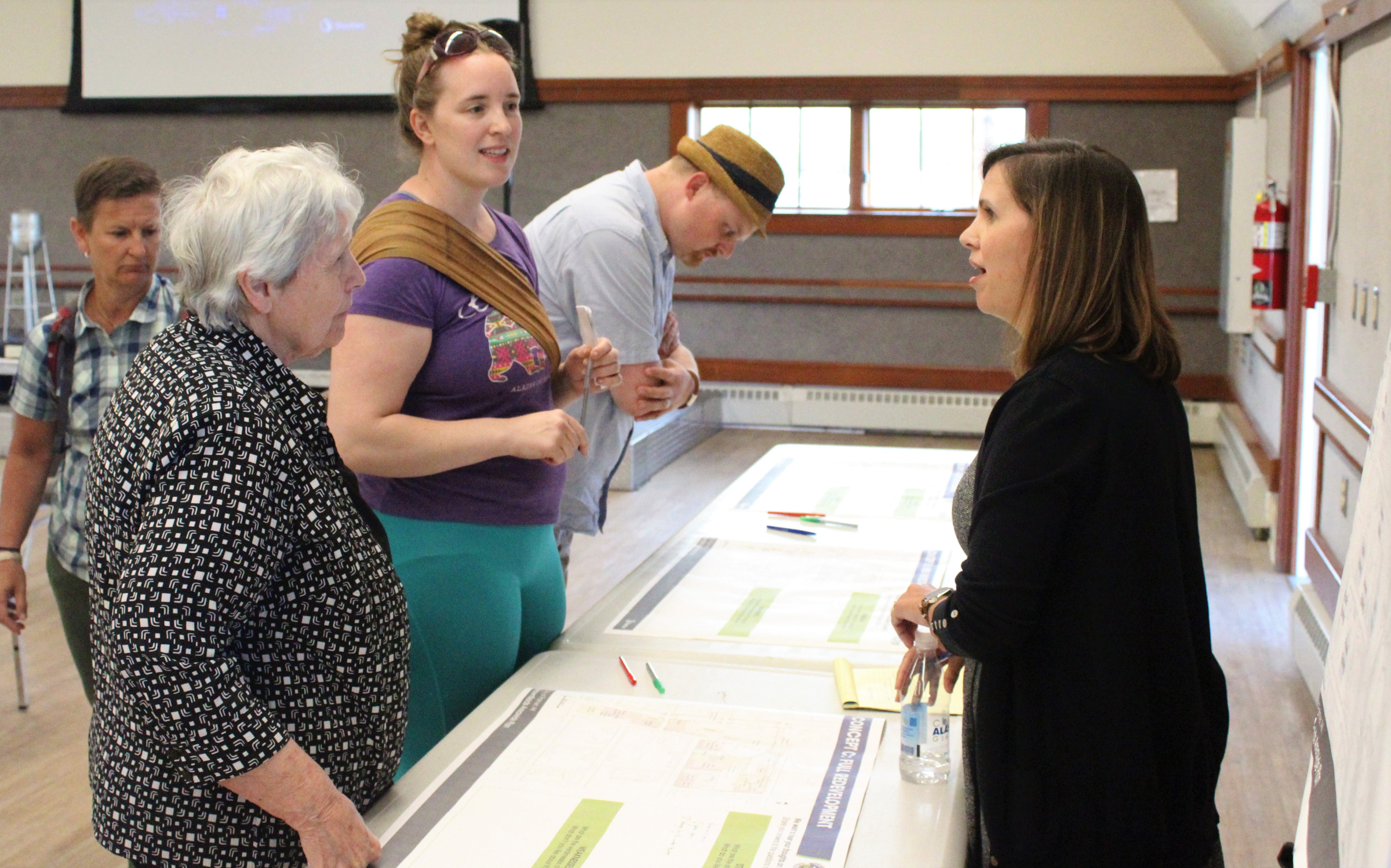
The pair met with property owners near the Mat Maid block on June 10 and held and open house at the Train Depot that evening. Most of the people packing Palmer were running past the depot as part of the Happy Run.
“It’s hard to compete with 70 degrees and sunshine,” Nygaard said.
City of Palmer staff, Mayor Edna DeVries and a handful of concerned community members dropped by to dialogue with the pair.“The reason why I came here is I wanted to make sure that even as we develop, we are holding onto that part that makes us so special. We are from Anchorage and Anchorage is a great urban space, but it doesn’t have that small town feel anymore and I don’t want to become another downtown Anchorage,” Rachel House said.
House said her family moved to Palmer 12 years ago from Anchorage because it would be a great place to raise their children. House’s husband owns Deeptree in downtown, and House says she hopes Palmer maintains it’s small-town essence while growing up as a community. While the meeting was not as well attended, Nygaard and Van Duyne are confident that their interactions with property owners, residents and city officials will be beneficial to their final product. Nygaard and Van Duyne presented three scenarios to the Palmer City Council on June 11.
Concept A would add two three-story buildings and use the green spaces on either side of the rail corridor. Concept B would have three buildings and remove the rail past the depot for more public spaces, and concept C would have five buildings with a possibility for another on the southwest corner of the lot.
“The goal is once we collect everyone’s ideas about the three concepts is to sort of refine them into a single direction that incorporates and balances those ideas, and come up with some strategies for how the city might do what they can,” Nygaard said.
The Mat-Su Borough received $500,000 for the first portion of the study. The Brownfield study assesses potential pollutants on the property such as asbestos or contaminated soil and then aids in removal if hazardous materials are found. Nygaard said that the initial process usually takes three to five years and cited an example of some of her work in Wisconsin that is coming to fruition around the three year mark. President Trump vetoed over $40 million in funding initially designated for Brownfield studies, accepting only $36 million of the proposed $80 million. Nygaard said that she does not expect the Mat-Su Borough to receive another $500,000 for cleanup, but that smaller projects are often awarded between $1-300,000.
“We heard from many people in the community is that walkability is important and there is a really nicely established trail system in Palmer and we want to build on that with anything that’s introduced,” Van Duyne said.
The borough’s grant is up at the end of 2019. Nygaard said that the pair have moved their presentation date from September to October to avoid another empty meeting during the height of moose hunting season. Upon return in October, Nygaard and Van Duyne will present a mixture of the three projects in what they deem is most feasible and what the adjacent property owners have agreed upon.
“For any of this to work out the economics have to work,” Palmer City Manager Nathan Wallace said.
Nygaard said that the initial three to five year development period is often followed by a momentous growth in the coming decades. Part of the final presentation will be to show the Council possible implementation strategies which Nygaard described as the, “carrot and stick.” Changes to city code, tax exemptions for development or issuing bonds could ease the process of redeveloping the block.
“It gets community members talking it gets property owners talking in ways that might not have been happening otherwise,” Nygaard said.
Wallace mentioned that the success of the project largely hinges on the momentum gained and passed to the individual property owners or developers. Wallace said that property transactions may be coming in the near future as a result of the discussion that Nygaard and Van Duyne started in March.

By Jeremiah Bartz Frontiersman.com A football coach using a hockey reference as the centerpiece for his keynote address may

Frontiersman.com With its headquarters in Wasilla, the Frontiersman has been a primary source of news for the Matanuska-Susitna

By Katie Stavick Frontiersman.com The next generation of leaders took flight this week as the Houston High School Class

By Kyle Wilkinson For the Frontiersman Keynote speaker and Carry the Cure President Bill Pagaran’s words boomed through the