Retiring teacher, coach urges Colony grads to ‘find their 68’
By Jeremiah Bartz Frontiersman.com A football coach using a hockey reference as the centerpiece for his keynote address may


The room was filled with resolve born in grief. Families who had lost children to fentanyl gathered at the White House. Among them was Sandy Snodgrass, carrying the memory of her son—and the courage to speak. When Bruce’s Law was signed, it was the result of relentless advocacy and one mother’s decision to bring the urgency of the crisis directly to those in power.
At the annual Youth Task Force meeting held at My House on March 17, 2026, Sandy Snodgrass recounted a recent memory. “Number one goal for me going into the Oval Office was not to throw up on the president,” she says. “Just don’t throw up, Sandy... try to stay there.”
That was the thought running through her mind as she stepped into the Oval Office holding a photograph of her son Bruce and rehearsing the single sentence she hoped she’d have the courage to say.
But once she was inside with Donald Trump, something shifted. “He has a way of putting people at ease,” she says. “He was very kind and personable.”
There were four parents in the room, each one carrying the same kind of loss. The president joked as he prepared to sign the bill. Holding up the pen, he said, “this is not the auto pen,” drawing a moment of laughter before making it official.
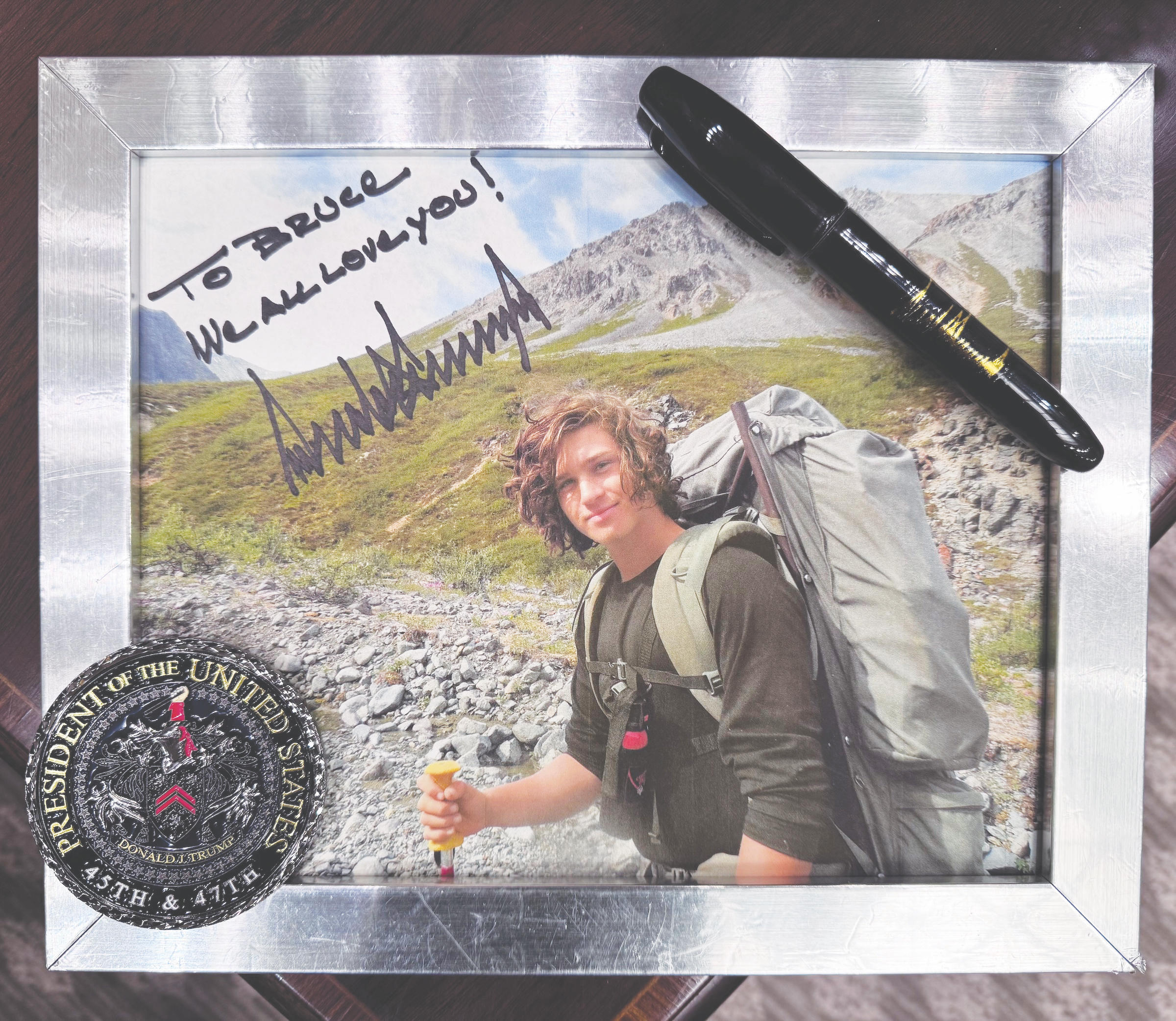
Afterward, he met with each of them individually. “We all had photographs of our children,” Sandy says. “And he signed them.”
When he took Bruce’s photo, he wrote: “To Bruce, we all love you.” “That was so lovely that he did that,” she says quietly. But Sandy hadn’t come only to remember. She had come prepared.
“There is a man—a chemist—whose son died ten years ago,” she explains. “He believes that fentanyl can and will be turned into a weapon of mass destruction.” He had even created renderings—scenarios where the drug could be aerosolized with devastating consequences.
“He knew I was going into the Oval Office,” she says, “and I might have an opportunity to say something.” So she decided what that something would be.
As the president held Bruce’s photo, Sandy spoke. “Mr. President,” she said, “the next step in the fight against fentanyl is designating it a weapon of mass destruction.”
She remembers the pause. “He was looking at Bruce, and looking up at me,” she says.
Then he answered: “That is a good idea. Why haven’t we done that?” He turned to his chief of staff and said one word: “Done.”
Two weeks after Sandy’s visit, On December 15, 2025, the president signed an executive order, “He said it out loud,” she recalls. “I am designating fentanyl as a weapon of mass destruction.” President Trump elevated Fentanyl to a national security threat. The order warned that fentanyl is “closer to a chemical weapon than a narcotic” and cited its potential for “large-scale terror attacks.”
Bruce’s Law honors those lost to fentanyl while tackling the crisis head-on: cracking down on trafficking, stiffening penalties, and expanding prevention and awareness. It recognizes fentanyl as a fast-moving threat tied to organized crime and to national security.
Bruce’s Legacy: From Tragedy to Law
“My 22-year-old son, in 2021, somehow got 100% fentanyl,” Sandy says, her voice steady but heavy with memory. “He took it—he wasn’t seeking it—and it killed him immediately. He dropped where he stood. He couldn’t call out for help. He was within 30 yards of a McDonald’s drive-through and a Wells Fargo drive-through, and he wasn’t able to...” Her voice trails off in grief.
For the first two months, Sandy and her family were “under water,” lost in grief like so many parents who face this tragedy. Then the toxicology report came back: 100% fentanyl. “I had heard the word, seen news reports that fentanyl was part of the illicit drug supply. I thought it was in the lower 48, not in Alaska. That report shocked me,” she says. From that moment, she threw herself into learning everything she could about fentanyl and how it could have reached her son in Anchorage. “I was cold-calling people, mostly law enforcement... just trying to understand it.”
“I told my family I was going to take a run at fentanyl,” she continues. “I did lots of things. I joined a meeting with Senator Murkowski. One of her staffers said we should do Bruce’s Law. I didn’t pay a lot of attention to that comment at first. But after that, we started having meetings every Wednesday for Bruce’s Law... and we kept going.”
The journey ended in the Oval Office. “December 2nd, 2025, President Trump signed Bruce’s Law, and now it’s the law,” she says, her eyes bright.
In the end, she kept her promise: she took a run at fentanyl transforming unimaginable loss into national change. Her son Bruce; who died tragically too young; has become a symbol of hope that fewer families will suffer the loss of their youth to fentanyl poisoning.

By Jeremiah Bartz Frontiersman.com A football coach using a hockey reference as the centerpiece for his keynote address may

Frontiersman.com With its headquarters in Wasilla, the Frontiersman has been a primary source of news for the Matanuska-Susitna

By Katie Stavick Frontiersman.com The next generation of leaders took flight this week as the Houston High School Class

By Kyle Wilkinson For the Frontiersman Keynote speaker and Carry the Cure President Bill Pagaran’s words boomed through the