Retiring teacher, coach urges Colony grads to ‘find their 68’
By Jeremiah Bartz Frontiersman.com A football coach using a hockey reference as the centerpiece for his keynote address may


BRIAN O’CONNOR/Frontiersman.com
PALMER — For someone who spent most of her morning “generating the mutilation” with sheep’s blood, fake cocaine, and overturned furniture, Kathleen Nevis was in a pretty good mood.
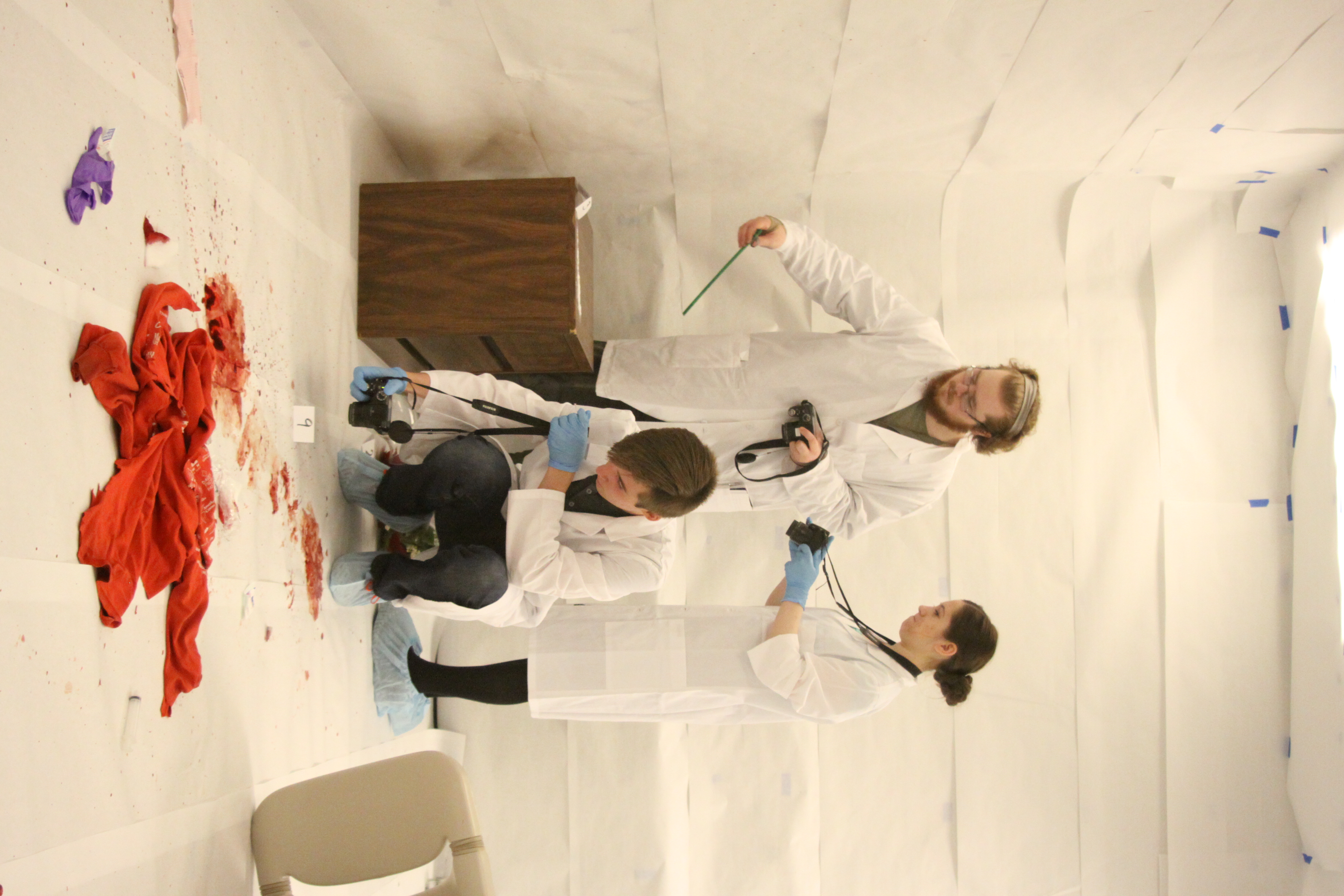
In this particular instance, the blood — safely obtained from a medical supply company and stripped of coagulants — cocaine-like powder, and furniture were meant to tell a story for the benefit of some local students enrolled in Burchell High School’s summer Forensics Academy.
The mutilation in question was a fictional assault and murder, and the scene was part of an introduction into the scientific method at Mat-Su College. Nevis, a new member of the college’s faculty with a background in microbiology, had carefully authored a gruesome story June 2.
The basic story goes like this: a man told police he found his girlfriend bleeding in the middle of a room now soaked with blood and scattered with overturned furniture. The woman left in an ambulance, and later died.
The wall had a bloody palm print on it. Drops of blood led away from the detritus-strewn scene, littered with the leavings of fake emergency medical technicians. The man’s clothes are represented by the blood-spattered full-length white body suit Nevis wore while staging the scene, which hung in one corner.
The boyfriend “tried to determine whether she was alive or not and called 911,” Nevis told the assembled Burchell High School students. They scribbled furiously on notebooks and pieces of loose paper in white lab coats and blue surgical gloves. In a few minutes, three designated photographers would don blue medical shoe covers and enter the scene, carefully documenting details at the behest of their investigative teammates. Their goal would eventually be to try and match the physical evidence with the boyfriend’s account, Nevis told them.
“What you’re going to want to do is make sure you document these clothes, because when we do blood splatter analysis next week, you’re going to have to determine whether his story and the blood spatter patterns are consistent,” she said.
While students focused on nabbing the girlfriend’s assailant, the class’s ultimate goal for the students was twofold, said Burchell Principal Adam Mokelke. The first was to get students out of the classroom, Mokelke said.
Previously, the school had used summer school to focus on class time. Students would spend up to half the day in a classroom, Mokelke said.
“That’s arduous for staff and students,” he said. “At the same time, when I observed this after my first year, we had archeology field school.”
The field school stuck out, because rather than hours in a classroom, students and teachers went to an actual archeological site, camped and helped dig, Mokelke said.
“So last year I proposed to our staff that we model our summer school program after the archeology field school, and that each of the programs we do we call ‘academies’ and we make them integrated, team-taught, collaborative, hands-on,” he said.
Teachers also chose the college setting for the forensics academy to take the edge off the transition from high school to college, Mokelke said. Students who successfully complete the forensics academy receive college credit.
Other academy themes include the “Freedom Riders,” based around the famous desegregation movement of the 1960s, the Adventure Academy, designed to combine outdoor recreation and a language arts elective, and the Archeology Field School, in addition to the Forensics Academy.
The Forensics Academy definitely fits the hands-on bill, even if the hands are carefully gloved. The class features presentations by Alaska State Trooper Investigators and technicians with the Scientific Crime Detection Laboratory in Anchorage.
“Anytime anyone wants us to come project something or show something, we are all for it,” said forensic scientist Carly Wiehe, who, along with literal partner-in-crime Jamie Nading, talked students through the basics of crime scene photography. The pair had just completed a forensics academy in Anchorage, and would head to the scene of a search warrant later that day. The job is mostly about teaching, whether that means talking to students or teaching trooper trainees how to work crime scenes at the Sitka Trooper Academy.
“Reaching out to the communities is something we love and we push for ourselves,” Wiehe said.
Students peppered troopers with questions, such as how long it takes them to work an investigation (answer: from one day to as long as a week), how bodies are retrieved from remote locations (answer: sometimes the medical examiner comes out and gets them, and other times, the bodies go via plane).
Students generally said they enjoyed the course.
For example, senior Josh Randall said he was already inclined toward problem solving.
“I’m just investigative in general, so (when) I see something like that, it kind of opens that part of my brain,” he said. “I’m not really into the whole medical part of this thing, but the forensics part’s pretty fun.”
Michael Bouchard always had an inkling television shows like “CSI: Crime Scene Investigation” on CBS were fake, and after some lessons at the local academy, his suspicions were confirmed.
“I always knew they were not real, I was just amazed at how not real,” he said.
Bouchard joined the class in order to get science credits, and chose the Forensic Academy because it was closer to home.
Whatever the reason for enrollment, student engagement remains the priority, Nevis said.
“Really what we’re trying to do is get high school students excited about anything,” she said.
Contact Brian O’Connor at 352-2269, brian.oconnor@frontiersman.com, or on Twitter @reporterbriano.
BRIAN O’CONNOR/Frontiersman

By Jeremiah Bartz Frontiersman.com A football coach using a hockey reference as the centerpiece for his keynote address may

Frontiersman.com With its headquarters in Wasilla, the Frontiersman has been a primary source of news for the Matanuska-Susitna

By Katie Stavick Frontiersman.com The next generation of leaders took flight this week as the Houston High School Class

By Kyle Wilkinson For the Frontiersman Keynote speaker and Carry the Cure President Bill Pagaran’s words boomed through the