Retiring teacher, coach urges Colony grads to ‘find their 68’
By Jeremiah Bartz Frontiersman.com A football coach using a hockey reference as the centerpiece for his keynote address may


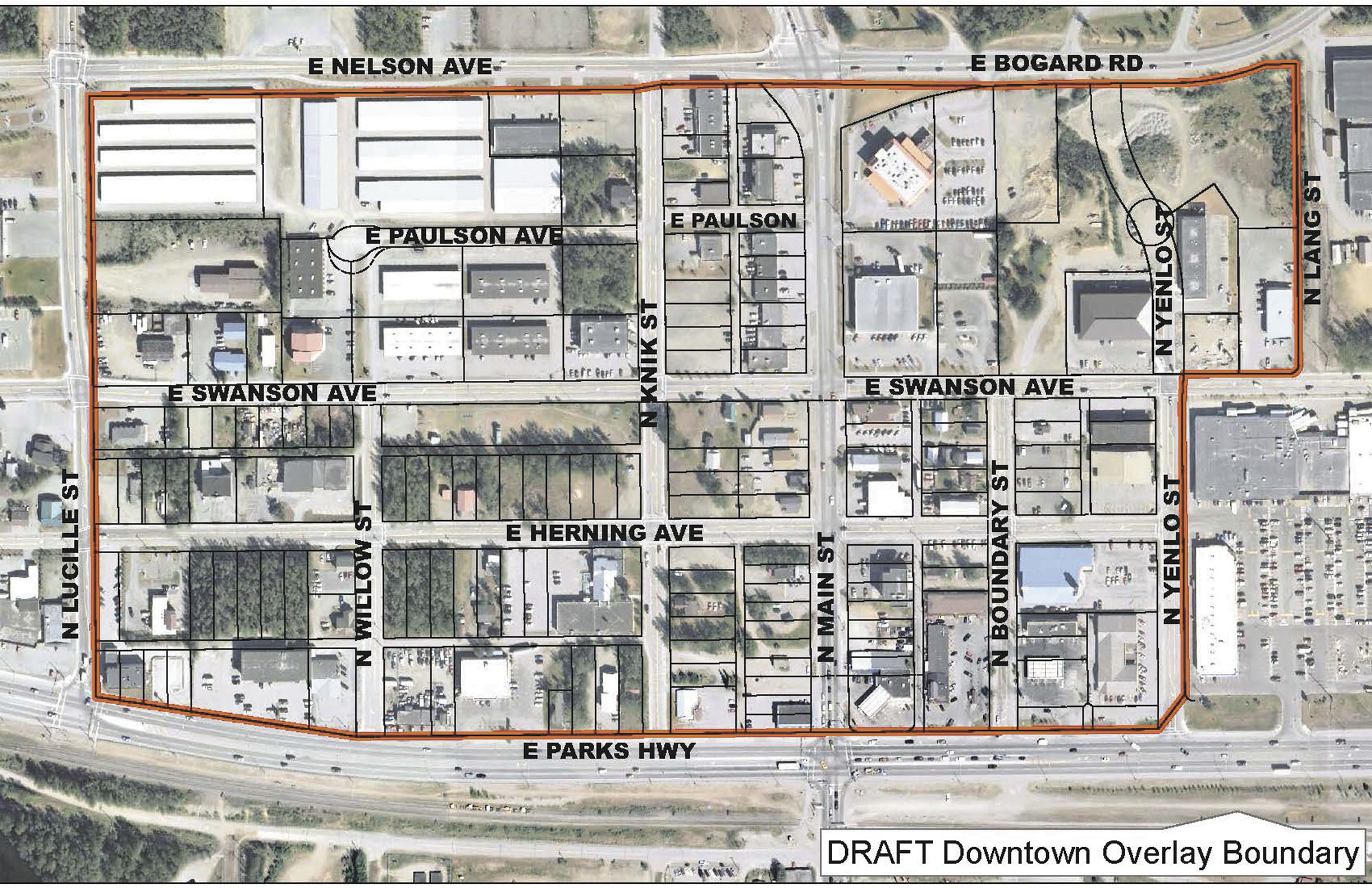
WASILLA — Some local business owners say a planned downtown overlay district could potentially hurt their bottom line, and worry resulting price increases could squeeze them out of the market.
City officials say the plan is designed to boost pedestrian traffic and aesthetics in the downtown area. The proposed district would prohibit the operation of certain types of businesses, as well as set forth design criteria for businesses operating within the downtown overlay district.
Existing businesses would be grandfathered in, though any substantial renovations would be subject to review by city planners. Taken in combination with the state-managed Main Street couplet project, which would split two-way traffic down Main Street and Knik-Goose Bay Road into one-way traffic in opposite directions along Main and Yenlo Streets, Wasilla’s downtown area could be radically altered within a few years.
A 20-page ordinance lays out the general rules of the district, and a 60-page document details design standards for virtually every aspect of businesses and residences within the district, from sidewalks to mailboxes. For example, a mailbox shaped like a fish would be prohibited, as would “any artworks perceived as a sign,” which would include, by way of illustrated example, a giant leaping fish outside a seafood restaurant.
The proposals went before the council meeting for a first reading April 27. A public hearing is scheduled May 11.
Hank Hartman owns Matanuska Music, a general sales music store at 280 North Willow Street. He doesn’t have a giant fish, or even a fish-shaped mailbox. Instead, Hartman has a roughly 12-foot guitar, and he finds the absence of data or statistics about the district somewhat fishy.
Hartman’s guitar statue is 4 feet taller than the design standards permit. What will become of his giant guitar under those standards is something of an open question, though it, too, would likely be grandfathered in, Hartman said. He doesn’t necessarily oppose the downtown overlay district, but he’d like to see more data showing what effects it would have on local businesses.
“I read all these regulations, and I want to know whose bright idea this is,” he said. “Why did somebody decide this was such a good idea and to put all the expense onto certain businesses?”
The criteria doesn’t address practical considerations like the south-facing solar panels Hartman said he’d like to install to cut energy costs. The design criteria do not contain the words “solar panels” or “wind mill.” Energy and sustainability are mentioned in sections pertaining to lighting and sustainable maintenance.
Some business owners say the proposal would place an unfair maintenance burden on local business owners, said H&R Block co-owner Beth Wright.
“It talks about installation of sidewalks, pedestrian lighting and street trees being the responsibility of the property owners,” she told the city council. “I always thought that was the kind of thing the city would pay for.”
The district’s standards would drive up the cost of renovations, construction and maintenance, which in turn would lead to increased fees for building tenants, Wright said.
“The Mat-Su Borough commercial rental market does not support the rental prices that the downtown overlay standards will create,” she said.
The effect of the design standards could increase exponentially the cost of renting for business in downtown, from between $1 and $1.50 per square foot to between $5 and $9 per square foot, Wright said.
“Where are we going to come up with an additional $5, $6, $7 a foot, when nothing’s changed but the structure of the building?” she said.
Business owners also were concerned the first they’d heard about the planned district was in a December 2014 Frontiersman article, though Public Works Director Archie Giddings told council members the planning commission had contacted property owners by mail.
Others long familiar with the downtown, though, think Wasilla residents may need to face something of an ugly truth.
Michelle Overstreet, the executive director of the non-profit MY House, which operates a retail business and a homeless outreach operation for youth about a block north along Willow Street, said she is generally supportive of the idea. She grew up in Palmer, she noted, which has a famously pedestrian-friendly urban core.
“I like the overall idea,” she said. “To coin a phrase, ‘You’re either going forward or you’re going backward,’ and a lot of these businesses need to have updated faces or updated fronts. When we moved into this building, there were a lot of things on this building that needed to be updated for fire safety. If we don’t update ever, we’re going backward. I think it’s important to little by little put the pieces in place and improve.”
Contact Brian O’Connor at 352-2269, brian.oconnor@frontiersman.com, or on Twitter @reporterbriano.

By Jeremiah Bartz Frontiersman.com A football coach using a hockey reference as the centerpiece for his keynote address may

Frontiersman.com With its headquarters in Wasilla, the Frontiersman has been a primary source of news for the Matanuska-Susitna

By Katie Stavick Frontiersman.com The next generation of leaders took flight this week as the Houston High School Class

By Kyle Wilkinson For the Frontiersman Keynote speaker and Carry the Cure President Bill Pagaran’s words boomed through the