Retiring teacher, coach urges Colony grads to ‘find their 68’
By Jeremiah Bartz Frontiersman.com A football coach using a hockey reference as the centerpiece for his keynote address may


PALMER — The only identification needed to show support for local art is your passport.
The Palmer Passport, a new program that connects area businesses with the arts community, is off to a fast start, said Selena Ortega-Chiolero, Palmer Museum of History and Art director. Participating businesses host Second Saturday events, shows and art receptions and are featured as “destinations” on the passport.
“Second Saturday is a national movement to promote arts in your community,” Ortega-Chiolero said. While Valley Arts Alliance has been promoting Second Saturday for several years, “it’s never been a real collaborative effort. So, a bunch of us in Palmer thought it would be better and stronger if (businesses) could see more unity into it.”
The result is that more than 400 people participated in the Palmer Passport program at the August Second Saturday, she said, and feedback has been positive from the business community.
“The great thing was a lot of the feedback we got from the participant stores was, ‘We got a lot of people who never knew we were here,’” she said. “I love anything that promotes the arts and gets people out there. You get to know your neighbors.”
That includes the Palmer Museum of History and Art, which featured its new exhibit, OneTree, Saturday. OneTree is a collaborative project with Valley Arts Alliance and the University of Alaska Fairbanks Cooperative Extension that gave pieces of a tree that was cut down during construction of the new Trunk Road to several artists to create “whatever they wanted,” Ortega-Chiolero said. “It’s a very interesting selection of artworks from one tree.”
At Fireside Books in downtown Palmer, owner David Cheezem said he hosts Second Saturday events “whenever we have a chance.” On Saturday, he hosted a meet-and-greet for local romance novelist Jackie Ivie, along with a discussion with author Suraj Holzwarth. Cheezem also channeled his inner Walt Whitman with a poetry reading.
“I have a thing about Walk Whitman,” he said. “I’ve done Walt Whitman-related events over the years. I believe you can’t really get what it means to be American without at least some awareness of Walt Whitman. He was one of the first distinct American voices.”
Artistically, the Valley is diverse and active, Cheezem said. “The Valley is a hotbed of great art and artist creativity — writers and sculptors and painters and poets and knitters.”
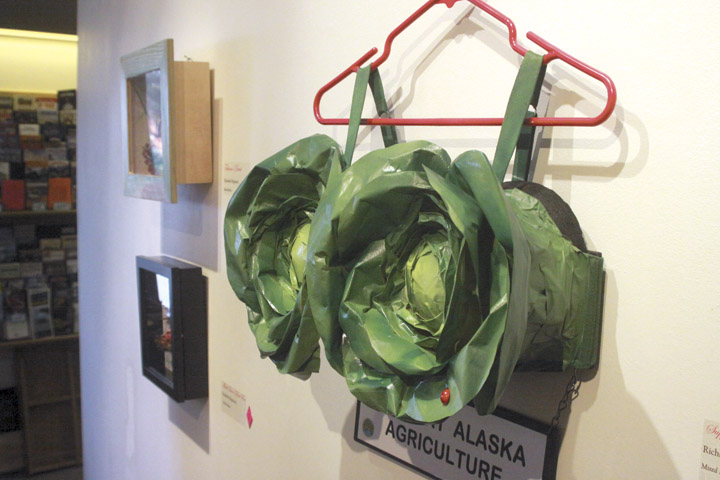
That creativity is on display at the Dorothy G. Page Museum in Wasilla, which opened its third annual Brassieres to Nowhere exhibit Saturday. Participants create bra-inspired art, which is auctioned off to benefit Casting for Recovery, a breast cancer nonprofit that hosts retreats and education for breast cancer patients and survivors.
Brassieres to Nowhere is typically one of the most popular exhibits of the year, museum curator Bethany Buckingham said.
“I had worked at a museum that had a Bra Dazzler, and they created pieces to sponsor a breast cancer awareness group in Juneau,” she said. “Some of the pieces there were absolutely amazing, and I knew our artists are just as talented, if not more. As you can see from this year’s pieces, they run the gamut.”
Like Elsie LeDoux’s entry, “Nefer-Titty,” an Egyptian-inspired mixed media collage.
“I just like to make people laugh and people seem to get a big kick out of what I do,” said LeDoux, who’s created pieces for Brassieres to Nowhere every year. “My husband actually came up with the name first. … This is a play of Nefertiti, the Egyptian queen. This is also a play on The Bangles’ song ‘Walk Like an Egyptian.’”
Richard Estelle shows a whimsical side with a distinctive Valley flair in his sculpture “Support Alaska Agriculture.” His work creates a brassiere out of two heads of cabbage hanging from a hanger. What inspired him to create his cabbage cups?
“I wouldn’t hazard a guess,” Estelle says in his description of the work.
While Estelle took the obvious route, other artists were more abstract with the Brassieres to Nowhere theme. Ortega-Chiolero actually entered a drawing titled “Back Bone” that shows the back of a woman with pieces of a brassiere as accents.
“In my drawing, I wanted to convey the feeling of being bound; restricted from true freedom, but always having the desire to break free and be seen for who we really are — strong individuals with an even stronger backbone,” she wrote in her description.
Contact reporter Greg Johnson at greg.johnson@frontiersman.com or 352-2269.

By Barbara Hunt Palmer Buzz It was 6:43 on Friday morning and the Plant Owner was sound asleep when

By Kyle Wilkinson Frontiersman Memorial Day Weekend was filled with a variety of events in Willow. From live music to

By Kyle Wilkinson For the Frontiersman The Susitna Valley Emergency Preparedness Fair will be held at the Willow Community Center

By Barbara Hunt Palmer Buzz Green-Up happened at exactly 9:34 am on Saturday morning in Palmer. This was