Retiring teacher, coach urges Colony grads to ‘find their 68’
By Jeremiah Bartz Frontiersman.com A football coach using a hockey reference as the centerpiece for his keynote address may


HOUSTON — For some of them it was old hat, for some it was likely their first time, but eight candidates for political office converged on the Mid-Valley Senior Center Tuesday to discuss the state’s biggest issues.
While large portions of the evening were spent debating senior issues and energy production, the most of the sparks flew when candidates were given a chance to ask each other questions.
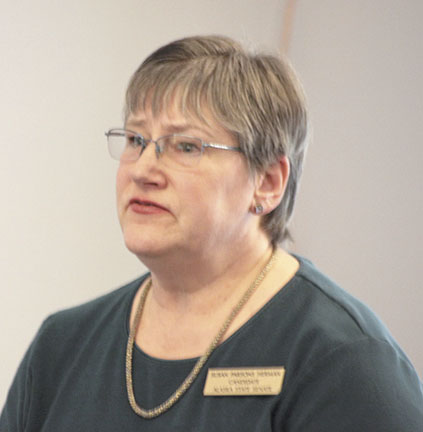
First up, Susan Parsons Herman, who is challenging Charlie Huggins for his seat in the state Senate, asked him why he declined to join the bi-partisan Senate Coalition and thus get a seat on the Finance Committee that could have allowed him to fund Valley projects.
“How was that a good thing for the Valley?” she asked.
Huggins replied that it’s not just committee seats that make a legislator effective.
“Just because you don’t sit on finance doesn’t mean you can’t do things for the Valley,” he said. “It’s about relationships and, quite frankly, credibility.”
When it was his turn to ask, Huggins said he’d looked at Parsons Herman’s Facebook page and found that she listed President Barack Obama as one of her heroes and wanted to know why.
Parsons Herman said she didn’t recall declaring Obama her hero but, “I do admire the man. I am very proud to have lived long enough to see a person of color in the White House.”
She said she is a big fan of the president’s health care reform legislation and thinks it will benefit “every single one of us in this room.”
Over on the other end of the table, Republican Mark Neuman of Big Lake faces challenger Democrat Pam Rahn for a House seat that was changed this year to include more of Fairview in exchange for the northern Susitna Valley communities of Willow and Talkeetna.
Neuman asked Rahn how Alaska, which currently gets the vast majority of state tax revenues from oil, can work to diversify its economy.
“We do have more than just oil,” Rahn said, noting that Alaska also has tourism and fishing. She said the state should diversify as much as possible but, “I believe we need to be very, very careful to do it responsibly.”
Rahn asked Neuman if he supports recently announced plans to build a road to Ambler and possibly farther into western Alaska.
“I think we should allow private industry to do it,” Neuman said.
He said the best way to do that would be to build a road running along a gas pipeline to deliver low-cost energy to the area.
Mike Dunleavy is challenging Linda Menard for a state Senate seat representing Palmer and areas skirting north around Wasilla and up to Talkeetna. He echoed a common refrain in this year’s election when he asked Menard how being a part of what he described as a “democrat-led bi-partisan coalition” has helped the Valley.
“I have been very much a player this year as far as bringing the capital budget back (to the Valley),” Menard said.
She said the coalition didn’t pressure her to stop trying to reform oil taxes and was totally on board with her funding requests, understanding that Mat-Su is the fastest growing part of the state.
Menard kept the coalition theme going in her question to Dunleavy, asking if he would have voted for a coalition-sponsored move that would have offered a 30 percent reduction in taxes for new oil production.
“I would work for any tax incentive that would increase oil production,” Dunleavy said.
“Then you just worked with the coalition,” Menard told him.
Last among the pairs of candidates, former Houston mayor Roger Purcell is challenging Wes Keller for his state House seat which this year was redrawn to include Talkeetna along with Houston, Willow and areas north of Wasilla.
Keller went first, asking Purcell what he would do about Medicare — cuts are coming, he said, and seniors are at risk.
“I would have to find people who know and studied and worked in the industry,” Purcell said. “I would work with our experts and I would work with our seniors.”
Purcell noted that before he was appointed to the Legislature and won re-election Keller was a legislative aide when asking Keller why he’d recently told a group he was looking forward to getting a fuller understanding of the budget.
“After 13 years, why is it you don’t already understand it?” Purcell asked.
Keller replied that, “Any legislator who gets up and says, ‘I understand the budget completely,’ don’t believe them. It’s pretty complex.”
Which is why, he said, he’s excited at the prospect of instituting performance budgeting to take a close look at where state departments are already spending money rather than just looking at where they intend to spend proposed increases.
Considering that the Mid-Valley Senior Center sits within the city of Houston, it perhaps wasn’t surprising that Purcell got more of the audience’s questions than other candidates. One asked if he’d ever apologized to the residents of Houston. Purcell left office under a cloud of controversy on the eve of a recall election. He said he did make mistakes.
“I learned from them and we moved on,” Purcell said. “I apologize for some of the mistakes I made.”
But, he added, he did a lot of good in office despite the controversy and afterward.
Contact reporter Andrew Wellner at andrew.wellner@frontiersman.com or 352-2270.

By Jeremiah Bartz Frontiersman.com A football coach using a hockey reference as the centerpiece for his keynote address may

Frontiersman.com With its headquarters in Wasilla, the Frontiersman has been a primary source of news for the Matanuska-Susitna

By Katie Stavick Frontiersman.com The next generation of leaders took flight this week as the Houston High School Class

By Kyle Wilkinson For the Frontiersman Keynote speaker and Carry the Cure President Bill Pagaran’s words boomed through the