Retiring teacher, coach urges Colony grads to ‘find their 68’
By Jeremiah Bartz Frontiersman.com A football coach using a hockey reference as the centerpiece for his keynote address may


WASILLA — Four Mat-Su Career and Technical High School students have been crowned the winners of a second regional competition for a national science contest.
Now it’s time to seek the “trifecta.”
After winning the Alaska Tsunami National Ocean Sciences Bowl Feb. 8 and the regional National Science Bowl Feb. 21, Career and Tech team members Ariel Hasse, Josh Hartman, Luke Arthur, Nate Peters-Landlord and Jacob Cucinello hope to secure a win in the regional Science Olympiad competition March 28.
“The idea is to win the Science bowl, Ocean bowl and Science Olympiad all in the same year, and go to nationals in all three,” Hartman said.
Although Hartman will not be participating in Science Olympiad this year due to a conflict with a Mat-Su Youth Court Bar Association event (for which he is a judge), and Peters-Landlord did not participate in the Tsunami Bowl, both young men were just as excited as their teammates at the prospect of winning all the major science competitions for their school.
Career and Tech teacher Tim Lundt — who coaches the local teams for the National Science Bowl, Ocean Sciences Bowl and Science Olympiad competitions — said winning all three regional competitions would be a first for the school.
Attending all three national competitions, too, he said, would be a feat not often accomplished in the history of the competitions.
Lundt’s brother Jack, for example, coached a team at Poudre High School in Colorado to several “trifecta” wins, but they only attended all three national competitions twice.
“It’s really only been done three or four times in the country,” Lundt said.
“If you look at how many high school kids participate in each three, and then the odds of going to nationals in all three, it’s like one in a million,” he added.
According to the U.S. Department of Energy — the sponsor of the National Science Bowl — about 240,000 students have participated in the national competition during its 24-year history.
By comparison, the NOAA-sponsored Ocean Sciences Bowl, in its 18-year history, has probably hosted around one-sixth as many students — about 2,000 per year, according to Wikipedia, which would equate to 36,000 since 1997.
In Alaska, however, the Tsunami Bowl typically draws more schools than the general Science Bowl, Hartman said. Last year, Alaska didn’t even hold a regional Science Bowl competition, though organizers requested that Lundt put together a team for the national competition with his Ocean Bowl and Science Olympiad participants.
The local Ocean Sciences Bowl is perhaps more popular because it’s more challenging, the majority of the team said.
“With Ocean Bowl, it’s oceanography and that’s it, so, since it’s only one topic, (questions) can be much more specific,” Hartman said.
But these competitions aren’t just about what individuals know, and what students learn in the programs goes beyond mere fast facts.
“(Science Bowl) provides an incentive to do outside learning in the fields that it covers, and that’s important for high school students especially because they might not otherwise push themselves to get further into a (specific career) field,” Cucinello said.
“Instead of just taking the curriculum that we have in school and stopping there, we’ll push ourselves farther, and it allows students to think critically about the world we’re in, not just (say) ‘oh that happens,’ it’s like, ‘well why does that happen?’” Peters-Landlord said.
For Arthur, the bowls have been particularly helpful in increasing efficiency and “focus,” he said.
“I need to make sure that I am still really knowledgeable and skilled at things that I learned maybe two years ago,” he said. “It means that everything (I’ve learned) has to be accessible all the time.”
Coach Lundt said his students’ personal growth also has been a noteworthy outcome of their participation in the science competitions.
“What Ocean bowl and Science bowl makes ’em do is come out of their shell,” he said.
“If they buzz in and they’re wrong, everybody knows they’re gonna be wrong. If they’re right, it’s a builder,” he continued. “So not only do you have to take chances and risks, but it also builds confidence, because as they get better at the buzzers, you can see them going faster and faster.”
Arthur agreed.
“It forces you to be aggressive and decide when to take a calculated risk,” he said.
Team captain Ariel Hasse also spoke to the confidence-building aspect of Science Bowl, but she comes to the competitions with a slightly different perspective.
Hasse, who was touring MIT and Princeton University last week and has been involved in science competitions since she was in middle school, spoke separately by phone Monday of times when she was overlooked in the “congratulations” offered to her teams.
“It’s not necessarily because they’re mean or ignorant or don’t understand, it’s just sort of a culture that we have that we don’t promote women in science,” she said.
Last year, Hasse and her teammates said, only one all-girls team was present at the National Science Bowl competition, and many of the teams were all male.
Still, Science Bowl, Hasse said, is one of the better ways for young women and girls to get into the sciences and gain “confidence in their intelligence.”
“Especially if you’re a girl, it’s a great way to get your toes in the water if you’re intimidated by a male-dominated field,” she said.
Little by little, girls seem to be taking Hasse’s advice. The Career and Tech Science Bowl B team, which took second place at the Feb. 21 competition, is mostly female competitors with captain Sarah Montalbano, Leah Wyzykowski and Kea Bekkedahl. Male teammates Cade Johnstone and Hector Campbell were also on the runner-up Science Bowl team.
But there’s always work to be done.
“More women just need to be a part of science,” Hasse said.
Contact Caitlin Skvorc at 352-2266 or caitlin.skvorc@frontiersman.com.
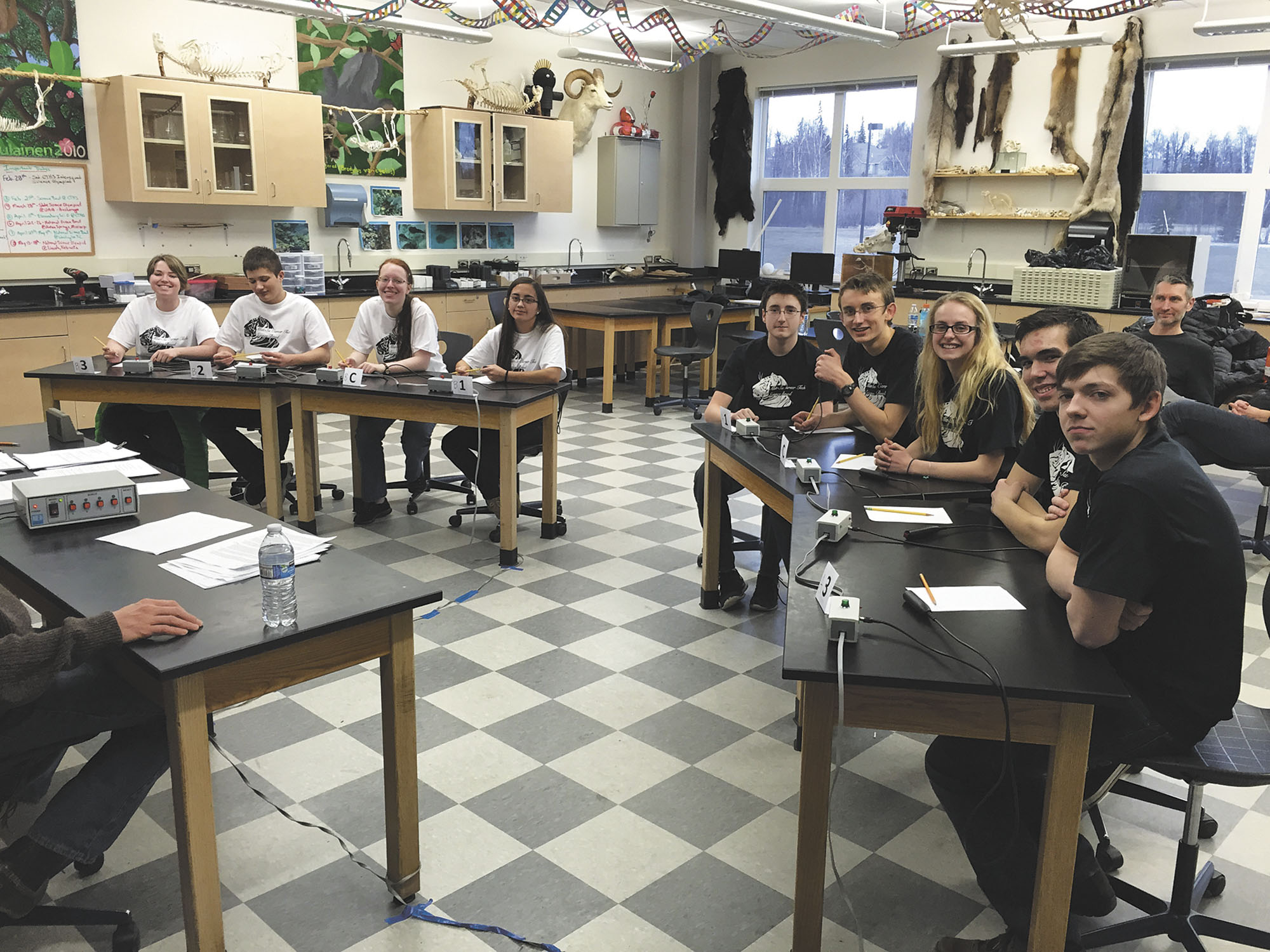
Members of the Career and Technical High School Quiz Bowl A Team hope to win a science contest trifecta this year and compete in national competitions the Alaska Tsunami National Ocean Sciences Bowl, the National Science Bowl and the national Science Olympiad
Photo courtesy Career and Technical High School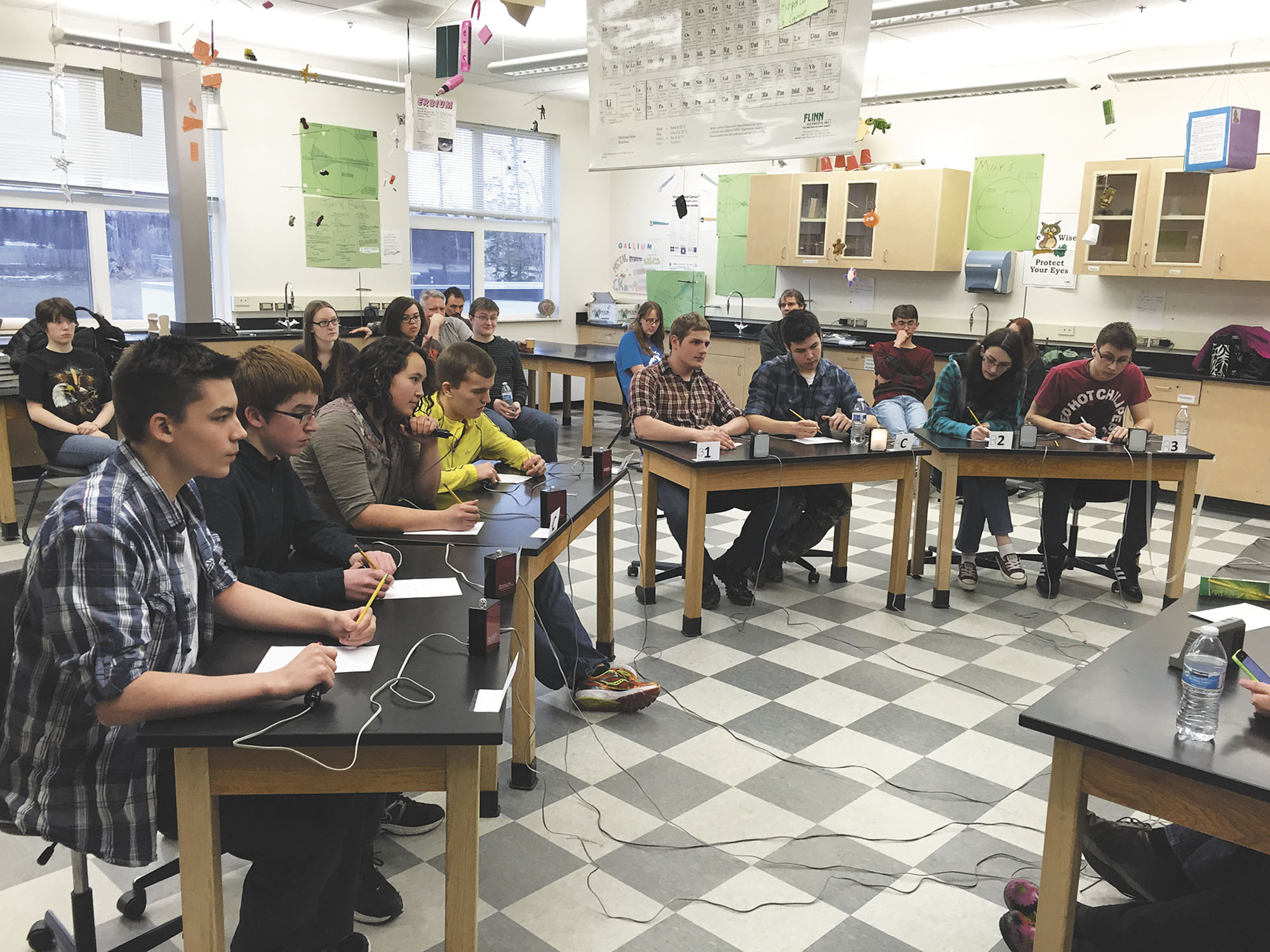
Members of the Career and Technical High School Quiz Bowl A Team hope to win a science contest trifecta this year and compete in national competitions the Alaska Tsunami National Ocean Sciences Bowl, the National Science Bowl and the national Science Olympiad
Photo courtesy Career and Technical High School
By Jeremiah Bartz Frontiersman.com A football coach using a hockey reference as the centerpiece for his keynote address may

By Katie Stavick Frontiersman.com The next generation of leaders took flight this week as the Houston High School Class

By Kyle Wilkinson For the Frontiersman Keynote speaker and Carry the Cure President Bill Pagaran’s words boomed through the

By Jeremiah Bartz Frontiersman.com The community of Palmer is known for a couple of things. At or near the