Retiring teacher, coach urges Colony grads to ‘find their 68’
By Jeremiah Bartz Frontiersman.com A football coach using a hockey reference as the centerpiece for his keynote address may


ANCHORAGE — They’ve toiled in the University of Alaska Anchorage labs and library, netted shorebirds on muddy Western Alaska sloughs, yanked philosophy out of its armchair and thrust it into everyday life. They’re studying cancer, probing biases and refining a device that could help scientists learn more about concussions.
All year, UAA scholars and artists have focused attention and passion on these and many other scholarly and artistic projects they hope might transform their communities and the world. They’ll present their work this month in the UAA University Honors College’s Undergraduate Research and Discovery Symposium, in the wake of student presentations that just took place during the 2015 Student Showcase.
Approximately 40 students participated in the symposium, including Valley grown Tesia Forstner and Kierra Hammons. The first Undergraduate Research and Discovery Symposium took place in 2007 when UAA established the Office of Undergraduate Research.
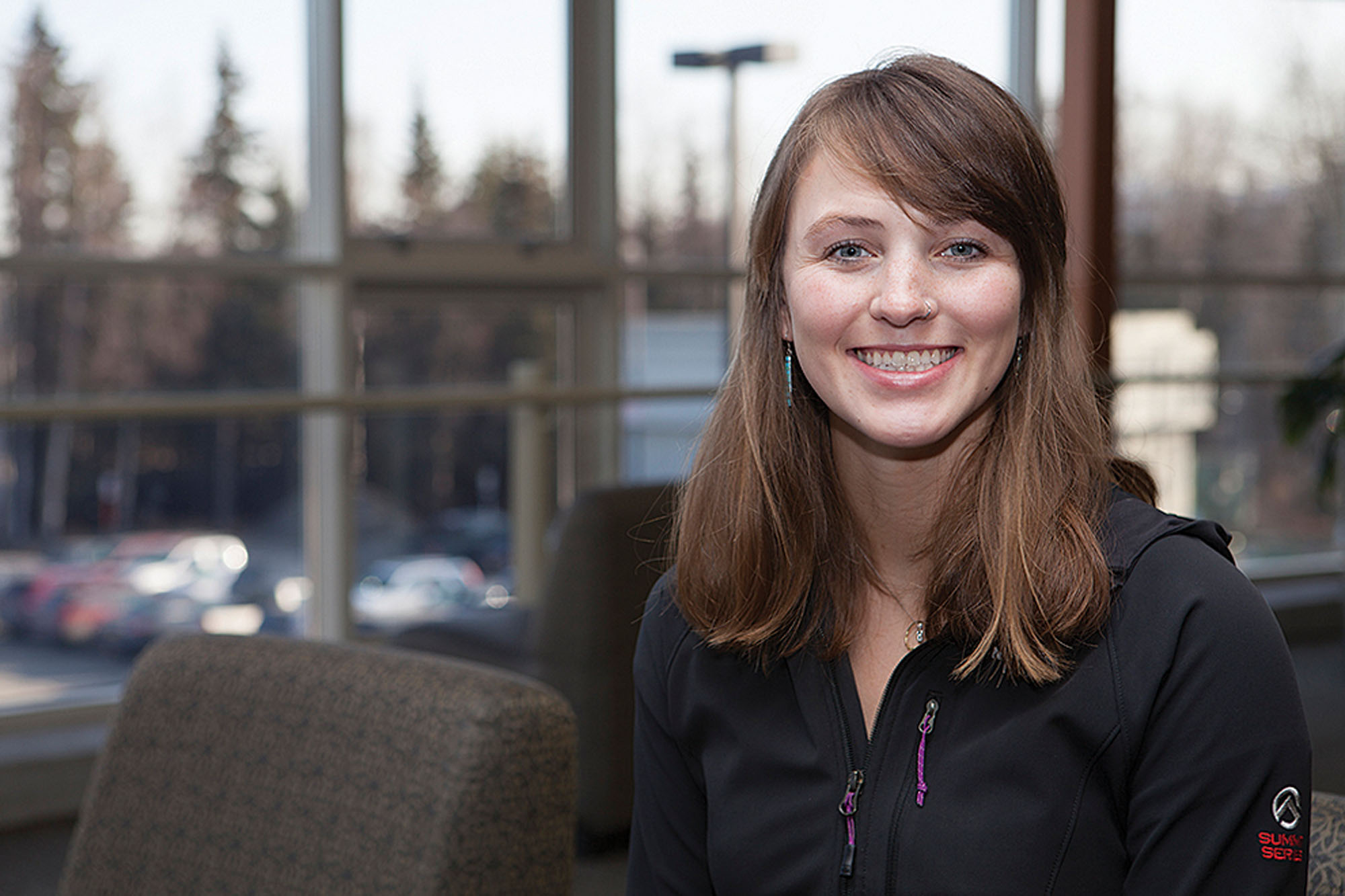
Tesia Forstner, of Wasilla, flew to Chevak last summer and then traveled 40 miles by boat to a tributary of the Kuskokwim River.
“It is this nirvana for birds; when you go there, you have to be really careful not to step on eggs,” said the UAA senior, who won this year’s Fran Ulmer Transformative Research Award for her work.
Forstner was working on a Prince William Sound Science Center project in which her UAA faculty mentor, Dr. Audrey Taylor, is involved.
The project’s purpose? Finding out what happened to black turnstone populations that abounded on Montague Island until the 1989 Exxon Valdez oil spill.
“When birds migrate, they have stopover sites,” Forstner said. “One of those sites was on Montague Island. After the spill, they stopped showing up. They’re thinking herring populations plummeted after the spill — and black turnstones eat herring. They don’t know if the population was depleted or just moved elsewhere.”
Forstner, Taylor and a few other researchers camped near that Kuskokwim tributary to locate and net 30 birds others had saddled with geolocators the previous year.
“The geolocators look like mini jetpacks,” the environmental sciences major said. “I wasn’t a birder before, didn’t know anything about them. Every species has a personality. The turnstones have a lot of attitude. They’re kind of chunky-looking for a bird, kind of fat. They just have a lot of sass. Catching them can be kind of tricky because they’re intelligent, adaptable to your methods — it’s hard to catch them more than once. There’s nothing I’ve enjoyed more than holding one of those little birds.”
The researchers caught 18 of the 30 “jetpacked” birds. They’ll use data they collect to learn more about where the birds traveled.
Why study shorebirds? Why chop up their feathers to study stable isotopes found in the fragments?
Forstner says answers scientists find are critical to preserving a healthy environment for humans as well as birds and other animals.
“It’s a little silly to me to think there’s parts of the environment that aren’t important,” Forstner said. “You’re taught in elementary school there are food webs, and we know there are food webs because it’s complicated. The one thing I’ve really learned is that everything is entirely connected. So it seems silly you would disregard a bird species, especially a migratory one, because that’s even more complicated. They’re not ecological indicators because they move, but they’re a piece of a really complicated puzzle.”
Kierra Hammons presented a project at the Student Showcase that she created as service learning in her applied ethics class.
“Basically you take a community issue, and then you apply philosophy to it and give a presentation about it to the relevant parties and try to make a difference,” she said. “We’re trying to move away from armchair philosophy to actually getting out and making a difference the community appreciates and can benefit from.”
Her project focused on Title IX issues at UAA.
“That was relevant because we were under review by the Office for Civil Rights,” she said. “I went to focus groups for the OCR, I spoke to the Title IX investigators, the Title IX director, and I got a sense of how Title IX claims are being handled here at UAA. I gave some suggestions to help the university communicate with students in a way that’s safe and productive and come up with solutions in a focus group setting in order to solve some of those problems they identified.”
One problem, Hammons said, was that the Office for Civil Rights evaluated UAA, UAF and UAS and then compiled all the data.
“We’re three separately accredited institutions, and I’m sure each institution does something right that the others can learn from, and each institution does something wrong that probably needs some work,” she said, “but it’s hard to tease those things out if all the data is compiled. And that’s the issue with the campus climate survey, too. …By figuring out a way to get down to a university level, figuring out how to group students together, how to make them feel safe, how to teach them to talk and share ideas and argue with one another for what should be done, then we can figure out ways to help our university that’s specific to UAA.”
Tracy Kalytiak lives in Palmer and works for the University of Alaska Anchorage Office of University Advancement

By Jeremiah Bartz Frontiersman.com A football coach using a hockey reference as the centerpiece for his keynote address may

By Katie Stavick Frontiersman.com The next generation of leaders took flight this week as the Houston High School Class

By Kyle Wilkinson For the Frontiersman Keynote speaker and Carry the Cure President Bill Pagaran’s words boomed through the

By Jeremiah Bartz Frontiersman.com The community of Palmer is known for a couple of things. At or near the