Retiring teacher, coach urges Colony grads to ‘find their 68’
By Jeremiah Bartz Frontiersman.com A football coach using a hockey reference as the centerpiece for his keynote address may


PALMER — After a few moments of terror turned tragic last week, Matanuska Electric Association CEO Joe Griffith now finds himself leading a grief-stricken company while trying to absorb the loss of a longtime friend.
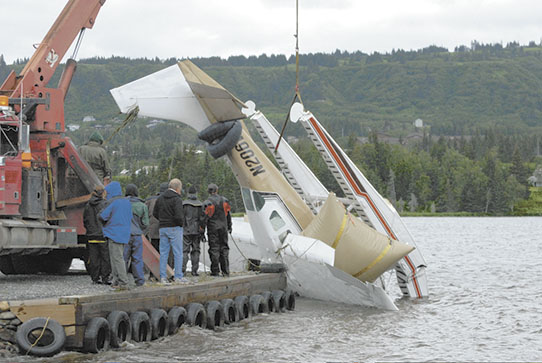
The 71-year-old executive was at the controls of his Cessna 206 the evening of July 10 when the floatplane landed on Beluga Lake near Homer. While taxiing in, a sudden gust of wind flipped the aircraft. The plane sank with Griffith and his four passengers still inside, hanging upside down in the lake’s frigid water.
“It was absolutely frightening,” Griffith said of the accident that killed Cheryll Heinze, 65, a former state legislator and MEA’s director of Human Resources and Public Affairs. “It filled up (with water) much faster than I anticipated. I thought I would have some time and I had no time. I screamed, ‘Get the doors open,’ and I knew when the fellow in the right hand, second-row seat got the door open, because that was it. There was no air left in the plane.”
That’s when fear turned to panic, said Griffith, back in his office at MEA Monday afternoon.
Also surviving the crash with non-life-threatening injuries were Tony Izzo, manager of fuel supply and contracts for the co-op’s Eklutna power plant project; Eddie Tanton, MEA safety manager; and Tony Zellers, director of the Eklutna generation station.
“Now you’re under water trapped in an airplane with no air supply,” Griffith said. “The panic factor sets in instantly to get out. Somebody was in front of me and I pushed as hard as I could off of whatever I got my feet onto to get them out the door so I could get some air myself.”
When he surfaced, Griffith said he knew he had to go back into the submerged plane because he realized Heinze didn’t make it out.
“As I went out the door, I saw Cheryll’s foot and I grabbed her foot so I didn’t lose her, so I knew where she was,” he said. “As soon as I got a gulp of air — and I’m spitting gasoline and water and my lungs are already taking in water — I was hurting for air.”
Both he and Zellers entered the submerged plane repeatedly attempting to get to Heinze, Griffith said. Soon he realized a successful rescue was unlikely.
“I know how long you can last, and it wasn’t long,” he said. “I knew she was probably already gone. I never gave up until the rescue people came, because I just couldn’t leave her.”
By the time rescue personnel arrived about 30 minutes later, hypothermia was starting to set in.
“By the time they got to us, we were both shaking so bad we were worthless,” Griffith said.
An experienced pilot with more than 6,000 hours of flying time in aircraft ranging from small single-engine Cessnas to F-4 jet fighters, Griffith said he believes Heinze didn’t make it out of that plane because she was already incapacitated.
“We touched down and it was a very normal touchdown, a smooth landing,” he said. “All of the sudden, instantaneously, the left wing came up — almost a violent movement — pulled the left float out of the water and the right wing tip touched the water. The impact up front, when I felt the wing dig in, I knew what it was instantly and there was nothing you can do except be lucky at that point.”
That violent movement may have caused Heinze to hit her head and not able to loosen her seat belt as the plane was turning, Griffith said. It’s a safety precaution he said she was very familiar with.
“I knew we were going over and I shouted to get the seat belts and get the doors open when it fills up,” he said. “That’s the rule of thumb and I’ve probably told Cheryll that 200 to 300 times over the last 10 years. Cheryll, (her husband) Harold and I have flown all over the state. … We had gone through that drill before. She would’ve pulled that seat belt first thing. She knew to loosen that seat belt.”
The loss of Heinze has hit everyone at MEA hard, Griffith said, while admitting her death also is very personal to him as well. Longtime friends, Heinze was one of the first people Griffith brought on board when he took over as CEO of the cooperative. They also share roots that go back to childhood.
Their families are from the same area in Oklahoma, Griffith said. Heinze was born Oct. 30, 1946, in Wewoka, Okla., not too far from where Griffith’s family lived.
“I knew her family well,” he said. “I didn’t pay a lot of attention to her because she was six years younger, but I knew her cousin, Hoyt Axton, a fantastic country-Western singer, and her aunt, May Axton, who wrote some of Elvis Presley’s works.”
Griffith said MEA “is hurting,” and that he talked with employees Monday morning.
“I told them what happened, how I saw it happening and how I wanted to proceed,” he said. “I told them we are going to maintain her standards as long as I’m around here. Anticipate that the first question to ask is ‘what would Cheryll say?’ on everything we do.”
He said Heinze was a friend who could also put him in his place when he needed it.
“She was my confidant, my adviser, my consultant, my haberdasher,” he said. “At times I accused her of acting like my mother, because she would keep me in line. I will miss that.”
Griffith also said he’s talked with her husband Harold Heinze, who works with MEA as executive project adviser for the Eklutna Generation Station project.
“I told him, ‘Harold, I’m so, so sorry and so crushed by this,’” Griffith said, adding Harold Heinze didn’t respond with hostility or in a negative way.
Piloting the plane involved in the crash that killed Heinze is among the hardest of the challenges life has dealt Griffith, he said. Dealing with the crash is more difficult than the three years of combat he saw in Vietnam, he said.
“This is the toughest thing I’ve had to go through,” he said. “You don’t expect it; at least in combat you expect it. She was such a vital piece of who we are and what we have become, and she was such a large piece of my life. She and Harold and I are very close. Harold was robbed of her years, and everywhere I look I see Cheryll, and it’ll be that way for a long time.”
Although the crash seems to be the result of a rogue wind gust, that he piloted the plane that night also weighs on his mind, Griffith said. He knew conditions on the lake were windy, but said the turbulence wasn’t too bad, the water ahead of him on the lake was calm and that the landing was smooth.
“I was at the controls when it happened,” he said. “I will second-guess myself all my life. The rest of my life I will say, ‘What should I have done differently?’ ‘What could I have done differently?’”
The tragedy hasn’t swayed Griffith’s commitment to MEA and the promises he made to the co-op’s board of directors. He plans to continue as CEO until the Eklutna power plant project is online and he’s helped the board find a new manager.
“This is my last job,” he said. “I promised the board that I would find a new general manager and I would build them a power plant. I’ll get the power plant online and a gas supply and a new general manager. Then, I will disappear into the sunset.”
Contact reporter Greg Johnson at greg.johnson@frontiersman.com or 352-2269.
Memorial services in honor of former Alaska legislator Cheryll Boren Heinze, Matanuska Electrical Association’s director of Human Resources and Public Affairs, are set for Tuesday.
Pastor David Dahms will officiate at a celebration of her life at 5:30 p.m., July 17 at Lazy Mountain Bible Church, 16005 E. Shawn Drive, Palmer.
A light meal will be provided after the celebration.
She will be buried in Lampasses, Texas, beside her family this summer.
All members of the MEA family are invited to attend.
Heinze died in a floatplane crash on Beluga Lake near Homer Tuesday, July 10, 2012.

By Jeremiah Bartz Frontiersman.com A football coach using a hockey reference as the centerpiece for his keynote address may

Frontiersman.com With its headquarters in Wasilla, the Frontiersman has been a primary source of news for the Matanuska-Susitna

By Katie Stavick Frontiersman.com The next generation of leaders took flight this week as the Houston High School Class

By Kyle Wilkinson For the Frontiersman Keynote speaker and Carry the Cure President Bill Pagaran’s words boomed through the