Retiring teacher, coach urges Colony grads to ‘find their 68’
By Jeremiah Bartz Frontiersman.com A football coach using a hockey reference as the centerpiece for his keynote address may


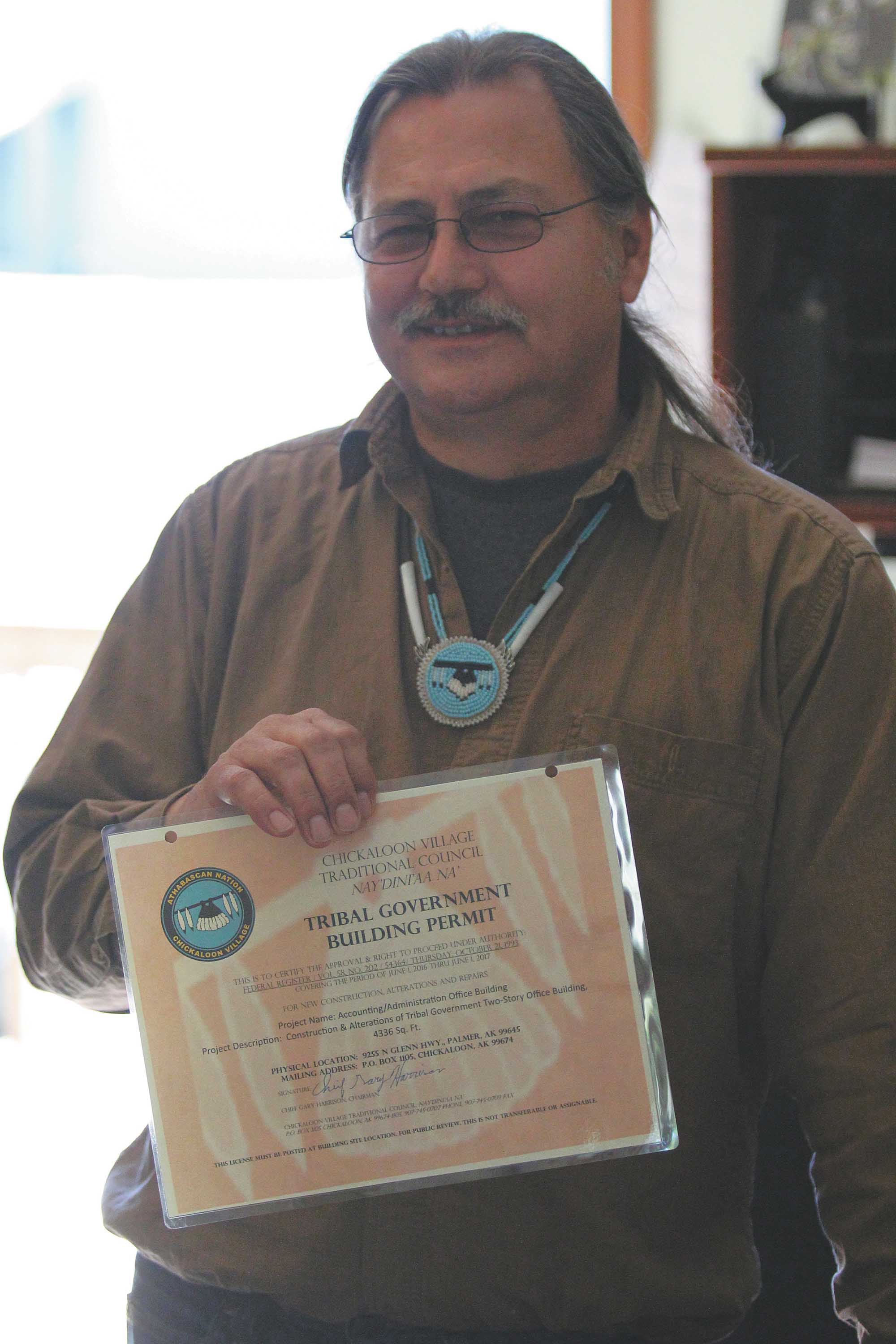
CHICKALOON — Local Native community leaders said they would defy a state-issued stop work order issued on an administrative building near Moose Creek.
Representatives of the Chickaloon Village Traditional Council and Department of Public Safety gave differing accounts of the order’s issuance, which came around 11 a.m. Thursday at a construction site near Moose Creek.
Traditional Chief and council chairman Gary Harrison said a construction crew was working on an office building near the Glenn Highway Thursday when they were approached by Deputy Fire Marshal Sven Hall.
Hall was in the area on an unrelated inspection when he spotted construction on the council’s property adjacent to Moose Creek, according to Department of Public Safety spokeswoman Megan Peters.
Neither of the officials available to speak publicly for the federally recognized Chickaloon Village witnessed the marshal’s interaction with builders employed by the council, but relayed details provided by them.
Lisa Wade was in the middle of teaching a traditional fish camp indoors at the nearby Ya Ne Da Ah School when Hall arrived. She didn’t witness the interaction directly, but had it described to her by some of the construction workers on scene.
“In the middle of our camp is when the fire marshal showed up,” she said.
Workers — and officials from the current council office building in Sutton — told Hall that as a federally recognized tribe, Chickaloon claims the right to administer elements of it’s own affairs, Wade said.
“Because we’re a federally recognized tribal government, we issue our own building permits, so it’s redundant for us to apply for those other permits,” she said.
Construction workers pushed the matter of the stop-work order, at which point, tribal officials say, Hall threatened them with arrest, Wade said.
“They asked what would happen if they were working today, if they continued working,” she said. “I don’t know whether it was a joke or what, but my understanding is that he reached to his side and shook his handcuffs.”
Joke or not, the interaction disrespected the village, Wade said.
“To have somebody come in in uniform saying ‘You can’t do this’ on our land is absolutely showing disrespect,” she said.
Nevertheless, camp organizers incorporated the encounter into the camp, Wade said.
“The students that are here are getting an interesting immersion into sovereignty, which is something that we try and teach our children at our school,” she said. “They’re seeing it firsthand. It’s just one more lesson that we’ve added into our fish camp.”
Peters disputed that Hall had threatened anyone with arrest at the site, or at a subsequent encounter outside the current village office space, when Hall presented officials with paperwork. Even the suggestion that the incident would end in arrest is wrong, Peters said.
“There is no consideration at all for an arrest to occur in this matter,” she said. “Hall did advise them however, that continuing construction would be in direct violation of state law.”
The worst possible penalty would be a citation and a fine, Peters said.
State law mandates that new buildings have plans on file with the fire marshal’s office. When Hall noticed the new construction without a plan, he responded appropriately, Peters said. Workers and officials at the present administrative offices were uncooperative, Peters said.
Harrison claimed that as a result of the encounter, he had reached out to numerous members of the Chickaloon tribe to stage a protest.
“We were going to have a protest,” he said. “Because he said he was going to come back and arrest everyone, we were going to say ‘Alright come down, bring a bus.’”
Harrison credited the office of Alaska Gov. Bill Walker with intervening to prevent a confrontation, which couldn’t be immediately confirmed with Walker spokeswoman Katie Marquette. Construction had temporarily stopped Friday, and people who had planned to show up to take part in the protest had gone home, Harrison and Wade said.
The governor’s office had contacted the Department of Public Safety after hearing of the matter, Peters said, but had not intervened in the enforcement decision one way or another. Department lawyers would review Hall’s actions, Peters said.
“At the end of the day it’s about safety and whether or not a building is going to be safe for occupancy,” she said.
The Traditional Council is the organization governing the federally recognized Chickaloon Village Alaskan Native community. In addition to the school, the council owns property housing a community health clinic in Sutton. The office building under construction is meant to replace administrative offices currently located along Meyers street in Sutton, part of a council effort to replace aging facilities with more energy-efficient and environmentally sound buildings, Wade said.
Past council-managed construction projects under previous marshals hadn’t been subjected to the same level of scrutiny, Harrison said.
The matter was one of sovereignty, Harrison added. The council has its own fire code, which is identical to the state code, but which is enforced by council officials, Harrison said.
“These people are trying to limit our sovereignty,” he said. “Sovereignty can be limited only two ways, either by your own request or by force. But even that doesn’t give away your sovereignty.”
Construction would continue on Monday, Harrison said.
UPDATE: Marquette responded via email late Friday.
"A governor's office staffer was made aware of an incident between a fire marshal employee and Chickaloon tribal members," she wrote. "She (the staffer) did not intervene; she only asked Department of Public Safety to keep her apprised of any developments."

By Jeremiah Bartz Frontiersman.com A football coach using a hockey reference as the centerpiece for his keynote address may

Frontiersman.com With its headquarters in Wasilla, the Frontiersman has been a primary source of news for the Matanuska-Susitna

By Katie Stavick Frontiersman.com The next generation of leaders took flight this week as the Houston High School Class

By Kyle Wilkinson For the Frontiersman Keynote speaker and Carry the Cure President Bill Pagaran’s words boomed through the