Retiring teacher, coach urges Colony grads to ‘find their 68’
By Jeremiah Bartz Frontiersman.com A football coach using a hockey reference as the centerpiece for his keynote address may


Frontiersman reporter
On a beautiful Monday afternoon four people set out onto Matanuska glacier with some very exciting goals in mind. We were going to learn how to ice climb, how to travel on a glacier safely and finally just learn a bit about glaciers courtesy, from Mountaineering and Ice Climbing Adventure Guides.
A guide from New Zealand, two women from New York and myself gathered in the guide shack at the foot of the glacier to go over some paperwork, check our packing lists and be issued the gear we'd need for the trip. There was an excited buzz in the shack and it was difficult to concentrate on anything other than the fact that the weather was beautiful and the glacier was just out the door, waiting to be climbed.
Chana Rosenberger, a nutrition major from Brooklyn University and Esther Richler a lab biologist from New York, had come to Alaska for a couple of weeks seeking some end of the summer excitement before having to head back home for school and work. Both girls had never been to Alaska before and neither had ever done any ice climbing or rappelling.
"This is going to be great, I've done some climbing before but never ice climbing," said Rosenberger, "and being here in Alaska has just about ruined the outdoors for me everywhere else."
Our guide was Jaya Marr from New Zealand. She had been guiding ice climbing and glacier tours for more than four years and this was her second season with MICA Guides at Matanuska Glacier.
"The best part of guiding trips is getting to hang out at one of my favorite places and meet people from all over the world," said Marr, "but what I really like is getting to teach people how to climb. It is my favorite thing in the entire world."
We were each outfitted with a pair of rigid mountaineering boots, a pair of crampons, a harness, a pair of waterproof gloves and a climbing helmet. We're all suppose to have brought a day pack, sunglasses, sunscreen, gloves, rain gear, warm fleece clothing and lunch, though, not everyone had everything. Luckily for the ill prepared, the guides had back-up equipment so no one was lacking the equipment we'd need for the day.
Once equipped and fitted, we set off down a dirt path that very quickly appeared to not be much of a path at all. Except for some blaze orange construction cones placed strategically along short intervals, the path seemed to disappear. The terrain seemed alien to the two New York woman, of course having never been on a glacier had a little to do with that.
"It almost feels like we're on another planet," said Richler. "I've never seen anything like this before, this is really cool."
The jutting ice formations and the bubbling vents, all of which I was a little familiar with, almost gave one the feel of being on another planet.
As we approached one of the vents along the trail, Marr pointed it out and told us to keep a mental picture of how it looked right then because when we came back some five hours later, it would look totally different. We each made a mental log of it and continued on our single-file path between the cones.
We eventually ran out of cones to follow and came out on a large flat part of the glacier. A nicked up, rough-looking picnic table that is used by glacier explorers before they start out on the ice was the first place we stopped. Marr told us to pull out our crampons and get them on, and I quickly realized just why the table looked so rough.
Having just been shown how to put crampons on back at the guide shack, the women needed a little help and managed to get them on easily enough. The next task was learning to walk on these steel-teethed devices strapped to our feet. Perhaps a little awkward at first, no one fell or took any sort of crampon-related injuries and managed to get it all figured out in short order. With our crampons on, we gathered the rest of the gear and left set trails behind and headed farther out onto the glacier.
As we worked our way across the ice, heading to a spot Marr used quite frequently to train new climbers, we made some stops near large, deep holes in the ice called moulins.
"Very often the surface of glaciers form cracks which may be 30 meters or more deep," said Marr. "Even deeper holes are formed when water collects on the top of the glacier and then drains away through the glacier. This can form a 'moulin' or drain hole which may reach all the way to the bottom of the glacier, 300 meters or more."
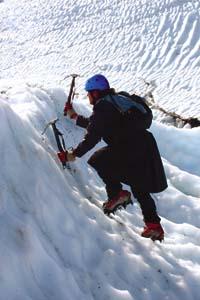
We finally made our way to a small steep slope that was about 10 feet high, which we used to start our climbing education. Marr demonstrated the technique and then we'd climb, using just our crampons at first to get a good bite in ice, and up we went, practicing our form. Marr encouraged each of us and offered minor corrections only to help make it easier as we worked the slope. Finally, when she decided we had a hang of it, we were given ice axes from her pack. After a brief demonstration we each practiced swinging the ax into the ice a number of times, alternating hands as we got comfortable with the other. Then we were given both axes and began our first ascent fully equipped. I'm sure our form wasn't perfect but we made it up and back down safely enough and our guide decided we were ready for the next step.
Our only big climb of the day was up out of a 40 foot-deep crevasse and required us to be tied in and belayed from the top. We had some down time as our guide headed up to the top in order to rig up the ropes, so we sat on some rocks and broke into the lunches we each brought. After about 15 to 20 minutes we were hailed from above and the rope was thrown down to us. One by one we made our way up the ice wall and reached the top without any trouble. From where we stood on top, we had an awesome view back down the way we'd come. The picnic table was just a dot on the ice now. Of course, one's reward for reaching the top is enjoying the ride down. Marr re-rigged the rope and set us up to go down the other side. Having a lot of experience rappelling, I volunteered to go first to demonstrate how it was done. In all fairness though it wasn't technically rappelling because we were being lowered down by our guide.
I reached the bottom quickly and unhooked, then maneuvered to a better spot for pictures. Rosenberger was the next up and wasn't very eager about stepping off the top, but after some coaxing by Marr she finally resolved herself to the task. She reached the bottom, very excited about her newest achievement.
"That was awesome," said Rosenberger. "I want to go again!"
Richler on the other hand, just hooked up and took the step, falling right onto her butt with her legs up in the air. She took a minute to get her feet back under her and easily made her way down as equally excited about her, newest and most favorite part of ice climbing, as her friend.
We hiked around some more and rappelled once more, mostly just exploring and asking our guide questions about all kinds of things. By the time we started back, we could hardly believe that it had already been more than four hours -- it really seemed as if we had just gotten started. We worked our way back across the ice and reached the picnic table where we took off our crampons and packed up our axes.
We headed back down the trail following the cones and when we reached the vent that our guide had pointed out as we started, the change was pretty dramatic. It looked totally different and the water had risen at least a foot or two, rushing down the bank to join with the rest of the Matanuska River. We got back to the shack and with great relief traded our stiff boots for our comfortable sandals.
We went through all our gear and gave back the borrowed equipment we'd used for the day.
"It was a wonderful experience," said Rosenberger. "It's a great workout and a lot of fun, I think everyone should try it."
"It was unbelievable, it was awesome, unlike anything I've ever seen or done," said Richler "It's not something you can imagine, you really have to just experience it."
A special thanks to MICA Guides and Jaya Marr for a great trip and a great climbing experience.
For more information about MICA Guides call (800) 956-6422 or go to their Web site at www.micaguides.com/index.html.
Contact Michael White at mike.white@frontiersman.com.

By Jeremiah Bartz Frontiersman.com A football coach using a hockey reference as the centerpiece for his keynote address may

Frontiersman.com With its headquarters in Wasilla, the Frontiersman has been a primary source of news for the Matanuska-Susitna

By Katie Stavick Frontiersman.com The next generation of leaders took flight this week as the Houston High School Class

By Kyle Wilkinson For the Frontiersman Keynote speaker and Carry the Cure President Bill Pagaran’s words boomed through the