Retiring teacher, coach urges Colony grads to ‘find their 68’
By Jeremiah Bartz Frontiersman.com A football coach using a hockey reference as the centerpiece for his keynote address may


ConocoPhillips announced a planning a second expansion of its producing CD-5 pad near the Alpine oil field on Alaska’s North Slope, and has also started production on a recently-completed project to expand viscous oil production at its West Sak project in the nearby Kuparuk River field, a company official announced Wednesday.
Hilcorp said it plans to begin construction next year of its “Moose Pad” project in the Milne Point field, also on the slope, and also reported that it has increased oil production in the fields it operates.
The announcements came at the Resource Development Council’s annual conference, held in Anchorage Nov. 15 and 16.
ConocoPhillips said 10 more production wells will be added at CD-5, which now has 22 wells producing 28,000 barrels per day, Lisa Bruner, the company’s vice president for North Slope development, told the RDC. The company is mid-way through a first expansion of the project, which is to increase the number of producers from 15 to 33 wells.
“CD-5 has been performing well above expectations,” Bruner told the conference.
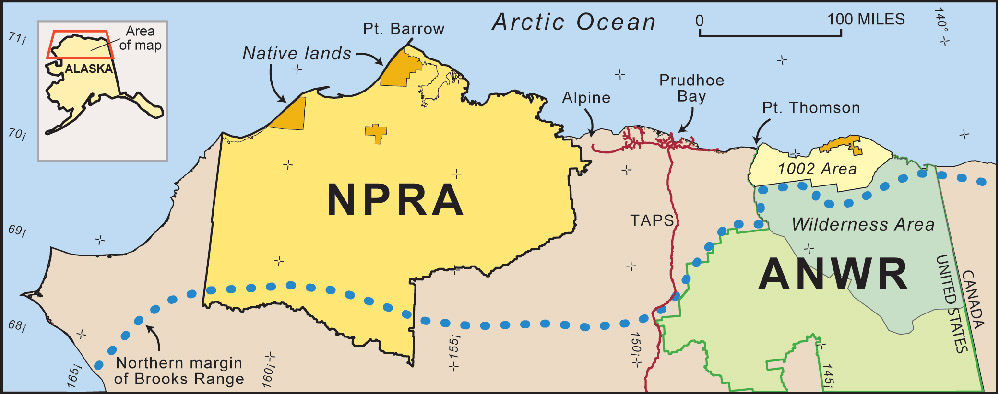
CD-5 is within the federal National Petroleum Reserve-Alaska but subsurface mineral rights are held by Arctic Slope Native Corp., which is owned by Arctic Slope Regional Corp., the Native regional development corporation for the state’s northern area. The CD-5 pad is supported by pipelines and other infrastructure on the nearby Alpine field, which is on state-owned lands.
In another development, ConocoPhillips said it has started production at its North East West Sak, or NEWS, a “viscous” oil project in the Kuparuk field after competing wells and production facilities.
West Sak has produced viscous oil for several years in the Kuparuk field. The oil is heavier and thicker than conventional oil found in North Slope fields, characterizations than made the viscous oil technically challenging and difficult to produce.
NEWS is producing wells with improved designs. It will add about 8,000 barrels per day to existing West Sak production, which now ranges between 16,000 and 18,000 barrels per day.
Large accumulations of viscous as well as heavy oil have been discovered on the North Slope but technical problems have limited a buildup of production at West Sak as well as at Schrader Bluff, a similar deposit in the Milne Point field that is operated by Hilcorp Energy.
On other ConocoPhillips projects on the slope, Bruner said the company is in its second year of construction at at the planned GMT-1 project, also in the NPR-A, and is in advanced planning and permitting at GMT-2, which is nearby and also in the petroleum reserve. Both GMT-1 and GMT-2 will produce about 25,000 barrels per day each.
A federal Supplemental Environmental Impact Statement for GMT-2 is expected to published next month by the U.S. Bureau of Land Management, which administers the NPR-A.
ConocoPhillips is also moving ahead with another Kuparuk River satellite deposit, Fiord West, which will be produced from extended-reach wells drilled from the field’s CD2 production pad. Fiord West is expected to produce 21,000 barrels per day beginning in 2021, Bruner said.
Also, more delineation and exploration drilling is planned this winter at Willow, a third NPR-A discovery by ConocoPhillips, Bruner said. Two delineation wells will confirm reserve at Willow now estimated at 300 million barrels while a third exploratory well will test for reserve additions, Bruner said. Willow is expected to produce 100,000 barrels per day
Hilcorp Energy told the RDC it has increased its North Slope oil production this year and is forecasting 42,000 barrels per day by the end of the year, up from 36,600 barrels per day last January. “Our plan is to be able to develop new oil at $40 to $50 a barrel. If we can do that, we feel we’re covered,” in the current price environment, David Wilkins, the company’s Alaska vice president, told contractors and business leaders at the Resource Development Council’s annual meeting.
Hilcorp will also begin drilling and production at its new Moose Pad project in the Milne Point field on the slope late next year and is forecasting peak production of 16,000 b/d by 2020, Wilkins told the conference.
Moose Pad is owned 50-50 and is operated by Hilcorp and BP. Wilkins said the accumulation being targeted has an estimated 30 to 50 million barrels of recoverable oil. Development costs are estimated at $300 million to $400 million.
Besides Milne Point, which is onshore, Hilcorp operates two offshore producing fields where it is 100 percent owner, Endicott and North Star in the Beaufort Sea.
The new production this year in Hilcorp’s producing North Slope fields results mainly by redevelopment of older wells drilled by BP, the former owner and operator. An example, Wilkins said, is at Northstar where the company successfully tapped new oil producing intervals in older wells and plans to continue the strategy.
Hilcorp also drilled 10 new wells this year in its slope fields, Wilkins said. “We see a potential for nine million barrels of new production just from the existing wells,” he told the conference.
One other Milne Point project Hilcorp is tackling is a pilot test to boost production of oil from the Schrader Bluff viscous oil deposit within Milne Point. Viscous oil is heavier and thicker than conventional crude oil and while Schrader Bluff is producing technical problems have complicated efforts to increase output. Wilkins said Hilcorp will be experimenting with the injection of polymer fluids to loosen the oil.
Meanwhile, a major new project Hilcorp is pursuing is development of Liberty, an offshore deposit, which is now in the final stages of permitting with the U.S. Bureau of Offshore Energy Management. Development costs are estimated at $1 billion, and Hilcorp expects Liberty will produce 50,000 to 80,000 barrels per day if it proceeds, Wilkins said.
Hilcorp owns 50 percent of Liberty with 40 percent owned by BP and 10 percent by Arctic Slope Exploration, a subsidiary of Arctic Slope Regional Corp., a Native American development corporation owned by the Inupiat Eskimo people of the North Slope. A decision to develop Liberty cannot be made until regulatory and permitting procedures are completed.
Liberty is five miles offshore and is in the federally-owned Outer Continental Shelf. It would be produced from an artificial gravel island built in shallow water with a buried subsea pipeline built to shore, and would be virtually a twin to Northstar, built by BP in 2001. Northstar is six miles offshore and is similarly connected to shore with a subsea pipeline.

By Jeremiah Bartz Frontiersman.com A football coach using a hockey reference as the centerpiece for his keynote address may

Frontiersman.com With its headquarters in Wasilla, the Frontiersman has been a primary source of news for the Matanuska-Susitna

By Katie Stavick Frontiersman.com The next generation of leaders took flight this week as the Houston High School Class

By Kyle Wilkinson For the Frontiersman Keynote speaker and Carry the Cure President Bill Pagaran’s words boomed through the