Retiring teacher, coach urges Colony grads to ‘find their 68’
By Jeremiah Bartz Frontiersman.com A football coach using a hockey reference as the centerpiece for his keynote address may


PALMER — It’s been 17 days since the 2015 local elections, yet one contentious race for the borough assembly remains in dispute.
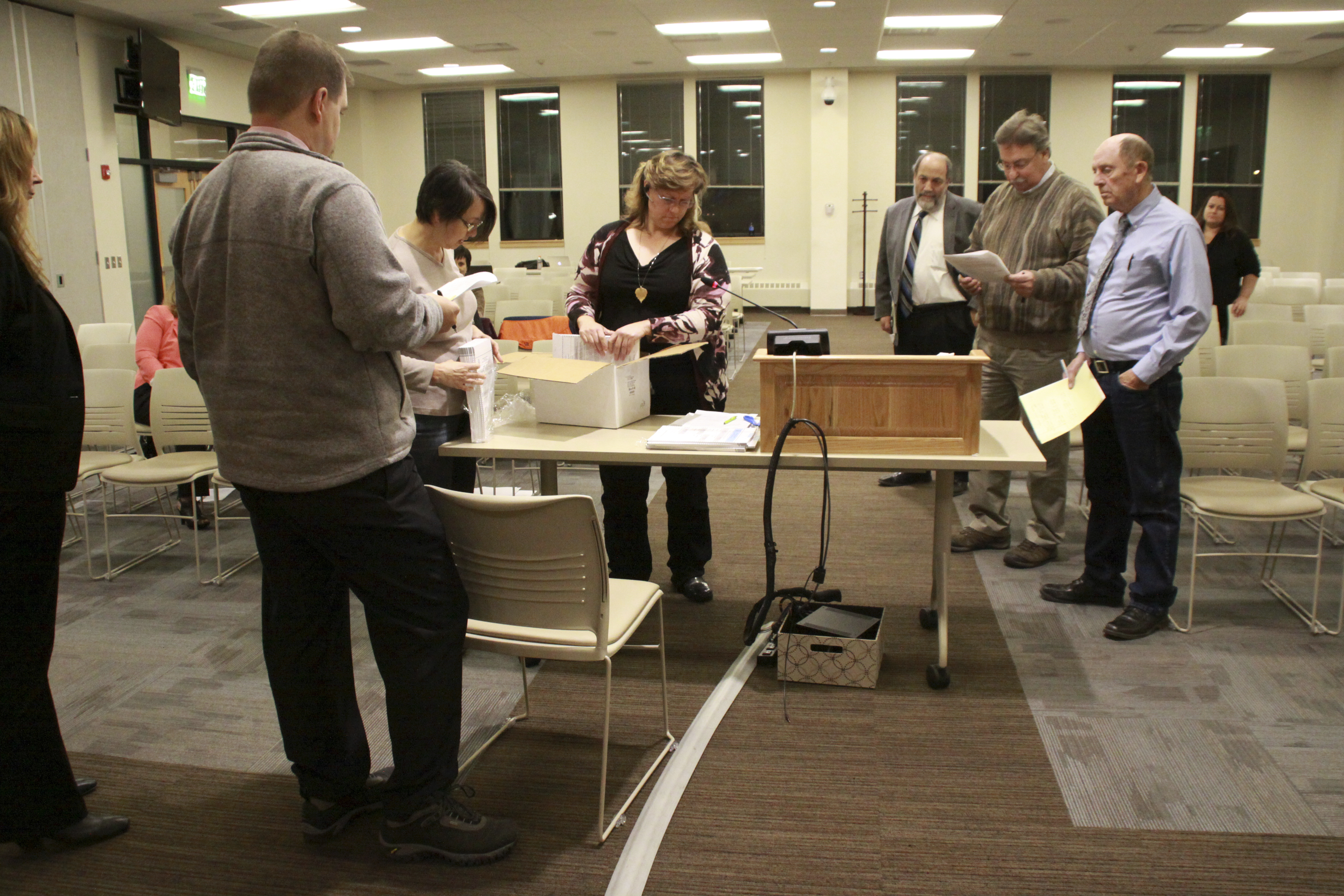
A three-hour investigation Thursday night did not immediately change the apparent outcome of the District 7 assembly race between Randall Kowalke and Doyle Holmes, nor was it expected to. It will be up to the Mat-Su Borough Assembly to determine whether to continue the investigation at Tuesday’s joint meeting with the borough planning commission or swear in Kowalke, who leads Holmes by 33 votes after a dramatic reversal of fortune between the election night preliminary results and the completion of ballot counting more than a week ago. The assembly will make that decision after borough attorney Nick Spiropoulos reports the results of Thursday night’s investigation.
The investigation involved interviews with all four precinct workers the night of the election — Pam Flowers, Francine Bennis, and Gary and Lois Lunak — as well as interviews with borough clerk Lonnie McKechnie, deputy clerk Jamie Newman, Houston City Clerk Sonya Dukes, the canvass board chair and the two members of the canvass board who checked the Talkeetna poll results. The entire canvass board attended the investigation, which was open to the public — though most of the about 20 people in attendance were there as part of the proceedings.
Holmes repeatedly asserted he did not think election officials were lying about what happened, but also said officials had deviated from the standard behavior.
Details of the election night don’t agree as to some exact specifics, but testimony before Spiropoulos and McKechnie generally related the same course of events. Sometime on the late afternoon or early evening of election day (officials were able to narrow the time down to a one-hour window between 4:30 and 5:30 p.m.), the AccuVote machine at the Talkeetna precinct stopped accepting ballots through its top slot, and voters instead slid them through a side slot. Talkeetna voters slid 28 of the 199 ballots there into the backup side slot and into a separate chamber, according to precinct chairwoman Bennis, who testified via phone.
When polls closed at 8 p.m., polling place volunteers removed the ballots from the main reservoir and the back-up reservoir, counted the totals to match them against a sign-in sheet, then filled out a Ballot Accountability Report (BAR) for the precinct. The five-page report — officials at every precinct fill out and sign a similar report — contains the signatures of the four officials at the precinct that night, the number of “spoiled” (ripped or damaged) ballots, and a list of “stub numbers,” serial numbers printed at the top of a ballot of the first unused ballot and the last unused ballot. It also contains a one-page table showing the math used to calculate the total number of ballots used, and a page for notes about the results.
Three other officials then went home, leaving Bennis alone with ballots until they were delivered to Hays-Dukes about an hour after polls closed.
Holmes has alleged that periods of time when the ballots were in the custody of a single person — roughly between when Bennis let the other officials go until the time they were delivered to McKechnie and Newman — constitute misconduct.
“In my complaint, it says ‘malconduct by an election official,’” Holmes said. “The election official statement includes the people in the polling place in Talkeetna as well as the clerks that handled the ballots also. So any opportunity to substitute the ballots at any point in that would and could introduce a bias. In testimony tonight by your questions, which were not completely accurate in those questions, there were at least four different statement of how the ballots and who removed those ballots from the machine, and who put them in the bag. The MSB regulations specifically require that people not be left alone with those ballots.”
The statutes also allow the clerk to instruct elections officials otherwise, including the designation of single officials, Spiropolous said.
Spiropoulos said singular possession didn’t necessarily constitute evidence that the vote had been biased or erroneous. He also pointed out that Holmes hadn’t introduced any evidence of bias, apart from the possibility of bias.
“The Supreme Court of the State of Alaska has been very clear,” he said. “It’s a significant deviation which introduces a bias into the vote. Your claims of error were, in the initial election contest, that only one person took possession of the ballots. Today, you augmented that with an e-mail that says there was no receiving team. The question to be answered, that the assembly will ultimately address is: did that inject bias into the vote?”
“It could,” Holmes answered.
“Notwithstanding what you said today, just here now, you have not made the allegation that an election official substituted it,” Spiropoulos said.
Without matching the serial numbers on the BAR to the serial numbers on the ballots, officials couldn’t definitively prove their result, Holmes said.
“So far, you can’t prove that all of the ballots that were issued from this building were returned without checking out those serial numbers that are still in that sealed box, and until that occurs, then you’re not going to be able to prove that there wasn’t something introduced into the system somewhere,” he said.
Eventually, Spiropoulos asked to check the full packs of unused ballots that returned from Talkeetna, which matched the numbers expected based on the BAR.
Spiropoulos did not check the serial numbers of the partially used pads of ballots, which would have required removing them from an envelope sealed by election officials. Asked about that after the meeting, Spiropoulos said he was waiting for an assembly vote before checking the registration numbers. Officials also said the hearing was conducted with no extra cost to the taxpayers or candidates.
“We’re salaried,” Spiropoulos quipped.
Holmes has filed a formal contest of the results, and not asked for a recount. The difference is that contesting an election covers "malconduct, fraud, or corruption," while a recount focuses on ballots which may have been improperly included. In either case, Holmes would bear the cost. A recount also requires a $100 deposit per precinct.
Holmes said he was reasonably satisfied with the outcome of Thursday’s hearing. Talkeetna voters had voiced questions about the outcome to him, and he said he hopes the additional scrutiny will eliminate doubts about the legitimacy of the election process.
“We don’t want anymore hanging chads,” he said, referencing the contested 2000 election.
Kowalke elected not to attend the meeting and instead went to a friend’s birthday party. The hearing was a waste of time, he said.
“The people who made the evaluation, the people who did the due diligence are the people who are now being asked to reverse their decisions,” he said. “I trust that their decisions were correct in the first place.”
The borough assembly and planning commission will meet jointly at 6 p.m. Tuesday in the borough assembly chambers.
Contact reporter Brian O’Connor at 352-2270, brian.oconnor@frontiersman.com, or on Twitter @reporterbriano.

By Jeremiah Bartz Frontiersman.com A football coach using a hockey reference as the centerpiece for his keynote address may

Frontiersman.com With its headquarters in Wasilla, the Frontiersman has been a primary source of news for the Matanuska-Susitna

By Katie Stavick Frontiersman.com The next generation of leaders took flight this week as the Houston High School Class

By Kyle Wilkinson For the Frontiersman Keynote speaker and Carry the Cure President Bill Pagaran’s words boomed through the