Retiring teacher, coach urges Colony grads to ‘find their 68’
By Jeremiah Bartz Frontiersman.com A football coach using a hockey reference as the centerpiece for his keynote address may


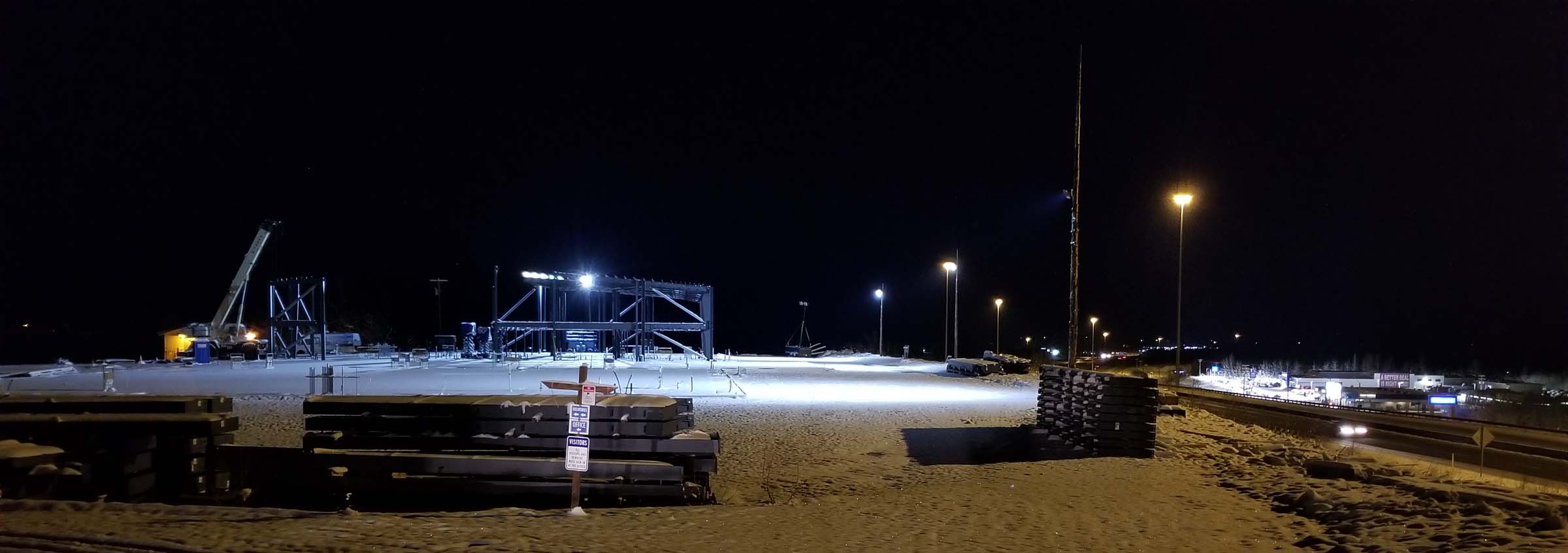
WASILLA — During the Oct. 31 Wasilla Planning Commission meeting, commissioners passed a resolution that approved the King’s Chapel church’s request to exceed the city’s height limit of 35 feet for a total of 61 feet and 11 inches to the new church currently under construction atop the hill on Sun Mountain Avenue, to the right of the Parks Highway overpass and entrance to Wasilla city limits. The motion also denied the church’s request to erect a lighted cross structure on the roof, which would’ve added an additional 17.42 feet.
“The commission is not approving whether or not a church can be there or not. It’s whether or not they are allowed the additional height and whether they’ve met their burden of proof for the criteria,” Wasilla city planner Tina Crawford said.
Just above the “Welcome to Wasilla” sign, the new King’s Chapel church’s foundation has been laid and construction is currently underway, which was one of the main points of concern for city commissioners, saying the church waited too long to inform them of the design changes and change in contractors.
Before the King’s Chapel discussion (Resolution # 18-18), most of the previous items addressed in the agenda went by rather quickly. The church discussion took well over an hour with numerous people on both sides of the debate providing public comment.
A majority of public comments were split between church representatives and members in favor of both requests while residents of the nearby neighborhood were mostly against the light pollution and hindrance of natural views of the mountains and stars.
Nearly all opponents of the church’s request wanted to assure everyone that they were not against the church itself or any church, but insisted the towering cross with bright lights would be an eye sore and would pollute the air with light. Several of these residents claimed they could already see the construction lights at night from the house and that was indicative as to what laid ahead when the church was complete.
All the council members went out of their way to insist that they too were not anti-church but merely trying to follow their rules and regulations.
“We are excited about our new church building and we really are excited it is on that property and the elevation that the property has,” John Paoletti, a member of church and the church building committee said when first took to the podium.
Paoletti said that he was there on behalf of Wally Pehrson, head of the church building committee.
Commission Seat B Darrell L. Breese and commission chair Jessica Dean both attended the meeting telephonically.
Brian McMillen, founder and owner of McMillen Designs, LLC and the architect for the King’s Chapel project, was the first person to speak during the public comment portion.
“In almost all communities, a steeple is never considered part of the building height and it’s always had an exception out because they usually tend to be 20 to 30 feet above,” McMillen said. “Every city I’ve ever worked in has the same thing and your code as far as I can find does not address that situation.”
McMillen said that he was sure there are currently churches in the area that are above 35 feet.
Breese asked Crawford about McMillen’s comment. Crawford said that the city code treats buildings and structures the same and there is some mention in the code about steeples but later said there were no specific definitions for steeples in the code.
“But this is by typical definition is not a steeple. It’s a feature that’s attached to the exterior of the building,” Crawford said.
Crawford said there could be some sort of exception in the code for a traditional steeple attached to the architecture. But in this case, the cross structure placed atop the building was, “basically artwork that was attached to the exterior of the building.”
“It may be serving the purposes of a steeple but it’s not the stereotypical steeple,” Crawford said.
Dean verified with Crawford that if King’s Chapel’s steeple were a traditional one, would there potentially be an allowance for it within the building codes. Crawford said yes.
Wasilla Planning Commission co-chair Brian Mayer asked the city attorney Anna Crary what to the commission should consider when defining a steeple.
Crary said to look at how the city planner defines a steeple, perhaps looking at past applications to see what structures were identified as steeples and if they vary from what’s proposed in the conditional use permit, past interpretations of Wasilla city code or in the absence of that, see if any Borough or other city codes have been similarly applied to Wasilla.
Breese asked Crawford, “if the cross was fixed or attached to the roof of the building, does that change things?” She said, “Yes, in short answer, yes” and stated that she just looked up the definition of a steeple on freedictionary.com and it stated, “a tall tower that forms the superstructure of a building (usually a church or temple) and that tapers to a point at the top spire.”
“So that’s my interpretation and understanding of the code and definitions as this is not a steeple. This is a structure that’s attached to it. It’s not part of the superstructure… If it were part of the architectural superstructure of that building then it would be considered a steeple and it would be exempt from that,” Crawford said.
Crawford said that if one were to remove a typical steeple right off the top of a church, there would be a big hole in the roof and the King’s Chapel building design could stand with or without the cross structure. She noted that their code did not specifically define steeples but based on past practice, that’s what her understanding of a steeple was.
The commission approved the church’s permit for use on Sept. 8, 2016. Mayer asked Paoletti why no one brought these significant changes forward until now.
Paoletti said that they had different contractor when they first started and that changed and that change altered the design due to cost.
Mayer asked McMillen if he knew about the city’s code and height restrictions while he was drawing up the plans for the building. McMillen said yes and cited the contractor change as one of the prevailing reasons for that.
Retired Mat-Su Borough School District teacher Diane Firmani was the only community member who explicitly argued against having a specific religious symbol as one of the first impressions people may get while driving into Wasilla on the Parks Highway.
“I’m afraid that the first impression is that we’re all about religion instead of letting all people know that they are welcome,” Firmani said.
That was one of several items on list Firmani cited in her opposition.
“Why now?” she asked. “Why is King’s Chapel seeking approval from the planning commission now? I’m no contractor but I can see there’s a building up there. The framework is set.”
Firmani said that it felt like the church was trying to get, “forgiveness not permission.” She said that they should have brought this up at least a year ago.
Barry Haggerty said that he was in favor of the church and both of their requests for height exemption. He saw the church will be an asset to the Valley and greater state of Alaska and that steeples have, “always been an identifying feature of a church building, regardless of the religious affiliation.”
“It gives people a symbol of hope,” Haggerty said.
Haggerty said that Alaskan winters are of course, very dark. He said that darkness allows people to see the glowing stars and Aurora Borealis.
“But there’s another darkness that unfortunately, as we said, hoping that a drug rehabilitation center would soon be out of business, that there would no longer be a need for that. There is a darkness that’s our community. Any type of positive light I think we should be welcomed,” Haggerty said.
Mayer asked Paoletti to recall to the best of his knowledge when they changed contractors. Paoletti said it was in 2016. Mayer then asked Paoletti what sort of communication the church exchanged to the city planning staff once they changed contractors.
“I don’t have an answer for that as far as how that went,” Paoletti said. “It kind of lost its momentum. It kinda’ stayed stale for a little bit and then it changed with a new idea. That is the change in the building that you see now verses what it was. I just to note that so that. It wasn’t something that we to try and get away with something.”
According to Paoletti, the church found the initial bid from the original contractor unaffordable. He said in that “interim,” Pehrson got involved to help out and is building “part” of the church representing Shiloh Construction.
“And that’s kind of the best history of what had happened and why things got, and I’m not making excuses, I’m just saying why I think the paperwork trail changed with the building changing. It wasn’t anything intended,” Paoletti said.
“It appears that it’s been at least two years’ time has passed when they could have approached a city planning officer earlier to address these issues. And that was not done for a lot of reasons: change of builders, change of contractors, different things but it was still a two year time period,” Commission seat D Simon Brown said.
Breese brought up a mathematic error, saying without the cross structure, the total building height would actually be 44 feet and 6 inches, not 61 feet and 11 inches.
“You’re correct. Thank you for correcting that. When I was altering this today, I overlooked that part so yes it would need to be changed to say 44.5 feet in the header,” Crawford said.
Breese asked to make an amendment for the size correction, which was passed.
“Someone mentioned that it’s easier to ask forgiveness than permission but it doesn’t mean it’s right and at this stage in the game I think if they would’ve came forward with the request earlier I don’t know that there’d be questions regarding it. I think that the timing of it is where I struggle, given the fact that steel’s already being erected, the building’s already being constructed,” Breese said.
Dean said that the commission’s decisions were based on president and regulations not their opinions. She noted that while she liked the building’s overall design, and the cross design, and how much it means to the people of the church, they need to stick to their codes.
“If we set the president where we allow this exception, and it doesn’t matter if it’s for a church or for anything else… We have rules set out in front of us,” Dean said.
Dean said that in spite of her support for the church the meaning of a cross and likelihood of helping a lot of people in the community, she has to stand by the codes. She said that a cross can be placed anywhere on that property as a free standing sign for up to 30 feet or onto the sides of the building.
“You can still get that same message that you want to have with that cross. I agree it’s not the same look and feel as a traditional steeple but the building already isn’t a traditional-looking church,” Dean said.
Crawford said due to the size of that cross structure and overall height requested it will have an impact on the visual of the area from the highway and also on the residential homes to the north, particularly with the light coming from the cross structure.
“There is adequate room on the site and on the walls of the building for them to have a cross on their site so it’s not intended to prohibit them from having a religious symbol, it is allowed,” Crawford said.
Crawford said that the staff did not think that the church met the burden of proof for additional height but they had plenty of options especially since there will be significant lengths of walls facing the parks highway that are plain that they could place the cross on.
Paoletti said that most churches in his experience have a steeple and most of the steeples reach up from, anywhere to 20 to 50 feet high.
The cross in question is 16 inches wide in diameter and rigged with a lighting system.
“We wanted to light it because we wanted it to be something that you can see as far as a steeple. Usually there’s light shining up on a steeple to give it ya know, its ambience. In this case we were gonna just go with the cross,” Paoletti said.
Crawford touched on the lighting matter so Paoletti could respond. She said that the commission staff received a zoomed in version of the cross structure that afternoon although they requested it “weeks ago.”
“So it [planning staff team] did not have an opportunity to comment on the lighting nor the actual diameter and how it’s attached to the building. So I do have that and that’s not so much the problem. What re-enforced staff’s opposition to the lighting is if you look at the drawing at the top it indicates there’s a spotlight on the top pointing into the air that now creates a light aspect and a glare aspect,” Crawford said.
The commission came to a vote and made their decision to approve the resolution to permit the building height exceed the maximum requirement but also denied the additional cross structure on the roof.
After the meeting, Paoletti said that he appreciated the time commission staff took to review their request.
“The times have changed I get that,” Paoletti said.
Paoletti said that despite the cross structure rejection, he was still pleased with the outcome and eager to move into the new location which will be better suited for the growing church.
“We outgrew ourselves,” Paoletti said.
Contact Mat-Su Valley Frontiersman reporter Jacob Mann at jacob.mann@frontiersman.com

By Jeremiah Bartz Frontiersman.com A football coach using a hockey reference as the centerpiece for his keynote address may

Frontiersman.com With its headquarters in Wasilla, the Frontiersman has been a primary source of news for the Matanuska-Susitna

By Katie Stavick Frontiersman.com The next generation of leaders took flight this week as the Houston High School Class

By Kyle Wilkinson For the Frontiersman Keynote speaker and Carry the Cure President Bill Pagaran’s words boomed through the