Retiring teacher, coach urges Colony grads to ‘find their 68’
By Jeremiah Bartz Frontiersman.com A football coach using a hockey reference as the centerpiece for his keynote address may


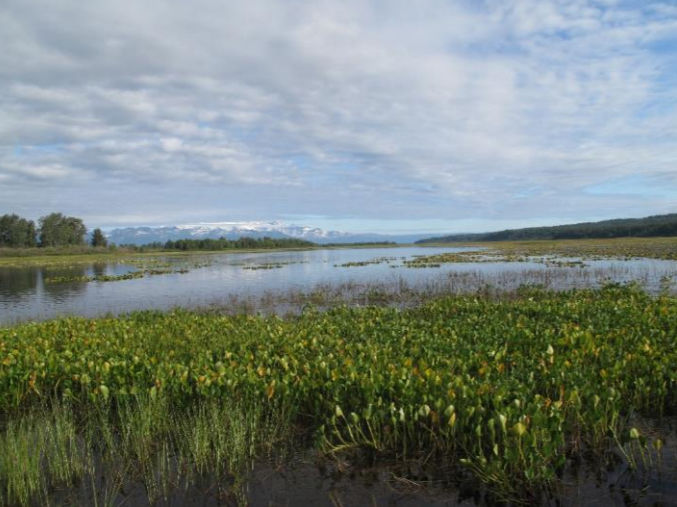
PALMER — The Mat-Su Borough Assembly finally held its long awaited Wetland Mitigation meeting with experts on how the wetlands in the Mat-Su Borough are being managed.
“We’re going to see and have been seeing a greater number of fish pass through because the public has got engaged and been unhappy with the way we manage this resource,” said Mat-Su Borough Fish Commissioner Larry Engel. “Twenty-five percent or more of landscape in this borough is classified as wetlands, which is a substantial amount...We need to work harder on those type of awareness to the public if we’re going to maintain these public values for our wetlands.”
Engel was among five speakers that informed the Borough on wetlands issues in a meeting that had been delayed over 10 months. Assemblyman Jim Sykes had requested that the meeting be moved to 3 p.m. on March 19 so that presenters could offer as much information as possible.
During Engel’s presentation, he noted that angler days have dropped in the Mat-Su Borough from 400,000 to just 160,000 in a course of two decades. Engel also noted that anglers spent $118 million in 2009 as an economic driver. Environmental Protection Agency Mitigation Lead for Alaska Matthew LaCroix also had economic impact statistics to present. According to a study done by a Seattle firm, the ecosystems within the Mat-Su Borough provide between $20 and $51 billion to the economy each year with a valuation of the ecosystem and it’s services between $500 billion and $1.3 trillion at a four percent discount rate. However, potential construction projects in particular pose a threat to valuable wetlands and their accompanying anadromous species. Jonathan Kirsch, Mat-Su Area Manager for the Alaska Department of Fish and Game Division of Habitat, gave updates on areas of concern for the Mat-Su Valley’s wetlands. Kirsch detailed that wetlands are an inordinately valuable ecosystem relative to their spatial prevalence. As had previously been mentioned by Engel, culverts have become a problem statewide but especially in the Mat-Su Valley.
“Culverts keep adult and juvenile fish from accessing critical habitats in their life cycle and it would be a great improvement to plug away at getting those replaced,” Kirsch said.
Of over 600 culverts inventoried by the borough, 273 of them have been classified as an impediment to either adult or juvenile fish, a number the borough is working hard to lower.
“The borough has taken a very active role in attempting to preserve and correct our aquatic resources,” Engel said.
Kirsch advocated for extended watershed authority. Fish and Game is only allowed authorized jurisdiction over streams with spawning salmon and urged anyone that sees spawning salmon in an unusual location to contact DF&G with the location to further protect spawning salmon habitat. Further jurisdiction over headwaters of streams would ensure greater protection of salmon habitat.
“I don’t really see any benefit though in the borough getting involved in this. I think the Army corps does a fine job and there’s not really a problem with the process. I don’t think we need to add additional burden and drive down our economy, particularly when we’re in a state of recession. There’s no need for the Mat-Su Borough to join the state in its recession,” Assemblyman Jesse Sumner said.
Sumner was not the only Assembly member wary of increased regulation. Assemblyman George McKee hassled Army Corps of Engineers Roberta Budnik about how much mitigation compensation was redirected to the Borough, repeatedly using the word ‘extortion’ when referring to mitigation compensation.
“We’re looking at that but we’re also looking at cumulative impacts. Our regulations require, please let me finish,” Budnik said as McKee began to interrupt her. “Our regulations require us to look at past projects, present projects, and future projects so that we can evaluate the watershed cumulatively.”
Budnik detailed that compensatory mitigation is required for wetland losses greater than 1/10 of one acre, but that can be waived if the impacts are determined to be no more than minimal. Not only are culverts having an adverse impact to the salmon populations in the Mat-Su Valley, but forces outside of the Valley are harming the fish statewide.
“Most people that are involved in the scientific aspect of fisheries would say that the major problem with King salmon in this area, and many areas of the state right now, is ocean related. There’s been changes in the ocean environment, and because of that you see weak runs coming in all over the place,” Engel said.
Engel noted the Mat-Su Borough’s willingness to listen to the anglers and recreators who use the waterways when it was awarded monies from the legislature for watersheds. Engel said that $900,000 of those monies were directed toward culvert repairs and that officials have developed a priority list of which culverts to fix when funds become available. Engel stressed public involvement over chasing funding sources for habitat management.
“We have to get active in managing protecting our wetlands and to do so we need to have bottom up involvement understanding and support from our community,” Engel said. “The best use of Alaska salmon is on Alaskan’s dinner table.”
Contact Frontiersman reporter Tim Rockey at tim.rockey@ frontiersman.com.

By Jeremiah Bartz Frontiersman.com A football coach using a hockey reference as the centerpiece for his keynote address may

Frontiersman.com With its headquarters in Wasilla, the Frontiersman has been a primary source of news for the Matanuska-Susitna

By Katie Stavick Frontiersman.com The next generation of leaders took flight this week as the Houston High School Class

By Kyle Wilkinson For the Frontiersman Keynote speaker and Carry the Cure President Bill Pagaran’s words boomed through the