Retiring teacher, coach urges Colony grads to ‘find their 68’
By Jeremiah Bartz Frontiersman.com A football coach using a hockey reference as the centerpiece for his keynote address may


Editor’s note: This is the first in a year-long series of monthly “Digging in the Archives” articles related to the Frontiersman’s news from 25 years ago. The series will illustrate our effort to remember the past with an eye toward the future.
WASILLA — Twenty-five years ago, Mat-Su Valley residents were talking up a storm about war in the Middle East. Though the conflict remains a major worldwide story, the way it’s talked about in Valley classrooms may have changed.
On Jan. 17, 1991, the U.S. began bombing Kuwait to rid the country of Saddam Hussein’s Iraqi troops — the beginning of the six-week Operation Desert Storm. The Frontiersman featured several stories about deployed Alaskan soldiers and the thoughts of Valley residents on the bombing and the outbreak of war. Of particular interest to one reporter was the response of students to the U.S. operation in local schools.
For the Jan. 23, 1991 edition of the Frontiersman, reporter Debra McGhan wrote a story titled, “Students struggle with war questions.” McGhan interviewed Janice Leppard’s seventh grade geography class after the students conducted a survey of various classes at Wasilla Middle School and found the school was “overwhelmingly in support of the war.” The support seemed driven by fear of Hussein gaining more power to conquer more places, though several students voiced concerns about Kuwaiti and American casualties. However, one girl said, “If we’re fighting for oil, we should just stay out of it.”
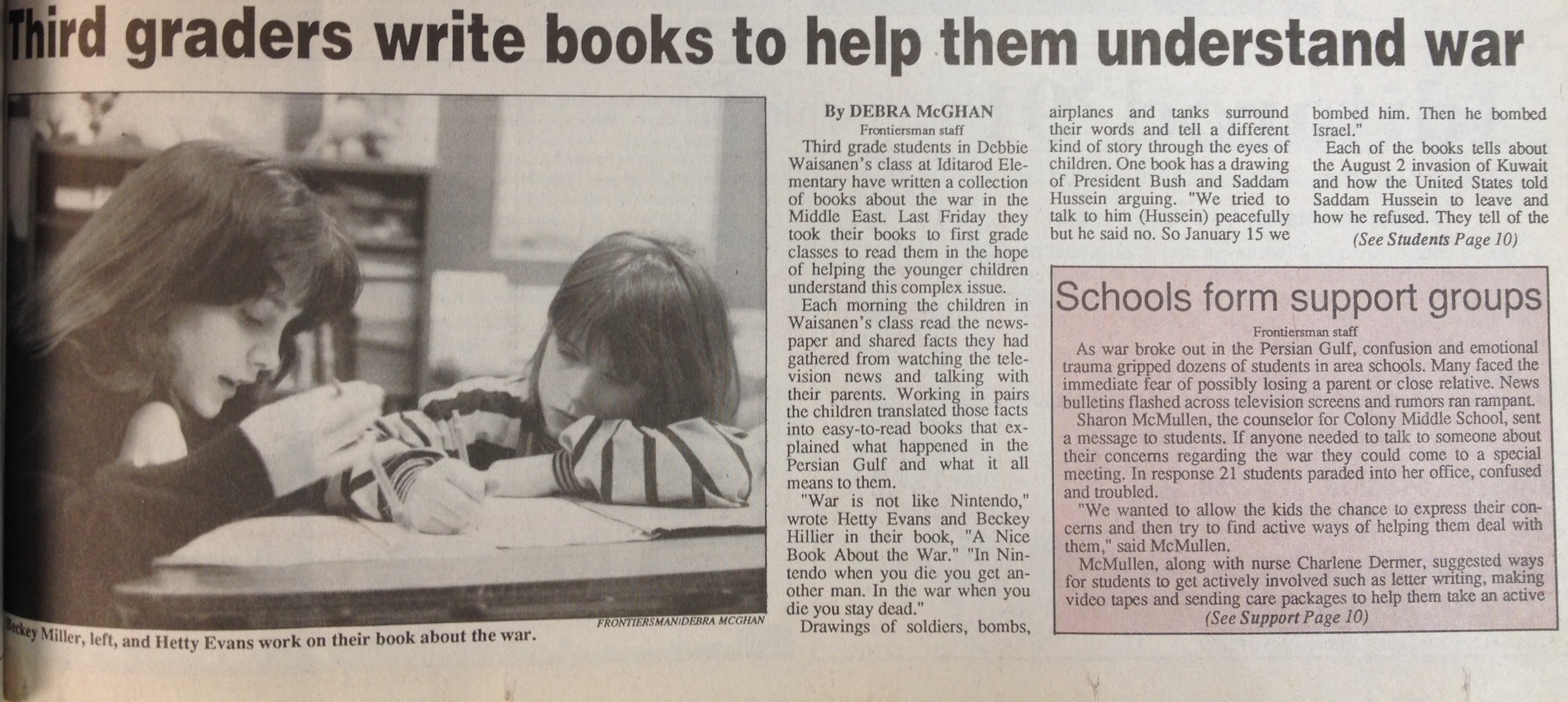
McGhan wrote another front-page story that month called “Third graders write books to help them understand war.” Debbie Waisanen’s students at Iditarod Elementary drafted illustrated children’s books describing the conflict and read them to first-graders. In one book, two third-grade girls wrote, “War is not like Nintendo. In Nintendo when you die you get another man. In the war when you die you stay dead.”
Waisanen, who now teaches at Our Lady of the Valley Catholic School in Wasilla, said she remembered talking to her students about the war and how to appropriately convey what was happening to the younger students.
“You don’t want to scare the children but you want to give them some understanding,” she said.
As the war went on, Waisanen also sent student-made cards and care packages to soldiers overseas, knowing — as the mother of a military man — how much it would be appreciated. In a separate project, her classes fashioned wooden Alaska huskies to be sent around the world, some of which, incidentally, made it to U.S. military bases in various countries.
Similarly, fifth-graders in Don Campbell’s 1991 class at Snowshoe Elementary wrote letters to someone overseas, but these would not be delivered — they were addressed to Saddam Hussein.
Some were written in what might be considered typical 10-year-old fashion — calling Hussein a “big bully” who was “rude” to attack a smaller country than his own, or simply asking why he would bomb anyone — while others were more demanding:
“Help your country be more interdependent so you don’t have to take over countries for their goods that you don’t have because you don’t try to produce it yourself. Sincerely yours, Mark Finnell.”
Between teacher mentoring trips to Gambell and Savoonga earlier this month, Campbell explained the reasoning behind his 1991 assignment by phone.
“It was about getting them to be aware of what the current events were, and that their voices — even though they’re young — were as important as other people’s voices,” he said. “Little people matter, too.”
It was important to Campbell that his students made educated comments, rather than voicing a gut reaction to what they saw on TV or heard from their parents.
“When I taught history, I always taught it from a ‘why’ aspect — why did this happen, instead of just what happened,” he said.
But the classroom climate changed after the World Trade Center towers fell on Sept. 11, 2001. Campbell said he noticed his students becoming “more passionate and a little bit prejudiced” in the ensuing discussions of terrorism and war, which hadn’t faded by the time he retired, 10 years later.
“Since 2001 I’ve seen more and more kids become a lot more vocal about their opinions and (they have) directed them against anyone not from America, or even Wasilla.”
Vanessa Powell, who now teaches fifth grade at Snowshoe (and has taught there for 18 years), said she’s perceived the same change.
She remembered one student in particular who raised his hand after the Sept. 11 attacks and said, “Mrs. Powell, I will learn to maybe forget this, but I will never forgive.”
“I realized right then this game has changed,” she said.
When Powell was teaching her students about The Crusades last semester, the word “Muslim” triggered a surprising level of hate speech with the names of Hussein and Osama Bin Laden thrown around the room.
“They hit that connection and then it just boiled,” she said.
Powell noted that elementary school students are especially prone to emotional responses to such issues, but that’s not a reason to not listen or answer back.
“It’s time to start learning how to talk about scary stuff with kids in real ways, and to tell them that I’m OK. They need to know that the adults in their life are OK, too,” she said.
“I think we do a disservice to kids if we don't open a vein and show them how human we are.”
Michele Kamilos, who teaches third grade at Iditarod Elementary, said it’s important to show students not just the humanity of teachers and adults, but of other people in general.
Kamilos recalled one comment regarding “all Asians” made by a Russian student, who hadn’t considered that he technically has Asian heritage, and that he, perhaps, did not fit the stereotype he prescribed to a whole group of people.
“It’s about meeting them when they make those comments,” she said.
Kamilos relayed another instance in which a student asked if someone could “get arrested for being different” in a discussion on Martin Luther King, Jr. Day. In response, she asked the class questions like, “What was Rosa Parks arrested for?” and “Who are the majority of people in prison nowadays,” giving the students the opportunity to draw their own conclusions as much as possible.
Often, Kamilos lets her students know that not every question is as easy to answer as they might think.
“I tell them, this is not a third-grade question — this isn’t in my (curriculum) book.”
Ultimately, though, it’s the teacher’s job to decide how far to pursue such a question or subjects like war, racism and terror, based on the students in the class.
“You have to be careful,” she said. “You don’t wanna offend anybody, but just to start them thinking about the whole world as bigger than this family and bigger than this community.”
Contact reporter Caitlin Skvorc at 352-2266 or caitlin.skvorc@frontiersman.com.

By Barbara Hunt Palmer Buzz It was 6:43 on Friday morning and the Plant Owner was sound asleep when

By Kyle Wilkinson Frontiersman Memorial Day Weekend was filled with a variety of events in Willow. From live music to

By Kyle Wilkinson For the Frontiersman The Susitna Valley Emergency Preparedness Fair will be held at the Willow Community Center

By Barbara Hunt Palmer Buzz Green-Up happened at exactly 9:34 am on Saturday morning in Palmer. This was