Retiring teacher, coach urges Colony grads to ‘find their 68’
By Jeremiah Bartz Frontiersman.com A football coach using a hockey reference as the centerpiece for his keynote address may


PALMER — It was just another sappy love story. Or maybe it was a love of sap story, depending on your perspective. Either way, the Palmer Center for Sustainable Living was the place to be Saturday afternoon to tap into the art of tapping birch tree sap.
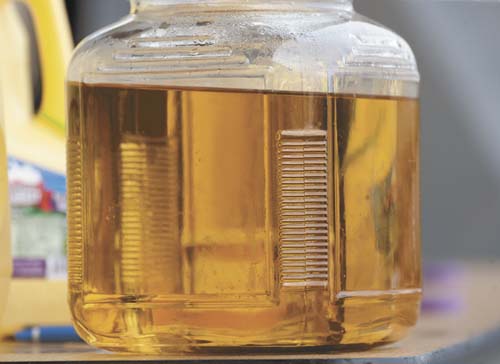
Sipping a small cup of clear, water-like sap, Wasilla resident Mary Donlon was one of about 75 Valley men and women to gather at the center, formerly called the Mat-Su Experimental Farm. She comments on the benign taste and color of the pure sap, taken from birch tree the day before. She also is a little taken aback at the work and effort involved in turning that sap into syrup.
It takes about 100 gallons — sometimes as much as 117 to 120 gallons — of sap to boil down to make 1 gallon of birch syrup, said University of Alaska Fairbanks Cooperative Extension Service representatives Julie Cascio and Valerie Barber, who taught the class.
“I’m intimidated by the sheer amount of work, but I am a wildcrafter,” Donlon said. “I like to collect plants and objects from nature and use those, and I want to know how to do this. I originally come from the East Coast, where they make maple syrup. Maple syrup is easier to make (taking only about 40 gallons of sap to make a gallon of syrup). But, if you want to live in Alaska, suck it up.”
She also was impressed with the difference between the raw sap and syrup.
“This is pretty light, so it’s amazing to think you’re going to get an intense syrup out of that,” she said.
For Nikalee Rath of Wasilla, the class was a way to connect with a part of her childhood.
“My mom did this with us when I was little,” she said about sap tapping. She attended the class as a refresher. “It’s been over 20 years, and I don’t even know where to get supplies anymore. I like it, I like being outside. I like knowing where my food comes from. I like being involved in real food that’s worth eating.”
Just what Rath will do with the sap she collects isn’t known, she said.
“We’ll probably try making syrup,” she said. “But, we’ll probably not get a full gallon. We’ll get enough that my kids can sample it.”
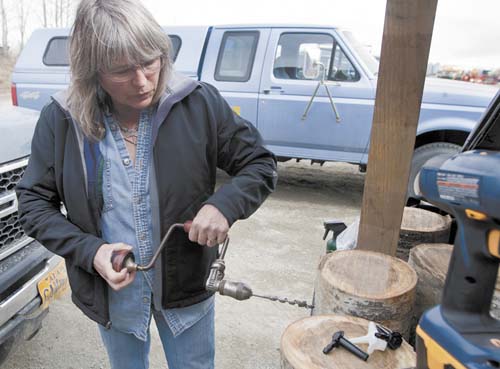
The kid component was also a main reason to attend the class for some. While the adults packed into a classroom to learn about the process, about a dozen youngsters were shown how to drill holes for taps and taught about the process of condensing the sap.
It’s also a good way to integrate some natural science into her home school curriculum, said Palmer resident Mylinda Klein. Klein said she has about 40 acres of land and lots of birch trees.
“I’ve never tapped, but because I have lots of trees I thought it would be a fun thing to do,” she said. “I also home school my kids, and I think it would be a great experiment for them to learn hands-on how to tap the trees, watch it, learn about evaporation — the whole nine yards.”
Aside from the large volume of sap needed to make syrup, those attending Saturday’s class also learned about the makeup of birch sap. Cascio explained that unlike the familiar maple syrup, which gets much of its taste from its main sugar, sucrose, birch has two very different sugars — fructose and glucose.
“Birch has a very different taste,” she said. “And you have to be really careful (when cooking it down) not to scorch the fructose, because it can get that burnt flavor to it.”
There’s also much more to birch sap than sugars, she said. It also contains vitamin C, potassium, calcium, manganese, magnesium, iron and other nutrients.
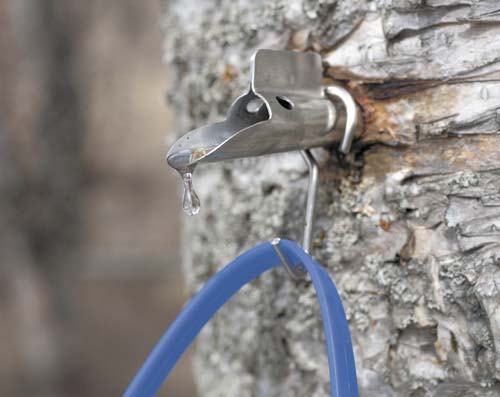
Barber also went through the supplies needed and the process for people to tap their trees, and the list isn’t extensive. Most people today use a drill and plastic taps, and collect sap either in a food-grade plastic bag, empty water jug or bucket.
In Alaska, the time for tapping is now, Barber said.
“When do we tap trees? Usually here, it’s about the middle of April,” she said. “We tried tapping last weekend, but the trees weren’t running yet, and about four days ago they started running. I tapped four trees at my house so I could boil some down (for the class), and I’m getting about two gallons a day, so I’m checking it morning and night.”
Contact reporter Greg Johnson at greg.johnson@frontiersman.com or 352-2269.

By Barbara Hunt Palmer Buzz It was 6:43 on Friday morning and the Plant Owner was sound asleep when

By Kyle Wilkinson Frontiersman Memorial Day Weekend was filled with a variety of events in Willow. From live music to

By Kyle Wilkinson For the Frontiersman The Susitna Valley Emergency Preparedness Fair will be held at the Willow Community Center

By Barbara Hunt Palmer Buzz Green-Up happened at exactly 9:34 am on Saturday morning in Palmer. This was