Retiring teacher, coach urges Colony grads to ‘find their 68’
By Jeremiah Bartz Frontiersman.com A football coach using a hockey reference as the centerpiece for his keynote address may


Representatives from the Alaska Department of Public Safety (DPS) gave a presentation to members of the Sutton community Tuesday night, updating the public on the status of the Chickaloon Tribal Police’s agreement with the state. DPS is currently reviewing the application for a DPS special commission for fully trained and qualified law enforcement officers with the Chickaloon Tribal Police Department (CTPD).
If granted, it would extend their authority to cover some state laws and allow those officers with the special commission to refer cases to prosecutors, make arrests for some crimes, and remand those suspects into state of Alaska jails. It would also allow some cases to be prosecuted in Tribal courts instead of state courts. Laws enforced would be limited to only certain Alaska statutes and regulations, not Tribal laws.
The meeting, held at the Sutton Elementary School, focused on the CTPD Special Commission application, the limited geographic area, and if approved, what crimes they could cover.
It comes just two weeks after a tense Sutton Community Council meeting in which residents voiced concerns and sometimes anger at the Chickaloon Village Traditional Council (CVTC) Justice Department’s desire to extend limited policing powers outside of their tribal properties and law enforcement authority. The issue has long been the source of tension, first addressed nearly two years ago at an information session when the CTPD first sought to expand its police force and their responsibilities.
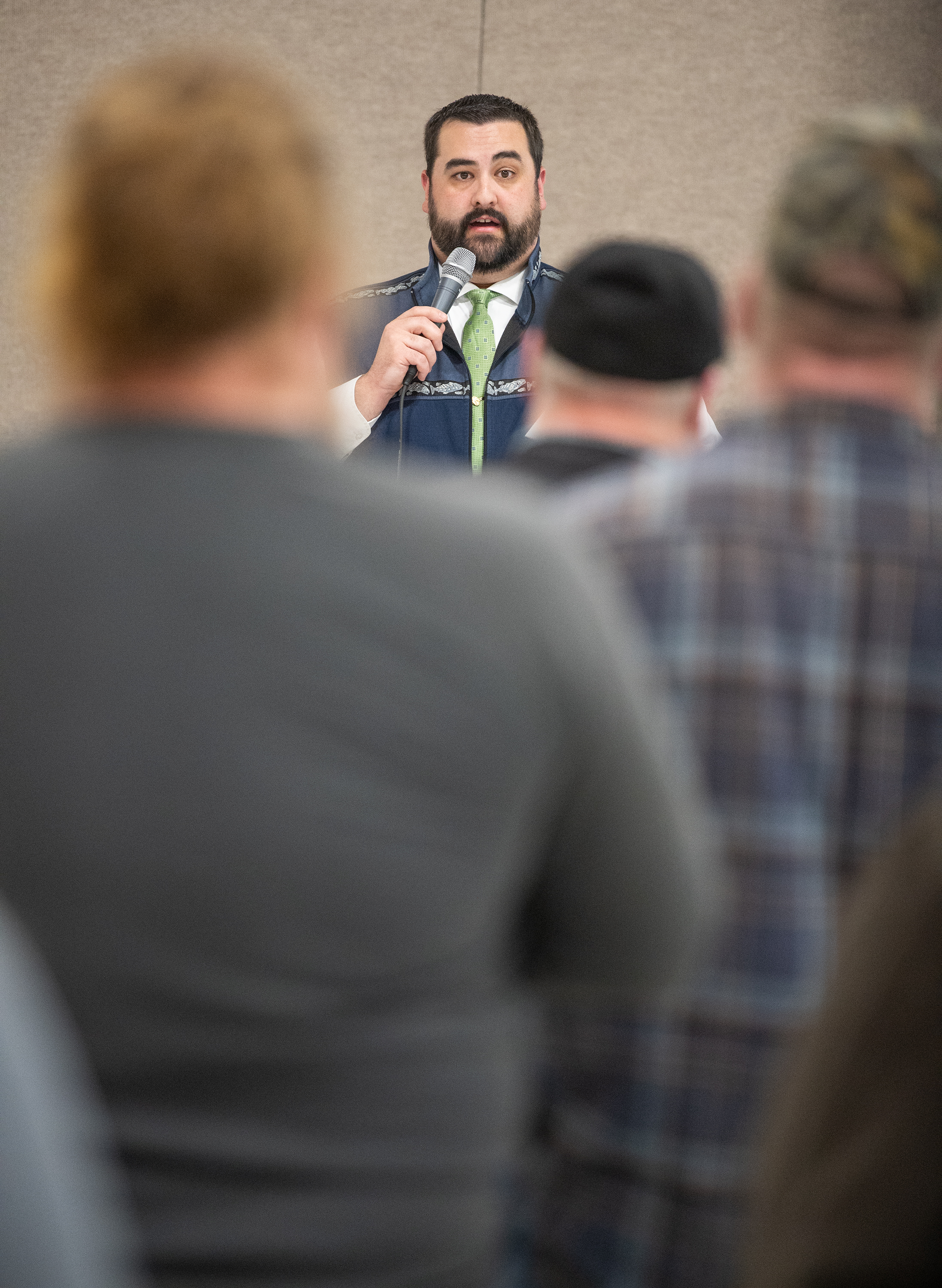
Austin McDaniel, Communications Director for the DPS, has been involved in the tribal policing components of the DPS for three years, started the meeting by explaining what a DPS Special Commission is and the role is plays in law enforcement.
“It is authority that the Commissioner of the Department of Public Safety can give to a qualified person that has law enforcement training to aid and assist Alaska State Troopers.” McDaniel clarified that this is not a designation given out simply because someone asks for it, but rather given to someone who has met the qualifications and the DPS is confident will aid the AST in completing their mission.
“We can issue a special commission that allows the officer to make the same type of arrests that an Alaska State Trooper can make. “ He said DPS can either narrow down the scope to a single statute or broaden as needed to any State of Alaska criminal law, adding that geographical limits can be made, or the special commission can be made state wide.
These special commissions are not a rare or unique entity, explained McDaniel, saying that there are 248 active special commissions right now, and they are given to Federal, State, and Local law enforcement officers.
“The AST runs the drug investigation task forces in the state…if a local police officer wants to work on that task force, we have to give that person the same authority that AST has. Federal law enforcement officers that are working in Alaska don’t have the authority to enforce state or local laws-they can only enforce federal laws. So AST will give special commissions to federal law enforcement to also work on our task forces,” he explained.
McDaniel then touched on the three different Tribal criminal jurisdictions within Alaska, including the DPS Special Commissions, Public Law 280, and Violence Against Women Act (VAWA) 2022.
DPS Spec commission allows Tribal police officer to enforce state of Alaska laws applies to any person that commits a covered crimes to enforce within geographic area. McDaniel also added that local, licensed police officers in Alaska, no matter their jurisdiction, has jurisdiction across the entire state of Alaska.
“A Juneau police officer up in Tok and could conduct a traffic stop, could refer charges to a prosecutor and that is completely in line with Alaska law.”
This would also apply to DPS special commission.
PL 280 deals specifically with Tribal laws and Tribal courts, and that the state and the Tribe have concurrent criminal justice jurisdiction over any Alaska Native that violates Tribal law within a boundary drawn by the Census Bureau, called an Alaska Native Statistical Village Area (ANSVA).
“The federal government draws these lines up. That means that a Tribe can enact Tribal criminal codes, they can have Tribal police go out contact, and potentially arrest or refer charges to Tribal prosecutors and send them to Tribal courts for Alaska Native offenders only. And the crime must occur within the ANSVA.”
He then talked about the Special Tribal Criminal Justice (STCJ) jurisdiction, created in the VAWA 2022, which allows Alaska Native villages as defined in ANSVA to enforce limited Tribal laws when the victim is an Alaska Native and the crime must have occurred within an ANSVA.
“Before the Tribe can do this STCJ, they must get approval from United States Attorney General. No Tribe in Alaska is anywhere close to being able to seek that approval as far as the DPS is aware,” McDaniel clarified, reiterating that PL-280 and VAWA 2022 are federal laws and that Alaska has no say in them.
McDaniel did clarify that DPS received the application from the CTPD for special commissions and that the department has been approaching it with a statewide viewpoint because of the vast amounts of money coming to Tribes across the state to hire and improve their criminal justice systems. He says DPS anticipates more applications, and that they will utilize the same template for those applications as for Chickaloon.
“One of the main things we are look with the special commission application was ‘will this help the DPS further our mission of ensuring public safety across the state?’ There is no doubt that across the state that more trained, qualified, licensed law enforcement officers that have some oversight is a good thing to ensure public safety across the state.”
Finally, McDaniel discussed the limited geographic area in which the DPS is exploring with special commissions, and referred to an area called the Chickaloon Census Designated Place (CDP), which is roughly 67.5 square miles, extending from Milepost 66 to Milepost 88 of the Glenn Highway.
DPS, working with the Chickaloon Tribe, also identified a number of properties of areas within Sutton that would be granted CTPD limited law enforcement authority, including Chickaloon housing, the health clinic, Chickaloon Administrative buildings, and the Ya Ne Dah Ah School, which are clearly marked as Chickaloon properties.
The crimes that DPS is going to give CTD include Title 11 misdemeanors (domestic violence, person crimes, and property crimes), misconduct involving a controlled substance (misdemeanor or felony), and sex trafficking (misdemeanor or felony). They will not enforce traffic laws, including DUIs, speeding, reckless driving, equipment violations, etc. Nor can they engage in vehicle pursuits or traffic stops on state or Borough roads.
“There’s two sets of crimes that CTPD will be able to enforce at a felony level that the AST, Alaska DPS believe are problems in the state and that we want every available resource to address.”
McDaniel said the CTPD will have to meet the exact same standards that any AST or police officers from Wasilla, Palmer, and cities across the state has to meet to become a certified police officer, which means candidates will have to have extensive background checks, psychological exams, and qualified law enforcement training. They will also have to have the Tribe maintain $1 million professional practice insurance for each other.
CTPD will not be authorized to answer 9-1-1 calls, and only if DPS requests assistance will CTPD be authorized to assist and respond. People must call the CTPD directly for assistance from that agency.
“We are not giving any of our area over to another agency. It is our responsibility and we’ll continue to monitor and respond,” reassured McDaniel.
Once the presentation was completed, the questions came fast and furious from Sutton residents, as one resident, Garret Nelson asked what many others seemed frustrated over--that the application for special commission was made months ago, yet appeared to be completed without an opportunity to comment or have their concerns addressed.
“As soon as a special commission is issued and a memorandum of understanding is signed…we will put out word to the Sutton community that it has been enacted. There have been no special commissions issued as of today,” McDaniel said, addressing a significant error on the information sheets handed out to attendees that said the DPS had already granted CTPD a special commission.
Other residents expressed concern regarding the geographic areas, specifically private properties, concerns over protecting non-Natives from CTPD overstepping authority, whether or not DPS would review Chickaloon’s policies and procedures when policing, federal funding, oversight on individual CTPD officers versus the department as a whole, and whether the people of Sutton could vote on the approval of the special commission or expanded police authority.
People also had a chance to comment, which McDaniel said would be taken under advisement as part of the application process, and many expressed frustration that the community, while discussing the issue, have not been made to feel validated in their concerns, as they feel the CTPD has all but been granted authorities as laid out.
“The goal was to get public comment from this community-Sutton, specifically. But this affects more than just the people of Sutton. We have people from Glacier View, Lazy Mountain, the Butte…they need to be in this,” commented Nelson.
The application remains on track to be approved, despite a majority of the attendees at the meeting voicing opposition.

By Jeremiah Bartz Frontiersman.com A football coach using a hockey reference as the centerpiece for his keynote address may

Frontiersman.com With its headquarters in Wasilla, the Frontiersman has been a primary source of news for the Matanuska-Susitna

By Katie Stavick Frontiersman.com The next generation of leaders took flight this week as the Houston High School Class

By Kyle Wilkinson For the Frontiersman Keynote speaker and Carry the Cure President Bill Pagaran’s words boomed through the